
Photo by Ted Balmer on Unsplash
Political ClimatePolitical Climate in Kohler, WI
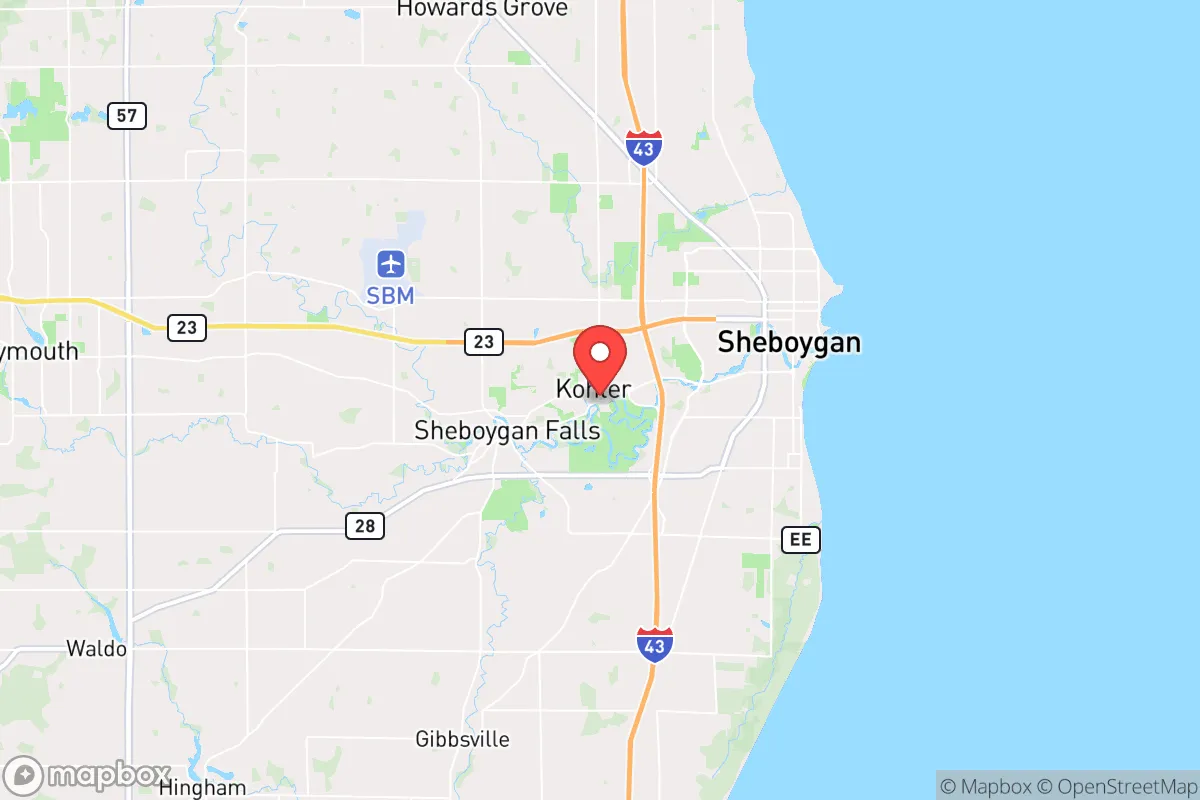
District shown is the primary district for this city’s centroid. Cities may span multiple districts.
Local Political AnalysisPolitical Analysis of Kohler, WI
Kohler, Wisconsin, is a deeply conservative pocket in a state that itself is a perennial battleground. The village sits in Sheboygan County, which has a Cook Partisan Voting Index (PVI) of R+8, meaning it votes about eight points more Republican than the national average. This isn't a recent shift; the area has been reliably red for decades, driven by a mix of manufacturing heritage, strong union ties that have moved rightward, and a largely white, suburban-to-rural demographic. While Wisconsin as a whole is a perfect EVEN on the Cook PVI—meaning it's a pure toss-up state—Kohler and its surroundings are a solid Republican stronghold. You won't see many yard signs flipping between parties here; it's consistently conservative, with local elections often decided in the GOP primary.
How it compares
The contrast between Kohler and the rest of Wisconsin is stark. Drive 15 miles south to Sheboygan, the county seat, and you'll find a more mixed political landscape—still leans Republican, but with a noticeable Democratic presence, especially in the city's older, union-heavy neighborhoods. Head 40 miles west to Fond du Lac, and you're in even redder territory. But the real contrast is with the state's urban centers. Madison, 90 miles southwest, is a deep-blue island, while Milwaukee, 60 miles south, is a Democratic stronghold. Kohler, by contrast, is a place where conservative values aren't just tolerated—they're the baseline. The village itself is a company town, built around Kohler Co., and that corporate culture has historically fostered a pro-business, low-tax ethos. You won't find the same kind of progressive activism here that you'd see in Madison or even parts of Milwaukee's suburbs. The political reality is that a Republican candidate can expect to win Kohler by a comfortable margin, while statewide races are nail-biters.
What this means for residents
For conservative residents, Kohler is comfortable. Local government tends to be fiscally conservative, zoning is business-friendly, and you're unlikely to feel out of step with your neighbors on social issues. The school board and village board elections rarely feature heated ideological battles; it's more about maintaining services and keeping taxes low. For liberal residents, life is different. You're not going to be ostracized, but you'll be in the minority. Political conversations at the grocery store or at a Packers watch party will likely lean right. That said, Kohler is a small, affluent village—people are generally polite, and political differences don't usually lead to open conflict. The real tension shows up in county-level politics, where debates over things like land use, environmental regulations, and school funding can get sharp. But day-to-day, most folks just get along.
One cultural distinction worth noting: Kohler's identity is tightly tied to its namesake company, which is a major employer and a global brand. That gives the village a slightly insular, almost corporate feel—think manicured lawns, a world-class golf course, and a resort that draws tourists. This isn't a place where you'll see much grassroots activism, whether left or right. The political climate is stable, predictable, and largely unchallenged. For the foreseeable future, expect Kohler to remain a Republican stronghold, even as Wisconsin itself continues to swing wildly between parties in statewide elections. If you're moving here, know that your vote will likely be in the minority if you lean left, but the community is small enough that personal relationships matter more than party labels.

State Political ClimatePolitical Climate in Wisconsin
State Political AnalysisPolitical Environment in the State
Wisconsin is the quintessential swing state, with a Cook PVI of EVEN that perfectly captures its knife-edge balance. Over the past 20 years, the state has shifted from a reliably blue-leaning battleground (voting for Democrats in every presidential election from 1988 to 2012) to a true toss-up, splitting its electoral votes between Trump and Biden in 2016 and 2020 by margins under 1%. The dominant coalition is a near-perfect 50/50 split between the Democratic stronghold of Milwaukee and Madison and the increasingly Republican exurbs, small towns, and rural north and west. The trajectory is a slow, grinding polarization: the urban cores are getting bluer and denser, while the rural and suburban areas are getting redder, with the decisive votes often cast by the suburban ring around Milwaukee and the Fox River Valley.
Urban vs. rural divide
The political map of Wisconsin is a study in contrast. The two Democratic engines are Milwaukee and Madison. Milwaukee County, home to the state’s largest city, delivers roughly 70% of its vote to Democrats, driven by a strong African American and Latino base and union-heavy working-class neighborhoods. Madison (Dane County) is even more lopsided, often hitting 75% Democratic, fueled by the University of Wisconsin and a massive state government workforce. The Republican base is anchored in the WOW counties — Waukesha, Ozaukee, and Washington — the affluent, largely white suburbs northwest of Milwaukee. These three counties alone can offset Milwaukee’s margin. Further north, the rural Northwoods counties like Vilas and Oneida are deep red, as are the western driftless counties like Lafayette and Grant. The Fox River Valley, including Green Bay and Appleton, is a classic swing region — culturally conservative but historically union-friendly, and it has trended rightward in the Trump era. The key battleground is the suburban crescent from Kenosha up through Racine and into the Milwaukee exurbs, where college-educated voters have shifted slightly toward Democrats while working-class voters have moved right.
Policy environment
Wisconsin’s policy environment is a patchwork of conservative and progressive elements, reflecting its divided government. The state has a flat income tax of 4.4% (down from 7.75% in 2011) and a 5% state sales tax, with local sales taxes adding up to 0.5-1.5%. Property taxes are among the highest in the Midwest, but a state-imposed levy limit (the “levy limit” law) has kept annual increases to roughly the rate of new construction. The regulatory posture is generally business-friendly, with a right-to-work law passed in 2015 and a tort reform system that caps noneconomic damages in medical malpractice cases. Education policy is a flashpoint: the state has a robust school choice program (vouchers for private schools, especially in Milwaukee and Racine) and a strong charter school sector, but public school funding has been a perennial battle, with per-pupil spending lagging the national average. Healthcare is dominated by two large systems (Froedtert and UW Health), and the state did not expand Medicaid under the Affordable Care Act, leaving a coverage gap for about 80,000 low-income adults. Election laws are moderately restrictive: voter ID is required, same-day registration is allowed, and absentee voting is available without excuse, but drop boxes were effectively banned by the state Supreme Court in 2022.
Recent policy direction
The last five years have seen a sharp rightward turn on several fronts, driven by a Republican-controlled legislature and a conservative-majority state Supreme Court (though that flipped to a 4-3 liberal majority in 2023). On gun and self-defense law, Wisconsin is a “shall-issue” state for concealed carry (since 2011) and has a “stand your ground” law (since 2011), with no permit required for open carry. In 2023, the legislature passed a bill allowing school staff to carry firearms, though it was vetoed by Governor Tony Evers. On parental and education rights, the state has seen a fierce debate over critical race theory and LGBTQ+ curriculum, with several school boards adopting parental notification policies. The 2023 Act 12 overhauled the state’s school accountability system, requiring schools to post curriculum materials online and allowing parents to opt their children out of certain instruction. On abortion and medical autonomy, the 1849 law banning abortion was effectively nullified by a 2023 Dane County court ruling, and the issue is now before the state Supreme Court, which is expected to rule in 2025. The state has no trigger law, and abortion remains legal up to 20 weeks as of 2024. On voting and ballot access, the 2022 Wisconsin Supreme Court ruling in Teigen v. Wisconsin Elections Commission banned most absentee ballot drop boxes, and a 2023 law (Act 169) tightened witness signature requirements for absentee ballots. On property rights, the state has a strong “takings” law (2017 Act 67) that requires compensation for regulatory actions that reduce property value by more than 50%. On privacy and surveillance, Wisconsin has no comprehensive data privacy law, but a 2023 bill (AB 466) would have restricted law enforcement’s use of facial recognition; it stalled in committee.
Civil unrest & political movements
Wisconsin has a history of intense political activism. The 2011 Act 10 protests against public-sector union bargaining rights drew over 100,000 people to the Capitol and sparked a statewide recall effort against Governor Scott Walker (which he survived in 2012). The 2020 Kenosha unrest, following the shooting of Jacob Blake, saw two nights of rioting, arson, and the killing of two protesters by a 17-year-old from Illinois, which became a national flashpoint for the Second Amendment and self-defense debate. The state has a strong grassroots conservative movement, anchored by the Wisconsin Family Action and the Wisconsin Institute for Law & Liberty, which has successfully litigated school choice and election integrity cases. On the left, the Wisconsin Democratic Party is heavily influenced by the progressive “Squad” wing, with Representative Mark Pocan (Madison) and Senator Tammy Baldwin as key figures. Immigration politics are relatively muted compared to border states, but the state has no sanctuary city policies, and a 2023 law (Act 100) requires local law enforcement to cooperate with ICE detainers. Election integrity remains a live issue: the 2020 election saw Trump’s campaign file multiple lawsuits in Wisconsin, and a 2022 audit by the nonpartisan Legislative Audit Bureau found no widespread fraud but identified administrative errors in absentee ballot processing.
Projection
Over the next 5-10 years, Wisconsin is likely to remain a toss-up, but the demographic trends favor a slight Democratic lean. The Milwaukee and Madison metros are growing faster than the rest of the state, and the college-educated population in the WOW suburbs is slowly shifting left. However, the rural and exurban areas are also growing, driven by in-migration from Illinois and Minnesota, and those newcomers tend to be conservative. The state Supreme Court’s 2023 flip to a liberal majority will likely result in a new legislative map for 2024, which could give Democrats a more competitive shot at the state Assembly and Senate. The key wildcard is the Fox River Valley: if the Green Bay and Appleton areas continue their rightward drift, the state could become a lean-Republican state by 2030. Conversely, if the Milwaukee suburbs continue their suburban shift toward Democrats, the state could become a lean-Democratic state. For a relocator, the practical implication is that Wisconsin will remain a place where your vote matters — and where the policy environment will swing with every election cycle.
For a new resident, the bottom line is that Wisconsin offers a genuinely competitive political environment where your vote carries real weight. If you’re conservative, you’ll find a state that has passed right-to-work, stand your ground, and school choice, but you’ll need to fight to keep those gains. If you’re liberal, you’ll find a state with a strong union history and a growing urban base, but you’ll face a legislature that has been gerrymandered against you. The practical takeaway: expect to be politically engaged, because the state’s future is genuinely up for grabs. The property taxes are high, but the income tax is low. The schools are good in the suburbs and uneven in the cities. And the politics will be a constant, lively, and consequential part of daily life.
* Values derived from national, state, county, city and local statistics and may differ in a specific area. Last updated: 2026-09-05T14:20:42.000Z
Narrative content on this page is AI-generated and may contain mistakes. Verify any details that matter before acting on them.
ReloMaps may earn a commission from affiliate links at no extra cost to you.

