
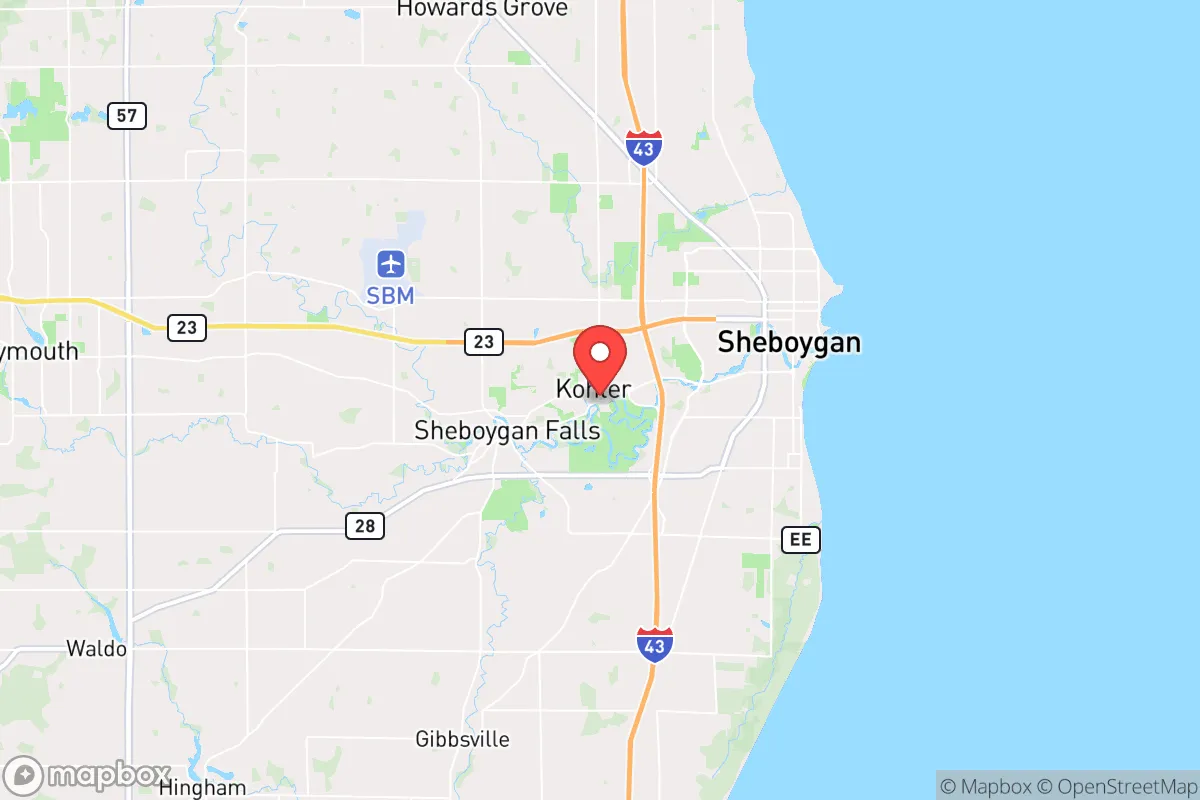
Photo by Ted Balmer on Unsplash
Demographics of Kohler, WI
Affluence Level in Kohler, WI
An upper-middle-class area. Household wealth, education levels, and homeownership run ahead of national benchmarks.
People of Kohler, WI
The people of Kohler, Wisconsin, today form a small, highly educated, and predominantly white community of 2,136 residents, shaped by a century of corporate planning and European immigrant labor. With 71.0% of adults holding a college degree—more than double the national average—the village functions as a professional enclave anchored by the Kohler Company. Its character is defined by a blend of old-stock German and Dutch heritage, a strong work ethic tied to the manufacturing giant, and a notably low racial diversity, with 94.6% of residents identifying as white and no Black, Asian, or Indian subcontinent population recorded.
How the city was settled and grew
Kohler was not a natural settlement but a planned company town, founded in 1912 by Walter J. Kohler, Sr., who moved his family's plumbing manufacturing operations from Sheboygan to a rural tract along the Sheboygan River. The original population was drawn almost entirely from German and Dutch immigrant laborers who had already settled in eastern Wisconsin in the mid-19th century. These workers built the first homes in the Riverbend neighborhood, a cluster of modest cottages near the factory, designed by the Kohler Company to house skilled tradesmen and their families. A second wave arrived during the 1920s and 1930s, when the company expanded its pottery and enamel operations, attracting second-generation German-Americans from nearby Sheboygan County and a smaller number of Polish immigrants. These families settled in the Highland Drive area, where larger homes for foremen and managers were constructed. The village's growth remained tightly controlled by the Kohler Company, which owned all land and housing until the 1960s, ensuring a homogeneous workforce loyal to the firm. By 1950, the population had reached roughly 1,200, almost entirely white and of Northern European descent.
Modern era (post-1965)
The post-1965 period brought little demographic change to Kohler, as the village's planned character and high housing costs limited in-migration. The Immigration and Nationality Act of 1965, which diversified immigration from Asia and Latin America, had virtually no impact here: the foreign-born population today stands at just 4.9%, and the Hispanic share is 4.8%—a figure that likely reflects a small number of service workers commuting from Sheboygan rather than residents settling within Kohler. Domestic in-migration has been driven by corporate transfers and professionals attracted to the Kohler Company's executive and engineering roles. These newcomers, overwhelmingly white and college-educated, have concentrated in the Woodlake neighborhood, a planned community of upscale homes and condominiums built around a man-made lake in the 1990s. The older Riverbend area has seen some turnover as original factory-worker families aged out, but it remains a stable, predominantly white neighborhood. The village's racial composition has remained static: 94.6% white, with no recorded Black, Asian, or Indian subcontinent residents. This homogeneity is reinforced by the lack of rental housing and the high cost of entry—median home values exceed $400,000—which effectively filters for high-income, white-collar households.
The future
Kohler's population is projected to remain stable or shrink slightly over the next decade, as the village has little land for new development and the Kohler Company's workforce has become more automated. The population is unlikely to become more diverse: the village's zoning and housing stock—dominated by single-family homes on large lots—offer few entry points for lower-income or immigrant families. The small Hispanic share (4.8%) may grow modestly if service-sector workers from Sheboygan seek closer housing, but this will likely be absorbed into the Woodlake rental units or the older Highland Drive homes. The broader cultural identity of Kohler is evolving from a company town into a luxury enclave, as the Kohler Company shifts toward hospitality and high-end real estate (the American Club resort, Whistling Straits golf course). This transformation attracts affluent retirees and second-home owners, who are dispersing across the River Wildlife conservation area and the newer Deer Trace subdivision. For the foreseeable future, Kohler will remain a white, highly educated, and insular community—a place where demographic change is measured in decades, not years.
For someone moving in now, Kohler offers a stable, safe, and culturally homogeneous environment with top-tier schools and proximity to Lake Michigan, but little racial or economic diversity. The village is becoming less a working factory town and more a gated-style retreat for professionals and retirees, meaning new residents should expect a quiet, planned community where the Kohler Company's influence remains central to daily life.

* Values derived from national, state, county, city and local statistics and may differ in a specific area. Last updated: 2026-09-05T14:20:42.000Z
Narrative content on this page is AI-generated and may contain mistakes. Verify any details that matter before acting on them.
ReloMaps may earn a commission from affiliate links at no extra cost to you.

