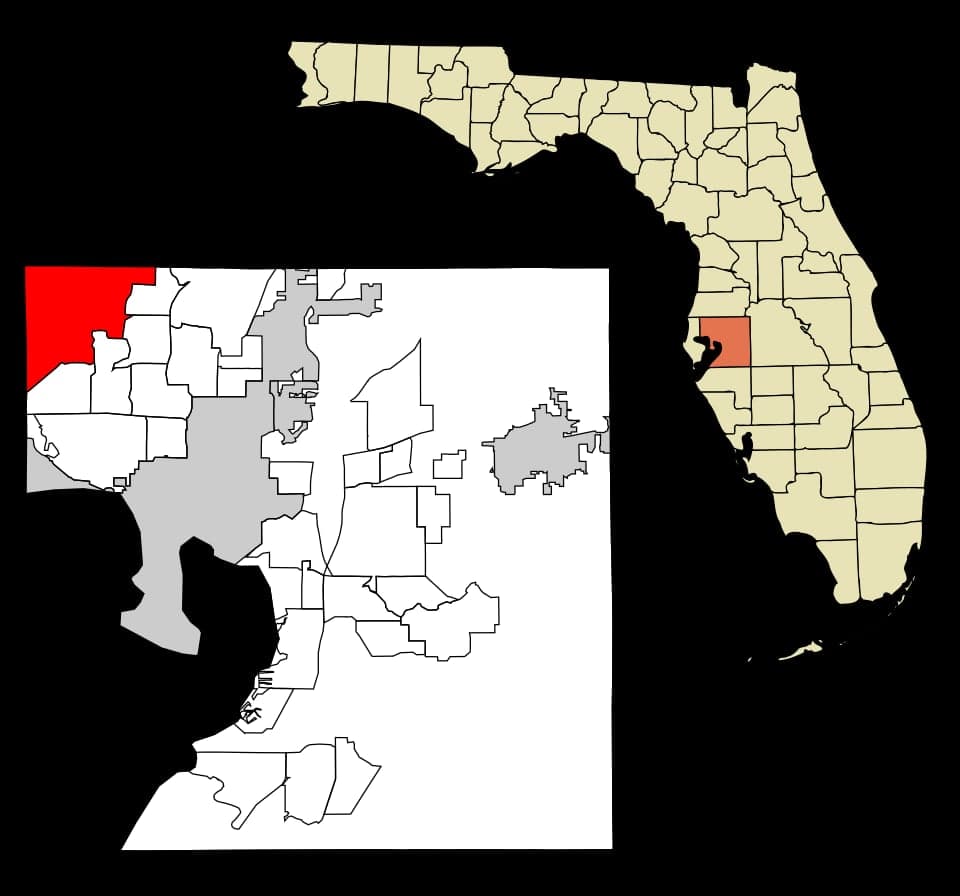
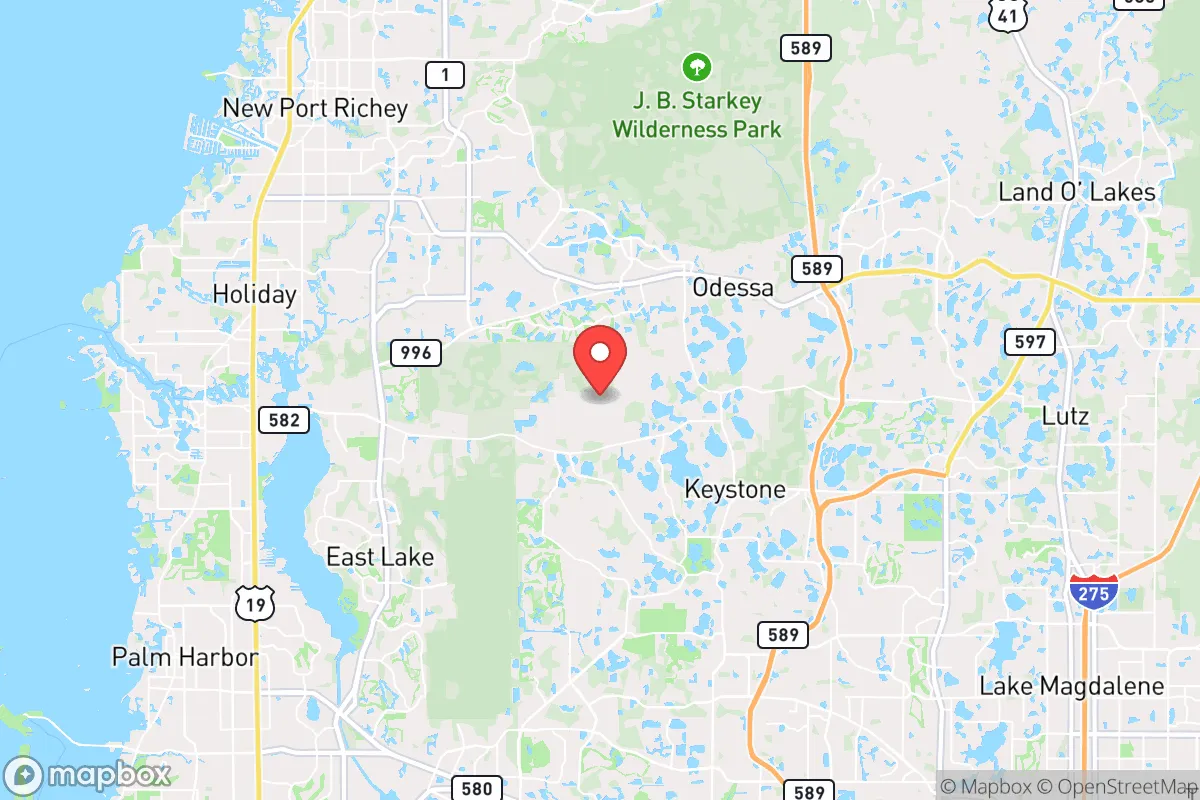
Photo: Wikipedia
Political ClimatePolitical Climate in Keystone, FL
District shown is the primary district for this city’s centroid. Cities may span multiple districts.
* Lean and PVI are calculated from Keystone, FL’s own 2020 presidential results (precinct returns summed to the city), with 2024 estimated from the surrounding county’s 2020–2024 shift, Cook-style. Sources: state election offices; VEST 2020 precinct results (CC BY 4.0).
Political rankings in Florida
- Most Conservative Cities in Florida
- Most Liberal Cities in Florida
- Best Liberal-Leaning Towns in the South
- Safest Liberal-Leaning Towns in the South
- Safest Conservative-Leaning Towns in the South
- Safest Liberal-Leaning Towns on the East Coast
- Safest Conservative-Leaning Towns on the East Coast
- Affordable Small Towns for Conservatives
- Most Conservative Counties in Florida
- Most Liberal Counties in Florida
Local Political AnalysisPolitical Analysis of Keystone, FL
Keystone, Florida, is a deeply conservative community, and that’s not a recent development—it’s been the bedrock of local politics for decades. The Cook Partisan Voting Index (PVI) of R+17 puts it among the most reliably Republican areas in the state, meaning Republican candidates typically win by a margin of about 17 points above the national average. If you’ve lived here as long as I have, you’ve watched the area shift even further right over the last ten years, driven by an influx of families and retirees from the Midwest and Northeast who were already looking for a redder shade of Florida. The local GOP is well-organized, and you’ll see yard signs for conservative candidates up months before any primary. It’s not a purple area, and it’s not trending purple—it’s solid red, and it’s getting redder.
How it compares
Compared to the rest of Florida, Keystone stands out as a conservative stronghold. The state as a whole is a swing state—Cook PVI for Florida is unknown, but it’s generally considered a toss-up or leans Republican by a narrow margin, with a PVI around R+3 or R+4 in recent cycles. That means Keystone is roughly 13 to 14 points more Republican than the state average. Drive 20 minutes south to Tampa or St. Petersburg, and you’ll hit a much more politically mixed environment, with Democratic strongholds in the city cores and liberal-leaning suburbs like Seminole Heights. Head east toward Lakeland, and you’ll find a similar conservative tilt, but not as pronounced as Keystone’s. The contrast is sharpest with nearby urban centers: in the 2024 election, Hillsborough County (Tampa) voted blue by a slim margin, while Pasco County, where Keystone sits, went red by double digits. If you’re a conservative, you’ll feel right at home here; if you’re a liberal, you’ll notice the difference the moment you cross the county line.
What this means for residents
For conservative residents, the political climate means their values are reflected in local governance. The county commission, school board, and sheriff’s office are all reliably Republican, and policies on taxes, development, and law enforcement tend to align with conservative priorities. You’ll see lower property tax rates compared to more liberal counties in the state, and there’s a strong emphasis on Second Amendment rights and limited government intervention. For liberal residents, it means being in the minority—sometimes a very small one. You won’t find many progressive candidates on the ballot, and local political discourse can feel one-sided. That said, it’s not hostile; most people are neighborly regardless of party, and you can still find like-minded folks at community events or online groups. The practical impact is that liberal residents often drive to Tampa for more diverse political engagement or cultural events, while conservatives enjoy a local environment that reinforces their worldview. Neither side is likely to see a major shift in the near future—the area’s demographics and growth patterns favor continued Republican dominance.
One cultural distinction that sets Keystone apart is its strong sense of rural identity, even as development creeps in from the south. You’ll find more pickup trucks with gun racks than Teslas, and local politics often revolve around land use, water rights, and keeping the area “country.” There’s a palpable resistance to the urbanization that’s transforming places like Wesley Chapel or Lutz, and that sentiment fuels the conservative lean. The local Republican club is active, but so are nonpartisan civic groups like the Keystone Civic Association, which focuses on quality-of-life issues. In practice, this means that while the politics are red, the community is still small enough that personal relationships matter more than party labels. If you’re moving here, expect a place where your vote is predictable, but your neighbor’s help is not—and that’s the kind of trade-off that defines life in Keystone.

State Political ClimatePolitical Climate in Florida
State Political AnalysisPolitical Environment in the State
Florida has transformed from a quintessential swing state into a solidly Republican-leaning powerhouse over the past decade, driven by a massive influx of conservative-leaning migrants from the Northeast and Midwest. The state now consistently votes Republican in statewide elections, with Governor Ron DeSantis winning re-election by nearly 20 points in 2022, and the GOP holding supermajorities in both legislative chambers. This shift represents a dramatic realignment from the 2000s and early 2010s, when Florida was the ultimate battleground, decided by margins of less than 1% in both the 2000 and 2012 presidential elections.
Urban vs. rural divide
The political geography of Florida is starkly divided. The major metropolitan areas of Miami-Dade County, Orlando (Orange County), and Tampa (Hillsborough County) lean Democratic, with Miami-Dade in particular experiencing a notable rightward shift among its Cuban-American and Venezuelan-American populations. The I-4 corridor running from Tampa through Lakeland to Orlando remains the state's most competitive battleground, with suburban counties like Pinellas and Seminole often flipping between parties. The rural Panhandle, from Pensacola to Tallahassee's outskirts, is deeply Republican, as are the sprawling exurbs of St. Johns County (south of Jacksonville) and Collier County (Naples). The Space Coast around Cape Canaveral has trended Republican as aerospace and defense workers have moved in, while college towns like Gainesville and Tallahassee proper remain Democratic strongholds.
Policy environment
Florida's policy environment is defined by its no state income tax, a constitutional cap on property tax increases (the Save Our Homes amendment), and a business-friendly regulatory climate that has attracted major corporate relocations. The state has a preemption-heavy governance model, where the legislature frequently overrides local ordinances on issues ranging from gun laws to rental regulations. Education policy centers on school choice, with the nation's largest voucher program (the Family Empowerment Scholarship) and a heavy emphasis on parental rights in curriculum and library materials. Healthcare policy is market-driven, with no state Medicaid expansion under the Affordable Care Act, though the state has invested in telemedicine and mental health services. Election laws have been tightened since 2020, with stricter voter ID requirements, limits on drop boxes, and a new election police force under the Office of Election Crimes and Security.
Recent policy direction
The last five years have seen Florida enact a sweeping conservative agenda that touches nearly every aspect of life a relocator might consider. On gun and self-defense law, Florida passed permitless carry (constitutional carry) in 2023, allowing concealed carry without a permit, while maintaining a three-day waiting period for handgun purchases. Parental and education rights were reshaped by the Parental Rights in Education Act (the "Don't Say Gay" law), which restricts classroom instruction on sexual orientation and gender identity through third grade, later expanded through twelfth grade. The state also banned DEI programs at public universities and restricted how race and history can be taught. On speech and privacy, Florida passed a social media "deplatforming" law targeting tech companies, though parts have been blocked by courts, and enacted a broad privacy law (the Florida Digital Bill of Rights) giving consumers control over their data. Medical and bodily autonomy saw a six-week abortion ban signed in 2023, which took effect after the Florida Supreme Court upheld the state's 15-week ban in 2024, while recreational marijuana remains illegal despite a 2024 ballot initiative that fell short of the 60% threshold. Property rights were strengthened through tort reform limiting homeowners' association fines and a new law restricting squatters' rights. Taxation remains the state's biggest draw, with no income tax and a temporary reduction in the commercial rent tax. Voting and ballot access has been tightened, with new restrictions on mail-in ballot requests and a requirement that drop boxes be staffed 24/7 during early voting.
Civil unrest & political movements
Florida has been a flashpoint for national political movements on both sides. The Parkland school shooting in 2018 sparked the March for Our Lives movement, leading to a temporary raising of the gun purchase age to 21 and a red flag law, though both have been partially rolled back since. The Black Lives Matter protests in 2020 were concentrated in Miami, Orlando, and Tampa, with some property damage but less sustained unrest than in other states. On the right, the Moms for Liberty movement, founded in Florida, has been highly active in school board elections and library book challenges. Immigration politics are uniquely intense in Florida, with Governor DeSantis's high-profile flights of migrants to Martha's Vineyard and the state's crackdown on undocumented labor through the "anti-sanctuary" law (SB 1718), which requires hospitals to ask about immigration status and criminalizes transporting undocumented people into the state. Election integrity remains a live issue, with the state's new election police unit making arrests for voter fraud, though critics argue the cases have been minor and politically motivated. A new resident will notice the constant presence of political messaging on billboards, local TV news, and even at gas stations, particularly in swing areas like the I-4 corridor.
Projection
Over the next 5-10 years, Florida is likely to become more Republican and more culturally conservative, driven by continued in-migration from blue states. The state is projected to gain two to three additional congressional seats after the 2030 census, all likely in Republican-leaning areas like the I-4 corridor exurbs and Southwest Florida. The Democratic Party's base is shrinking in Miami-Dade as older Cuban-American voters are replaced by younger, more conservative generations, while the party's hopes rest on growing Hispanic populations in Central Florida (Puerto Ricans in Orlando) and young voters in urban cores. Climate change will become a more salient political issue as insurance costs rise and coastal flooding worsens, potentially creating a new cleavage between development-friendly Republicans and environmental conservatives. The state's education and housing policies will continue to attract families from high-cost, high-tax states, reinforcing the conservative majority. A relocator moving in now should expect to find a state where Republican governance is the norm, with little chance of a Democratic takeover in the next decade, but where local politics in cities like Miami Beach, Orlando, and St. Petersburg will remain Democratic and culturally distinct.
For a new resident, the bottom line is that Florida offers a predictably conservative state government with low taxes, school choice, and strong property rights, but also a highly polarized media environment and active political movements on both sides. Conservative families will find their values reflected in state law and school policy, while liberal residents will find welcoming communities in the major cities and college towns, but will face an uphill battle on statewide issues. The key practical takeaway is to choose your county carefully—the political and cultural experience of living in Miami-Dade versus St. Johns County versus Alachua County is vastly different, even though the same state laws apply to all.
* Values derived from national, state, county, city and local statistics and may differ in a specific area. Last updated: 2026-11-21T13:20:47.000Z
Narrative content on this page is AI-generated and may contain mistakes. Verify any details that matter before acting on them.
ReloMaps may earn a commission from affiliate links at no extra cost to you.

