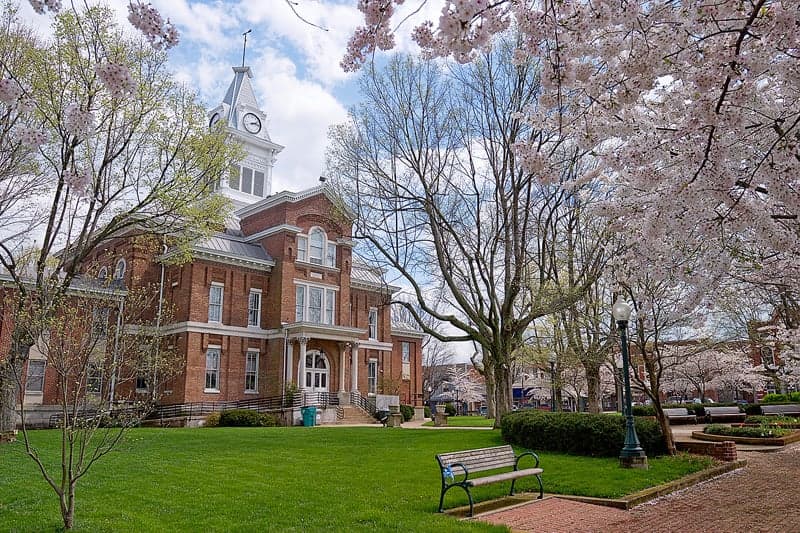

Photo: Wikipedia
Political ClimatePolitical Climate in Simpson County
Showing district-level results — no local-only data available.
Local Political AnalysisPolitical Analysis of Simpson County
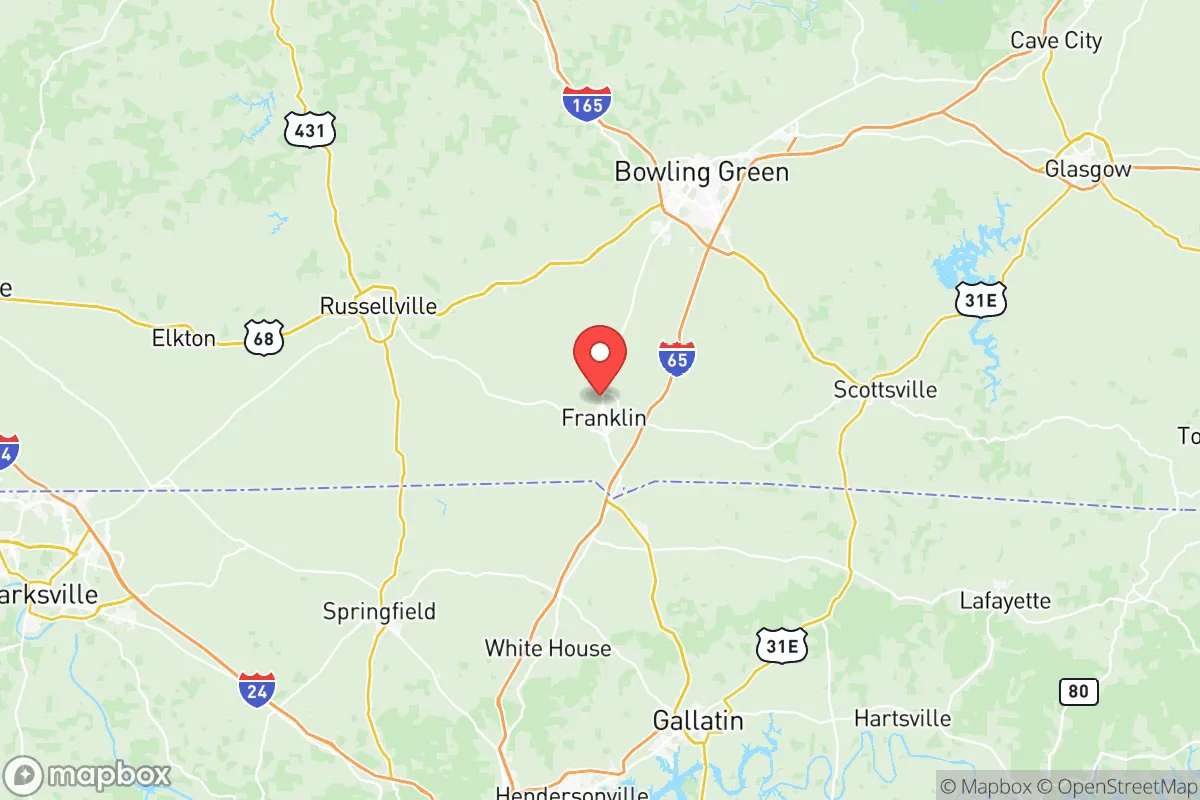
Simpson County, Kentucky, is a reliably Republican stronghold with a Cook Partisan Voting Index (PVI) of R+23, making it significantly more conservative than the state of Kentucky as a whole, which sits at R+15. This isn't a recent shift; the county has voted for the GOP presidential candidate by wide margins for decades, with the 2024 race seeing a roughly 72-26 split in favor of the Republican ticket. The county seat, Franklin, is the only incorporated city and the political epicenter, but even here, the conservative lean is deep and consistent, though you'll find a few more moderate pockets near the downtown square and around the Western Kentucky University campus extension.
How it compares
The eight-point gap between Simpson County's R+23 and Kentucky's R+15 is substantial. To put it in perspective, while Kentucky as a whole is a solid red state, Simpson County votes about as Republican as the deepest red districts in the state, like those in the far eastern mountains or the rural western Purchase area. The difference is that Simpson County is more uniformly conservative; you don't see the same level of intra-county variation you might find in a place like Fayette County (Lexington) or Jefferson County (Louisville), where the urban cores are deep blue. In Simpson County, the only real variation is subtle: precincts in the more rural, agricultural areas north and east of Franklin tend to vote even more heavily Republican (often 80%+), while the handful of precincts within Franklin's city limits, particularly those near the historic downtown and the industrial park, might dip to a 65-70% Republican share. There are no swing precincts in the traditional sense; the entire county is a safe Republican zone.
What this means for residents
For conservative residents, the political climate is a comfortable fit. Local elections are dominated by Republican candidates, and the county's policies—on taxes, land use, and social issues—tend to align with a small-government, traditional-values worldview. The county fiscal court and school board are reliably conservative, and there's little organized opposition. For liberal or moderate residents, the reality is that they are a clear minority. While they are not ostracized—Franklin is a friendly, neighborly place—they will find few elected officials who share their views, and local political discourse is overwhelmingly one-sided. This can feel isolating for some, but it also means that political arguments are rare in daily life; the community tends to focus on practical matters like the local economy, schools, and the new industrial developments along I-65 rather than partisan battles.
A key cultural distinction is the county's strong sense of local identity, which often transcends national politics. Simpson County is proud of its agricultural heritage—it's a top producer of soybeans, corn, and cattle—and its growing manufacturing base, anchored by companies like the large Fruit of the Loom distribution center and several automotive parts suppliers. This economic pragmatism means that even in a deeply red county, there is broad support for infrastructure investments and workforce development programs, regardless of the party in power. The local newspaper, the Franklin Favorite, reflects this: its coverage is heavy on local sports, school news, and county government meetings, with national politics taking a back seat. For anyone moving here, the bottom line is that Simpson County offers a stable, predictable political environment where the conservative majority sets the tone, but the day-to-day focus is on community and economic growth, not ideological conflict.

State Political ClimatePolitical Climate in Kentucky
State Political AnalysisPolitical Environment in the State
Kentucky is a deeply conservative state, carrying a Cook Partisan Voting Index of R+15, meaning it votes about 15 points more Republican than the national average in presidential elections. The state has shifted sharply rightward over the past two decades: in 2004, George W. Bush won it by 20 points; by 2024, Donald Trump carried it by roughly 30 points, a trend driven by the collapse of Democratic strength in rural areas and the exodus of culturally conservative voters from the Democratic Party. The dominant coalition is a mix of rural and small-town voters, evangelical Christians, and working-class whites, with the Republican Party holding supermajorities in both chambers of the state legislature and every statewide office except the governorship, which has flipped between parties in recent cycles.
Urban vs. rural divide
The political map of Kentucky is a textbook study in the urban-rural split. The state’s two major population centers—Louisville (Jefferson County) and Lexington (Fayette County)—are the only reliably Democratic strongholds. Louisville, home to about 620,000 people, votes blue by double digits in most elections; Lexington, with roughly 320,000, is similarly Democratic but slightly less so. These two cities account for nearly all of the state’s Democratic votes, but they are surrounded by a sea of deep-red rural and exurban counties. The northern Kentucky suburbs of Cincinnati—places like Fort Thomas, Independence, and Florence—lean Republican but are more moderate than the rest of the state, often splitting tickets in local races. The state’s third-largest city, Bowling Green, is a conservative stronghold, anchored by Western Kentucky University and a growing industrial base. The eastern coalfields, including towns like Hazard and Pikeville, are among the most Republican areas in the nation, routinely voting 80%+ for GOP candidates. The western part of the state, including Paducah and Murray, is also solidly red, though with a slightly more independent streak in local elections. The only notable recent flip was Fayette County itself, which shifted from purple to solidly blue over the past decade, driven by Lexington’s growing professional class and university population.
Policy environment
Kentucky’s policy environment is shaped by a low-tax, low-regulation philosophy. The state has a flat income tax rate of 4.5% (down from 6% in 2018, with a scheduled phase-down to 4% by 2026), no estate tax, and a sales tax of 6% that exempts most groceries and prescription drugs. Property taxes are among the lowest in the nation, with average effective rates around 0.8% of home value. The regulatory posture is business-friendly: Kentucky is a right-to-work state (since 2017), and its workers’ compensation and unemployment insurance systems are structured to minimize employer costs. Education policy is a flashpoint: the state has a school choice program (the Education Opportunity Account Act, passed in 2022) that provides tax credits for private school scholarships, but it was struck down by the state Supreme Court in 2023 and remains in legal limbo. Public school funding is below the national average, and teacher protests in 2018 and 2019 over pension reform were among the largest in state history. Healthcare policy is dominated by the state’s expansion of Medicaid under the Affordable Care Act (done by then-Governor Steve Beshear in 2014), which now covers about 1.6 million Kentuckians. However, the state has imposed work requirements and premiums for some able-bodied adults, and the program remains a political battleground. Election laws are moderately restrictive: Kentucky requires a photo ID to vote, has no-excuse absentee voting only for those 65+ or with a medical condition, and limits early voting to three days before Election Day. The state does not have automatic voter registration, but same-day registration is available during early voting.
Recent policy direction
The last five years have seen Kentucky move decisively in a conservative direction across multiple fronts. On gun and self-defense law, the state enacted constitutional carry (permitless carry of concealed firearms) in 2019, and in 2024 it passed a law allowing teachers to carry firearms on school grounds with district approval. On parental and education rights, the 2022 “Parents’ Bill of Rights” (HB 9) requires schools to notify parents of any changes to a student’s health or well-being and prohibits instruction on sexual orientation or gender identity in grades K-5. On speech and privacy, the state passed a law in 2023 banning TikTok on government devices and requiring social media platforms to verify the ages of Kentucky users. On medical and bodily autonomy, Kentucky has one of the most restrictive abortion bans in the nation: a near-total ban with no exceptions for rape or incest, passed as a trigger law in 2019 and upheld by the state Supreme Court in 2023. The state also bans gender-affirming care for minors (SB 150, 2023), overriding a veto from Democratic Governor Andy Beshear. On property rights, Kentucky is a “Dillon’s Rule” state, meaning local governments have only the powers explicitly granted by the state legislature, which has preempted local ordinances on everything from plastic bag bans to short-term rental regulations. On taxation, the legislature has passed a series of income tax cuts, with a goal of reaching a 4% flat rate by 2026, and has resisted any new broad-based taxes. On voting and ballot access, the state has tightened voter ID requirements and shortened the window for absentee ballot requests, though it has also expanded early voting hours in some counties.
Civil unrest & political movements
Kentucky has seen its share of political flashpoints. The 2020 protests in Louisville over the killing of Breonna Taylor were among the largest in the nation, with weeks of demonstrations, property damage, and a heavy police presence. That event reshaped local politics in Louisville, leading to the election of a more progressive city council and a police reform package that included a ban on no-knock warrants (the “Breonna’s Law”). In the rest of the state, the dominant political movements are on the right: the Kentucky Freedom Coalition, a conservative activist group, has been influential in pushing school board candidates and local GOP platforms. Immigration politics are relatively low-key, as Kentucky has a small foreign-born population (about 4%), but there have been flashpoints over the resettlement of refugees in cities like Louisville and Bowling Green, with some local officials pushing for more restrictions. There is no serious secession or nullification movement, though some rural counties have passed symbolic “Second Amendment sanctuary” resolutions. Election integrity controversies have been muted compared to other states, though the 2020 election saw some local GOP officials question the results, and the state legislature passed a law in 2021 creating a new election audit process. The most visible ongoing political tension is between the Democratic governor, Andy Beshear, and the Republican supermajority legislature, which has resulted in frequent veto overrides and a constant state of legislative warfare over education, healthcare, and social policy.
Projection
Over the next 5-10 years, Kentucky’s political trajectory is likely to continue its rightward drift, but with some important caveats. The state’s population is aging and growing slowly, with most growth concentrated in the urban centers of Louisville and Lexington and the suburban corridor along I-75 from Georgetown to Richmond. These areas are becoming more diverse and more Democratic, but they are not growing fast enough to offset the deep-red rural counties. The biggest demographic wild card is in-migration from other states: Kentucky has seen a modest influx of retirees and remote workers from higher-cost states like California and Illinois, but these newcomers tend to be more conservative than the national average and are settling in places like Bowling Green and the Lake Cumberland region. The state’s Republican supermajority is likely to persist, and the next major policy fights will be over further income tax cuts (possibly to 3.5% or lower), school choice expansion, and potential privatization of the state’s pension system. The biggest unknown is the governorship: Andy Beshear is term-limited in 2027, and the open-seat race will be a national bellwether. If a Republican wins, expect a full conservative agenda with no vetoes; if a Democrat holds the seat, the current pattern of legislative overrides and executive orders will continue. For a new resident, the practical reality is that Kentucky will remain a solidly red state with low taxes, limited government services, and a culture that values personal liberty and local control, but with sharp urban-rural divides that shape daily life.
For someone moving to Kentucky, the bottom line is this: you’ll find a state where conservative values dominate policy and culture, but where the urban centers offer a more liberal alternative. If you’re a conservative, you’ll feel at home in most of the state, with low taxes, strong gun rights, and a government that generally stays out of your business. If you’re a liberal, you’ll need to live in Louisville or Lexington to find a like-minded community, and you’ll face a state government that is actively hostile to many of your priorities. The political climate is stable but contentious, with the governor and legislature in constant conflict, and the trajectory points toward continued conservative governance with incremental tax cuts and social restrictions. Plan your move accordingly.
* Values derived from national, state, county, city and local statistics and may differ in a specific area. Last updated: 2026-06-17T07:52:02.000Z
Narrative content on this page is AI-generated and may contain mistakes. Verify any details that matter before acting on them.
ReloMaps may earn a commission from affiliate links at no extra cost to you.

