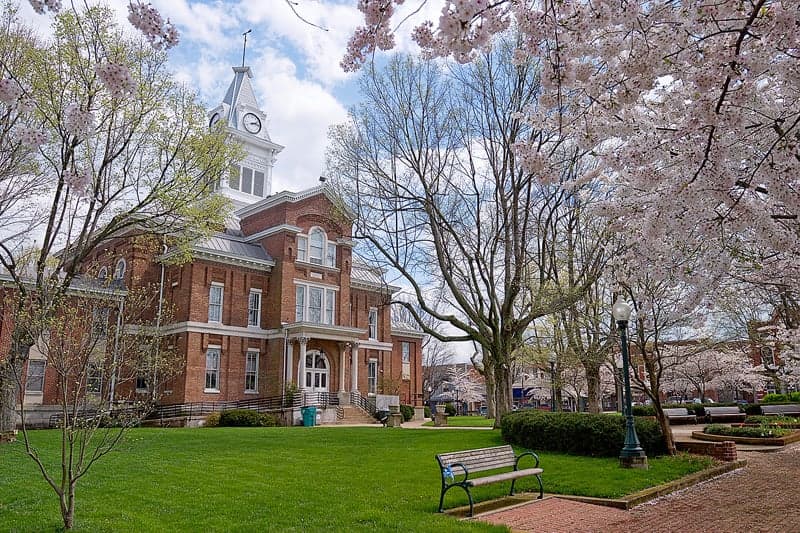
Photo: Wikipedia
Demographics of Simpson County
Affluence Level in Simpson County
A below-average socioeconomic profile. Incomes, home values, and educational attainment trail the U.S., with higher poverty and unemployment.
People of Simpson County
Simpson County, Kentucky, today is a predominantly white, rural community of just under 20,000 residents, anchored by the county seat of Franklin. With a foreign-born population of less than 1% and a Black population of 6.9%, the county remains far less diverse than the national average, reflecting its deep roots in Anglo-American settlement and a slow, steady pattern of domestic migration rather than international influx. The county’s identity is shaped by its agricultural heritage, its position along the I-65 corridor between Nashville and Bowling Green, and a population that is older and less college-educated than the state average, giving it a distinctly traditional, family-oriented character.
Settlement & growth (pre-1960)
Long before European settlers arrived, the area that is now Simpson County was part of the hunting grounds of the Cherokee and Shawnee nations. These groups used the region’s abundant game and fertile river valleys, but established no permanent villages within the county’s modern boundaries. The first European presence came in the late 18th century, when long hunters and surveyors from Virginia and North Carolina crossed the Cumberland Gap and followed the Cumberland River into south-central Kentucky.
Permanent settlement began in earnest after the 1795 Treaty of Greenville opened the region to American expansion. The first wave of settlers were overwhelmingly Scots-Irish and English from the Upper South, who arrived between 1795 and 1820. They were drawn by cheap, fertile land in the drainages of the West Fork of the Drakes Creek and the Little Barren River. These families—names like Simpson, Goodnight, and Goad—established subsistence farms and small crossroads communities. The town of Franklin, founded in 1815 and named after Benjamin Franklin, became the county seat when Simpson County was formed from parts of Logan, Warren, and Allen counties in 1819. Nearby Gold City and Providence emerged as tiny hamlets serving the agricultural trade.
The second major wave came between 1820 and 1860, as enslaved African Americans were forcibly brought into the county by white landowners to work the expanding tobacco and hemp plantations. By 1860, enslaved people made up roughly 30% of the county’s population, a proportion typical of Kentucky’s fertile southern tier. After the Civil War and Emancipation, many freedmen remained in the county, forming small rural communities like Black Jack and settling on the outskirts of Franklin. Their descendants still make up the majority of Simpson County’s Black population today.
The late 19th and early 20th centuries saw little new immigration. A small number of German Catholic families arrived in the 1880s, settling near Salem in the county’s northwest corner, but they were never numerous enough to form a distinct ethnic enclave. The county’s economy remained tied to tobacco, corn, and livestock, and its population peaked at around 14,000 in 1900 before slowly declining as young people left for industrial jobs in Louisville, Nashville, and Detroit. The post-World War II period brought modest growth as the construction of I-65 in the 1960s connected Franklin to the broader regional economy, but the county’s demographic character remained overwhelmingly white, native-born, and rural.
Modern era (post-1965)
The 1965 Hart-Cellar Act, which transformed U.S. immigration by eliminating national-origin quotas, had almost no impact on Simpson County. The county’s foreign-born population remains at just 0.7% in 2026, one of the lowest rates in Kentucky. Unlike many parts of the South that saw a surge of Hispanic and Asian immigrants after 1965, Simpson County’s isolation from major urban centers and its lack of large-scale manufacturing or meatpacking plants meant that few immigrants settled here.
The most significant demographic shift since 1965 has been domestic migration from the Rust Belt and rural Appalachia. Beginning in the 1980s and accelerating after 2000, families from Ohio, Indiana, and Michigan have moved to Simpson County seeking lower housing costs, a slower pace of life, and proximity to Nashville’s job market. This wave has concentrated in Franklin and along the I-65 corridor near the Simpson-Warren county line, where new subdivisions have been built on former farmland. These newcomers are predominantly white and middle-class, and they have slightly higher education levels than the native-born population, though the county’s college attainment rate remains low at 16.8%.
The Hispanic population has grown from near zero in 1990 to 3.4% today, driven primarily by Mexican-origin families working in tobacco and vegetable farming, as well as in construction and landscaping in Franklin. This community is small and dispersed, with no single ethnic neighborhood, though a handful of Hispanic-owned businesses have opened along North Main Street in Franklin. The Asian population, at just 0.2%, consists of a few families of Vietnamese and Chinese descent, most of whom are professionals employed at the Franklin-Simpson Memorial Hospital or at Western Kentucky University in nearby Bowling Green. The Indian-subcontinent population is effectively zero.
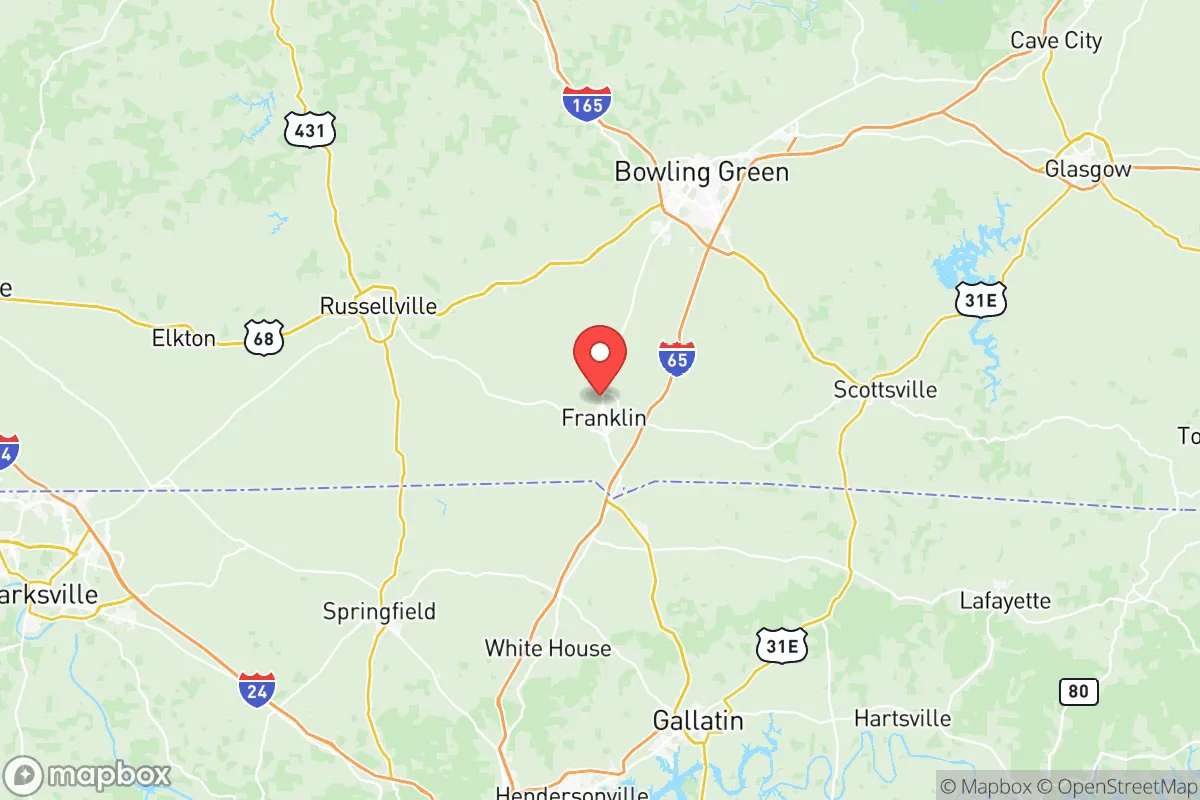
Suburbanization has been modest but real. Franklin has grown from a town of 7,000 in 1990 to roughly 10,000 today, with new housing developments like Hunter’s Ridge and Lake Spring Estates attracting commuters who work in Bowling Green (25 minutes north) or even Nashville (50 minutes south). However, the county’s rural character remains intact: the population density is just 55 people per square mile, and most of the land is still in farms or forest.
The future
Simpson County is likely to become slightly more diverse over the next 10-20 years, but the change will be slow. The Hispanic share of the population is projected to rise to 5-6% by 2040, driven by natural increase and continued labor demand in agriculture and construction. The Black population is expected to remain stable at around 7%, as outmigration of younger Black residents to Nashville and Louisville offsets any growth. The Asian and Indian populations will likely remain negligible, as the county lacks the high-skilled job base or university presence that attracts these groups.
The most significant demographic trend is the continued in-migration of white retirees and remote workers from the Midwest and coastal states. Simpson County’s low cost of living, low crime rates, and access to outdoor recreation at Lake Spring and the Barren River Lake make it attractive to those seeking a quieter life. This influx will gradually raise the county’s median age and income, but it will also reinforce its cultural conservatism. The county voted +42 points for Donald Trump in 2024, and that political orientation is unlikely to shift as new residents are drawn by the same values.
New development will concentrate in and around Franklin, particularly along the US 31-W corridor and near the I-65 interchange at Exit 2. The unincorporated communities of Gold City and Providence will likely see modest infill, but the county’s rural zoning laws and lack of public water/sewer in many areas will prevent large-scale suburban sprawl. The population is projected to reach 22,000-23,000 by 2040, a growth rate of about 0.5% per year.
For someone moving in now, Simpson County offers a stable, predictable, and culturally homogeneous community where change comes slowly. It is not a place of rapid demographic transformation or ethnic diversity, but rather a place where the population is gradually becoming more affluent, more educated, and more connected to the Nashville metro area while retaining its small-town, agricultural roots. The people of Simpson County are overwhelmingly native-born, white, and conservative, and that character is likely to persist for at least another generation.

* Values derived from national, state, county, city and local statistics and may differ in a specific area. Last updated: 2026-06-17T07:52:02.000Z
Narrative content on this page is AI-generated and may contain mistakes. Verify any details that matter before acting on them.
ReloMaps may earn a commission from affiliate links at no extra cost to you.

