Photo: Wikipedia
Political ClimatePolitical Climate in Franklin County
Showing district-level results — no local-only data available.
Local Political AnalysisPolitical Analysis of Franklin County
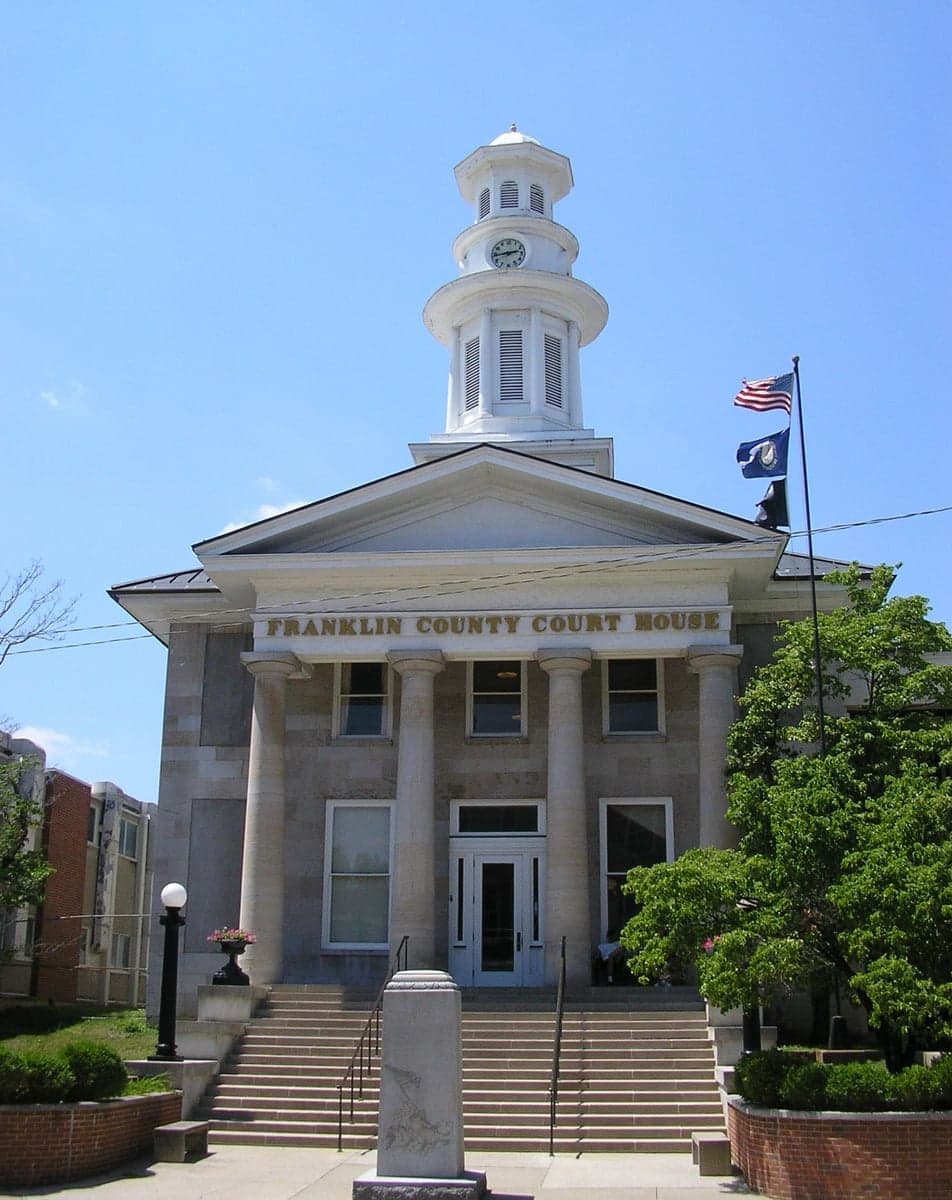
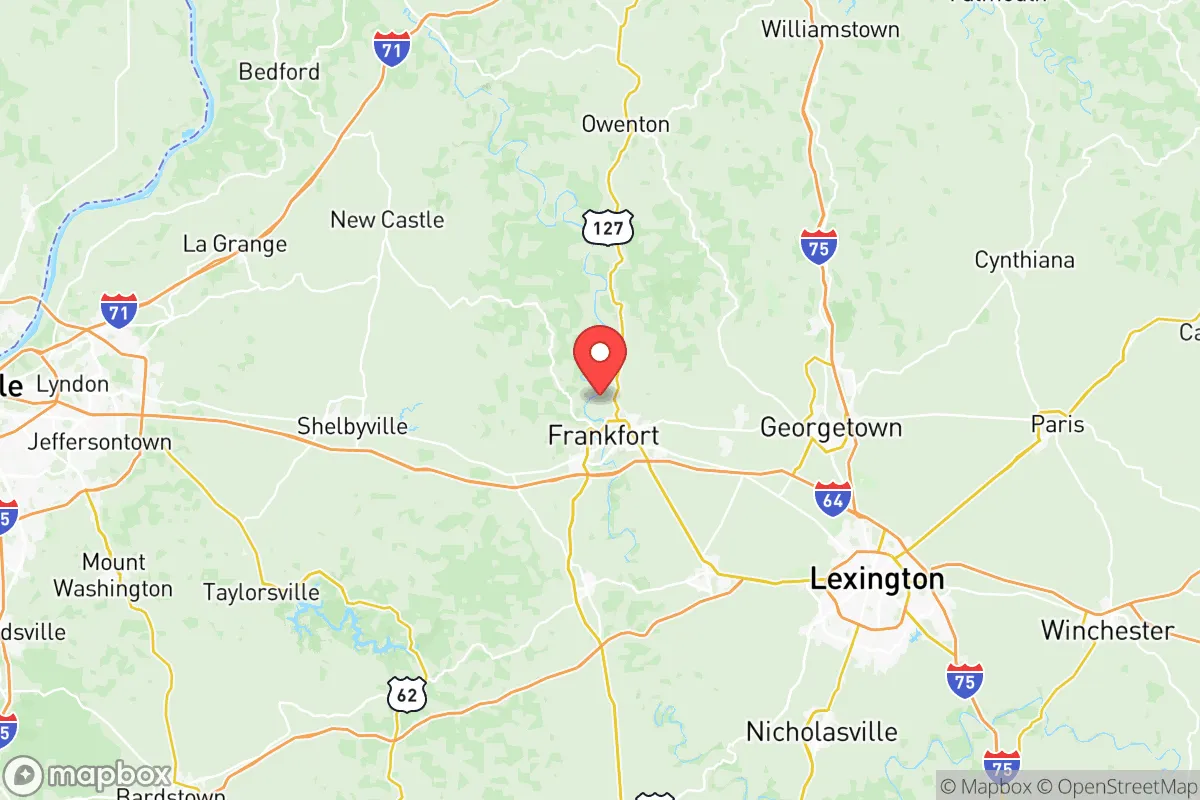
Franklin County, Kentucky, is a fascinating political outlier in the Bluegrass State, anchored by its capital city, Frankfort. While the county as a whole carries a Cook Partisan Voting Index (PVI) of R+23, making it a solidly Republican stronghold on paper, the reality on the ground is far more nuanced. The presence of state government, Kentucky State University, and a sizable professional class creates a distinct Democratic-leaning bubble in the city of Frankfort itself, particularly in precincts around the Capitol and downtown. Meanwhile, the rural stretches of the county—towns like Bridgeport, Switzer, and Benson—vote overwhelmingly Republican, often by margins exceeding 70%. This urban-rural split means the county's overall R+23 rating masks a deeply divided political landscape where the city and countryside are in constant tension.
How it compares
Franklin County's R+23 PVI is significantly more Republican than the state of Kentucky's overall R+15 rating, which might seem counterintuitive given Frankfort's status as a government hub. The reason is simple: the rural precincts outside the city limits are among the most conservative in the state, pulling the county's average well to the right of Kentucky as a whole. For example, in the 2024 presidential election, precincts in the western part of the county near the Shelby County line voted for the Republican candidate by margins of 80% or more, while precincts in Frankfort's South Frankfort neighborhood and near the Kentucky State University campus voted Democratic by similar margins. This creates a sharper political divide than in many other Kentucky counties, where the urban-rural gap is less pronounced. In contrast, counties like Fayette (Lexington) and Jefferson (Louisville) are Democratic-leaning, while rural counties like Breathitt or Knott are deeply Republican, but Franklin County's mix of a blue city and a deep-red countryside makes it a true bellwether for the state's political polarization.
What this means for residents
For conservative residents, especially those in the rural parts of the county, life is largely comfortable. Local elections in the county commission and school board are often dominated by Republicans, and the county's Republican Party is well-organized, with active precinct committees in places like Forks of Elkhorn and Jett. However, they must contend with a Democratic mayor and city council in Frankfort, which can lead to friction over issues like zoning, taxes, and law enforcement funding. For liberal residents, the experience is more of a mixed bag. While Frankfort itself is a safe space for progressive politics—with a thriving LGBTQ+ community, a local Democratic Party that holds regular events, and a city government that leans left—the surrounding county can feel like a different world. A liberal resident living in the city might feel perfectly at home, but a drive just 10 minutes outside the city limits to a place like Benson or Switzer can feel like entering a deeply conservative environment. This means that for both sides, political life in Franklin County is about navigating a constant, visible divide, with the state capitol building serving as a daily reminder of the power dynamics at play.
Culturally, this split manifests in distinct ways. Frankfort's downtown is home to a vibrant arts scene, craft breweries, and a walkable historic district that feels more like a small liberal college town. The rural parts of the county, by contrast, are dominated by horse farms, tobacco fields, and a strong tradition of hunting and outdoor recreation. Policy-wise, the county's Republican lean means that local government tends to be fiscally conservative, with lower property tax rates than in neighboring Fayette County. However, the city of Frankfort has its own set of progressive ordinances, including a non-discrimination ordinance that protects LGBTQ+ residents, which is a point of pride for liberals and a source of tension for some conservatives. Looking ahead, the county's political trajectory is likely to remain stable, with the city's Democratic lean growing slightly as Frankfort attracts more young professionals and state workers, while the rural areas stay deeply red. This makes Franklin County a microcosm of Kentucky's broader political landscape—a place where the two sides coexist, often uneasily, but with a shared sense of place that keeps the community together.

State Political ClimatePolitical Climate in Kentucky
State Political AnalysisPolitical Environment in the State
Kentucky is a deeply red state with a Cook PVI of R+15, meaning it votes about 15 points more Republican than the national average in presidential elections. The dominant coalition is a mix of rural and small-town conservatives, evangelical Christians, and working-class voters who have shifted sharply rightward over the past two decades. While the state voted for Bill Clinton in 1992 and 1996, it has not backed a Democratic presidential candidate since, and the margin has only widened — Donald Trump won it by 26 points in 2020 and by over 30 points in 2024. This trajectory reflects a broader realignment: culturally conservative, union-heavy regions that once leaned Democratic have become reliably Republican, while the state’s few urban centers have moved in the opposite direction.
Urban vs. rural divide
The political map of Kentucky is a study in contrasts. The two major metros — Louisville (Jefferson County) and Lexington (Fayette County) — are Democratic strongholds. Louisville, the state’s largest city, voted for Joe Biden by about 20 points in 2020 and has a progressive city council that has pushed police reform and LGBTQ+ nondiscrimination ordinances. Lexington, home to the University of Kentucky, is similarly blue, though slightly less so, with Biden winning by around 15 points. These two counties alone account for roughly 20% of the state’s population but are increasingly isolated in a sea of red. The rest of the state — from the Appalachian coalfields in the east to the Purchase region in the west — votes overwhelmingly Republican. Notable flips include Pike County in eastern Kentucky, which voted for Obama in 2008 and 2012 but went for Trump by over 50 points in 2020, and McCracken County (Paducah), which has shifted from competitive to solidly red. The only other blue pockets are a handful of college towns like Bowling Green (Warren County) and Richmond (Madison County), where younger and more educated populations create small Democratic islands. The rural-urban divide is stark: drive 20 minutes outside Louisville or Lexington, and you’re in deep-red territory where Trump flags and “Let’s Go Brandon” signs are common.
Policy environment
Kentucky’s policy environment is shaped by a Republican supermajority that has controlled both chambers of the legislature since 2017 and the governorship since 2019. The state has a flat income tax rate of 4.5%, which is being phased down from 5% with a goal of reaching 4% by 2026. Property taxes are low, with an average effective rate of 0.83% of home value, and there is no tax on Social Security benefits. The regulatory posture is business-friendly: Kentucky is a right-to-work state (enacted in 2017) and has a tort reform cap on noneconomic damages in medical malpractice cases. Education policy leans conservative: the state has a school choice program (the Education Opportunity Account Act, passed in 2021) that provides tax credits for donations to scholarship funds for private or homeschool expenses. Public school funding, however, remains below the national average. Healthcare is a mixed bag: Kentucky expanded Medicaid under the Affordable Care Act in 2014, covering over 400,000 residents, but the state has imposed work requirements for able-bodied adults (currently tied up in litigation). Election laws are moderately restrictive: voters must present a photo ID at the polls, and absentee voting requires an excuse (though no-excuse early voting was expanded in 2024). The state does not have automatic voter registration, and same-day registration is not allowed.
Recent policy direction
Over the past five years, Kentucky has moved decisively in a conservative direction across multiple fronts. On gun rights, the state passed constitutional carry (permitless concealed carry) in 2019, and in 2023 it enacted a “Second Amendment Sanctuary” law prohibiting state enforcement of any future federal gun bans or registration schemes. On parental rights and education, the 2022 “Parents’ Bill of Rights” (SB 178) requires schools to notify parents of any changes to a student’s health or well-being and prohibits instruction on sexual orientation or gender identity in grades K-5. In 2023, the legislature passed a ban on gender-affirming care for minors (SB 150), overriding Governor Andy Beshear’s veto. On speech and privacy, Kentucky has no broad surveillance law, but it does have a biometric privacy law (the Kentucky Biometric Information Privacy Act, passed in 2023) that requires consent before collecting fingerprints or facial scans. On medical and bodily autonomy, abortion is banned with very limited exceptions (life of the mother, rape, and incest) under a trigger law that took effect after Roe v. Wade was overturned in 2022. On property rights, the state has strong eminent domain protections and a “right to farm” law shielding agricultural operations from nuisance lawsuits. On voting, the 2021 law (SB 1) shortened the absentee voting window and required the Secretary of State to audit election results, though no widespread fraud has been found. The overall direction is toward greater individual liberty on guns and parental control, but tighter restrictions on abortion and transgender rights.
Civil unrest & political movements
Kentucky has seen its share of political flashpoints, though large-scale civil unrest is rare outside of Louisville. The most notable recent event was the 2020 protests in Louisville following the death of Breonna Taylor, which included weeks of demonstrations, clashes with police, and the fatal shooting of a protester by law enforcement. The city remains a focal point for racial justice activism, with groups like the Kentucky Alliance Against Racist and Political Repression maintaining a presence. On the right, the Kentucky Freedom Coalition and local Tea Party groups are active, particularly in rural areas and suburbs like Shelbyville and Elizabethtown. Immigration politics are relatively low-key, as Kentucky has a small foreign-born population (about 4%), but there have been localized tensions around meatpacking plants in Mayfield and Russellville that employ immigrant workers. There is no sanctuary city policy anywhere in the state; in fact, a 2023 law (HB 5) requires local law enforcement to cooperate with federal immigration authorities. Election integrity controversies flared after 2020, with Republican Secretary of State Michael Adams (who is relatively moderate) facing pressure from his own party to audit the results, though he has defended the state’s election security. Secession or nullification rhetoric is minimal, though some rural counties have passed symbolic “Second Amendment Sanctuary” resolutions. Overall, the political temperature is warm but not boiling — most Kentuckians are civically engaged but not in a state of constant protest.
Projection
Over the next 5-10 years, Kentucky is likely to remain solidly red, but the margins may narrow slightly in suburban areas. In-migration is modest — the state grew by about 3.8% between 2010 and 2020, slower than the national average — and most newcomers are retirees or remote workers from the Midwest and South who tend to be conservative or moderate. The biggest demographic shift is the continued urbanization of Louisville and Lexington, which are attracting younger, more diverse populations that lean Democratic. However, these cities are growing slowly, while the rural areas are aging and shrinking. The Republican supermajority is unlikely to be seriously challenged, as the state’s legislative districts are heavily gerrymandered. The wild card is the 2027 gubernatorial election: if a Democrat like Beshear (who won in 2023 despite Trump’s popularity) can hold the governorship, it would signal that ticket-splitting is still possible, but the legislature will remain firmly in GOP hands. For a new resident, expect the state’s conservative trajectory to continue: more school choice, further income tax cuts, and continued restrictions on abortion and transgender rights. The urban-rural cultural divide will persist, but the state as a whole will not flip blue in any foreseeable scenario.
For a new resident, the bottom line is that Kentucky offers a low-tax, business-friendly environment with strong gun rights and a culturally conservative social fabric. If you lean conservative, you’ll find your values reflected in state law and local norms. If you lean liberal, you’ll have two welcoming cities — Louisville and Lexington — but will face a state government that is actively hostile to many of your priorities. The practical takeaway: choose your county carefully. A family moving to Oldham County (a wealthy, conservative suburb of Louisville) will have a very different experience than one settling in the Highlands neighborhood of Louisville. The state is not a monolith, but its political direction is clear, and it’s not changing anytime soon.
* Values derived from national, state, county, city and local statistics and may differ in a specific area. Last updated: 2026-07-18T06:34:46.000Z
Narrative content on this page is AI-generated and may contain mistakes. Verify any details that matter before acting on them.
ReloMaps may earn a commission from affiliate links at no extra cost to you.

