
Photo: Wikipedia
Personal Sovereignty in Franklin County
Viable for self-reliance. Generally workable, though some barriers may limit total independence.
What does Personal Sovereignty tell us?
Personal Sovereignty measures your capacity for self-reliance and independence with minimal government friction. Higher scores mean fewer barriers between you and the way you want to live... but it assumes you have the space you need and good neighbors.
What does this tell us?
Personal Sovereignty measures your capacity for self-reliance and independence with minimal government friction. Higher scores mean fewer barriers between you and the way you want to live... but it assumes you have the space you need and good neighbors.
State Policy
Energy independence: Importer (60% of energy produced in-state)
Personal Liberty
Homesteading

Personal Liberty Analysis
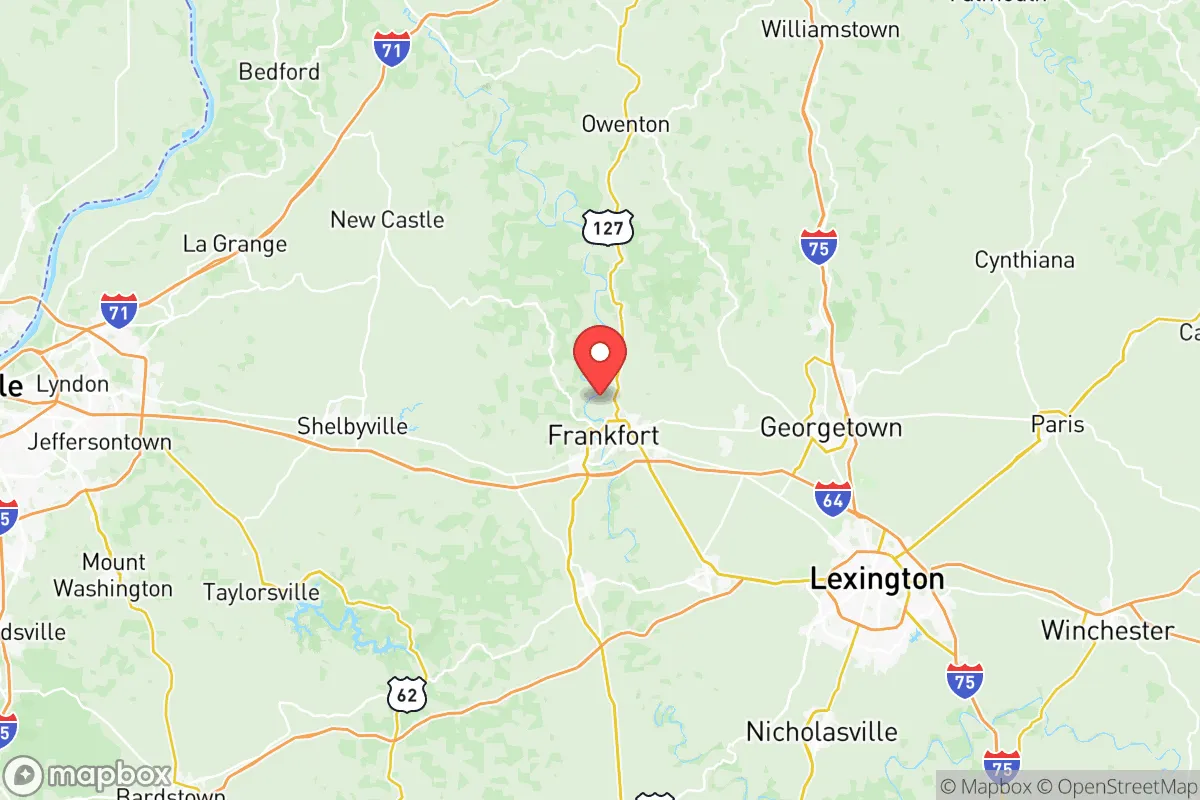
Franklin County, Kentucky, anchored by the state capital of Frankfort, presents a nuanced personal sovereignty environment that balances Kentucky’s generally light-touch state-level governance with the practical realities of a county that houses a significant portion of state government operations. For individuals and families prioritizing autonomy, the area offers a distinctly different posture than the more heavily regulated urban centers of Louisville or Lexington, with a regulatory climate that leans toward personal responsibility rather than prescriptive oversight. The county’s mix of small-town communities, rural farmland, and the capital city creates a landscape where self-reliance is both culturally valued and practically feasible, though the degree of personal freedom varies notably between Frankfort’s city limits and the outlying areas like Bridgeport, Benson, and Switzer.
Tax burden and regulatory posture in Franklin County compared to surrounding areas
Kentucky’s state-level tax structure is relatively favorable for personal sovereignty, with a flat 4.5% individual income tax rate as of 2026 and no tax on Social Security benefits. Franklin County adds a local occupational tax of 1.0% on wages, which is moderate compared to Lexington’s 2.25% or Louisville’s 2.2%. Property taxes are low: the county’s real estate tax rate is approximately $0.12 per $100 of assessed value, and the city of Frankfort adds roughly $0.21 per $100, yielding a combined rate around $0.33 — well below the national average. This means a $250,000 home carries an annual property tax bill of roughly $825. The regulatory posture in unincorporated areas of Franklin County is notably lighter than inside Frankfort’s city limits. For example, zoning in rural pockets near Peaks Mill and Jett is minimal, with no building permit required for structures under 200 square feet in many cases, whereas Frankfort enforces a full building code and zoning overlay. Business licensing is straightforward: a general business license costs $50 annually in the county, and home-based businesses face few restrictions outside of the city. Compared to neighboring Shelby County, which has a more aggressive economic development posture with tax increment financing districts, Franklin County’s approach is more laissez-faire, particularly for agricultural and small-scale commercial activities.
Self-defense and gun law specifics in Franklin County’s communities
Kentucky is a constitutional carry state, meaning no permit is required to carry a concealed firearm for anyone 21 or older who is legally allowed to possess a gun. Franklin County fully aligns with this, and local law enforcement in Frankfort and the surrounding communities of Forks of Elkhorn and Bald Knob generally respect the state preemption law that prohibits local governments from enacting stricter firearm ordinances than state law. Open carry is legal without a permit. The county has a strong gun-friendly culture: the Frankfort Gun Show occurs quarterly at the Franklin County Fairgrounds, and there are multiple indoor and outdoor shooting ranges, including the Capital City Gun Club near Bridgeport. Stand-your-ground laws apply statewide, with no duty to retreat in any place where a person is lawfully present. The sheriff’s office issues concealed carry permits for reciprocity purposes (for travel to states that require a permit), and the process is straightforward — a $60 fee, a background check, and no training requirement for those 21 and older, though many residents opt for a voluntary safety course. There are no county-specific magazine capacity restrictions or ammunition regulations. The only notable local nuance is that discharging a firearm within Frankfort city limits is prohibited except at approved ranges, but this restriction does not apply in the unincorporated areas of the county, where target shooting on private property is common and accepted.
Self-reliance and homesteading viability across Franklin County’s zoning districts
Homesteading and off-grid living are genuinely viable in Franklin County, particularly outside the Frankfort urban growth boundary. Minimum lot sizes in the county’s agricultural zoning district (A-1) are 10 acres, which is typical for Kentucky but allows for substantial self-sufficiency. In the rural residential zone (R-R), minimum lot sizes drop to 1 acre, making smaller homesteads feasible near communities like Switzer and Benson. Off-grid infrastructure is largely unregulated at the county level: rainwater collection is unrestricted, composting toilets are permitted with a simple septic system variance, and solar panel installation requires no county permit for systems under 10 kW. The county does not enforce any building code in unincorporated areas for owner-occupied dwellings under 1,000 square feet, though a septic permit from the health department is required. Poultry and livestock are allowed on parcels of 3 acres or more without a special use permit, and beekeeping is permitted on any lot over half an acre. The Frankfort Plant Board provides electricity and water within the city, but rural areas rely on Blue Grass Energy for electricity and private wells for water — well drilling costs average $5,000-$8,000 for a 200-foot well. There are no county-level restrictions on food preservation, home canning, or selling raw milk directly from the farm, though state law requires a permit for raw milk sales. The county’s extension office in Frankfort offers free soil testing and workshops on small-scale farming, which supports the self-reliance ethos.
Personal liberties: parental rights, medical autonomy, speech, and property rights
Franklin County’s personal liberties environment is shaped by Kentucky’s broader legal framework, which generally favors individual autonomy in several key areas. Parental rights are strongly protected: Kentucky law requires parental consent for minors seeking medical care, including reproductive health services, and the state’s school choice options include charter schools, homeschooling, and private school vouchers through the Education Opportunity Account program. Homeschooling is straightforward — parents file a one-time notice with the local school board and provide 175 days of instruction annually, with no standardized testing requirement. Medical autonomy is mixed: Kentucky has a broad religious exemption for vaccine mandates, and the state does not require COVID-19 vaccinations for any public services. However, the state’s medical cannabis program is limited to a pilot study for chronic pain and PTSD, and full recreational use remains illegal. Free speech is robust, with no county-level restrictions on political signage or public assembly beyond standard time-place-manner rules in Frankfort’s downtown. Property rights are well-protected: Kentucky is a “Dillon’s Rule” state, meaning counties have only the powers explicitly granted by the state, which limits Franklin County’s ability to impose land-use restrictions beyond what state law allows. Eminent domain is rarely used for private development, and the county’s comprehensive plan is advisory rather than mandatory in rural areas. The only notable friction point is that the Frankfort city government has a historic preservation overlay in the downtown district, which can restrict exterior modifications to properties built before 1940 — but this applies only to a small area near the Capitol.
Overall, Franklin County offers a personal sovereignty profile that is stronger than the national average and notably more permissive than Kentucky’s urban counties like Fayette or Jefferson. The combination of low taxes, constitutional carry, minimal zoning in rural areas, and strong parental rights creates an environment where self-reliant individuals and families can operate with significant freedom. The county’s main trade-off is that Frankfort itself, as the state capital, has a more regulated core than the surrounding communities of Bridgeport, Benson, and Peaks Mill, where the regulatory touch is lightest. For a conservative-leaning reader weighing relocation, Franklin County ranks favorably against similar-sized counties in the Midwest and South — roughly comparable to Tennessee’s Williamson County in tax burden but with fewer restrictions on homesteading and self-defense. The area’s autonomy environment is best suited for those who want the services of a small city (Frankfort’s population is about 28,000) while retaining the ability to live with minimal government interference in the county’s rural reaches.

* Values derived from national, state, county, city and local statistics and may differ in a specific area. Last updated: 2026-07-18T06:34:46.000Z
Narrative content on this page is AI-generated and may contain mistakes. Verify any details that matter before acting on them.
ReloMaps may earn a commission from affiliate links at no extra cost to you.

