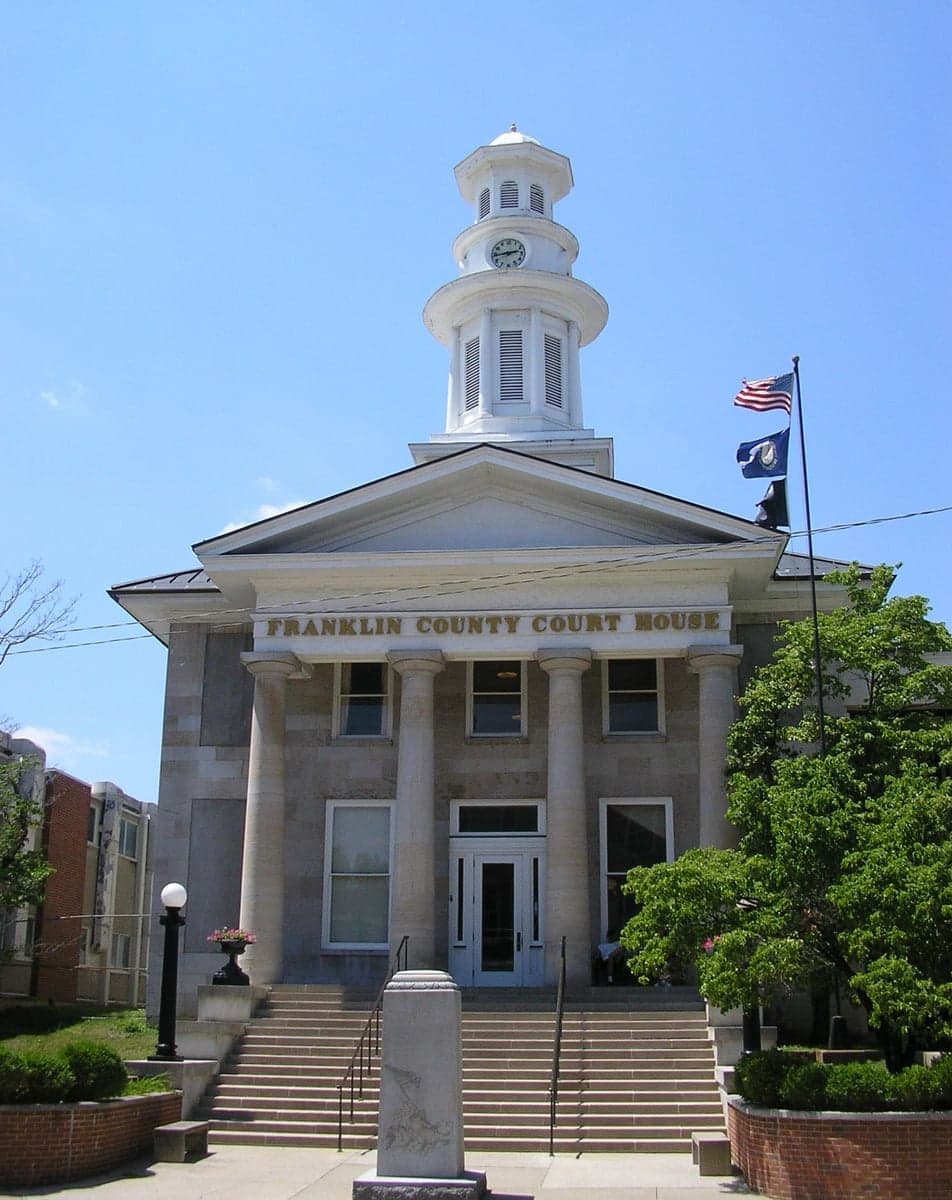
Photo: Wikipedia
Demographics of Franklin County
Affluence Level in Franklin County
A middle-class area roughly in line with national averages across income, home values, education, and employment.
People of Franklin County
The people of Franklin County, Kentucky, today number 51,563, forming a community that is predominantly white (80.9%) with a significant Black minority (9.2%) and a growing Hispanic population (4.1%). The county is anchored by its capital city, Frankfort, which gives the area a distinctive blend of state government professionals, bourbon industry workers, and long-standing rural families. With a foreign-born population of just 3.2% and a college-educated rate of 31.8%, Franklin County is less diverse than the national average but more so than many surrounding Kentucky counties, reflecting its role as a political and administrative hub.
Settlement & growth (pre-1960)
Before European settlement, the region that is now Franklin County was part of the traditional hunting grounds of the Shawnee and Cherokee nations. The area was sparsely populated by Native peoples, who used the Kentucky River valley for seasonal hunting and travel. French and British explorers passed through in the 17th and 18th centuries, but no permanent European settlements were established until after the American Revolution.
The first major wave of settlers arrived in the 1780s and 1790s, primarily Scots-Irish and English pioneers moving west through the Cumberland Gap. These early settlers were drawn by the promise of fertile land along the Kentucky River and the protection offered by newly established forts. The town of Frankfort was founded in 1786 on a bend of the Kentucky River, chosen as the state capital in 1792 due to its central location. The early economy was agricultural, with tobacco and hemp as primary cash crops, and the river provided a vital transportation route for goods.
A second wave of settlement came with the expansion of slavery and the plantation system in the early 19th century. By 1830, enslaved African Americans made up roughly 30% of Franklin County's population, working on tobacco plantations and in domestic service. The county's Black population remained substantial after emancipation, with many freedmen and their descendants settling in the South Frankfort neighborhood and the rural community of Bridgport. These areas became the historic heart of the county's African American community, with churches, schools, and businesses that persisted through the Jim Crow era.
The late 19th and early 20th centuries brought a modest influx of German and Irish immigrants, who found work in the growing bourbon distilling industry and on the railroads. The town of Forks of Elkhorn became a small but distinct German-American settlement, with families operating farms and distilleries. The bourbon industry, centered in Frankfort and the surrounding area, attracted skilled coopers, distillers, and laborers from Europe, though the foreign-born population never exceeded 5% of the county total.
World War II and the post-war era saw a significant shift as the state government expanded. The growth of the Kentucky state bureaucracy in Frankfort drew white-collar workers from across the state, many of them from rural Kentucky counties. This period also saw the beginning of suburbanization, with new housing developments spreading into the Peaks Mill and Benson areas. The county's population grew steadily from about 25,000 in 1940 to 35,000 by 1960, driven by government employment and the expansion of Kentucky State University (then Kentucky State College), which became a magnet for African American students and faculty from across the South.
Modern era (post-1965)
The 1965 Hart-Cellar Act had a limited direct impact on Franklin County, as the area did not attract large numbers of post-1965 immigrants. The foreign-born population remains low at 3.2%, compared to the national average of 13.7%. However, the county has experienced significant domestic demographic shifts since the 1970s.
The most notable change has been the growth of the Hispanic population, which rose from less than 1% in 1990 to 4.1% today. This growth is driven primarily by Mexican and Central American immigrants who arrived for work in the bourbon industry, construction, and agriculture. The Hispanic community is concentrated in Frankfort, particularly in the West Frankfort area, where a small but growing enclave of Hispanic-owned businesses and a Catholic church with Spanish-language services have formed. The community is dispersed rather than densely clustered, with many families living in the newer subdivisions on the city's outskirts.
The Indian subcontinent population, at 1.1%, is a more recent arrival, primarily professionals working in healthcare, information technology, and academia. Many are employed by the state government, Kentucky State University, or the Frankfort Regional Medical Center. This community is highly educated and geographically dispersed, with no single ethnic enclave, though a small concentration of Indian families can be found in the Lakeview neighborhood near the hospital.
East and Southeast Asian communities (0.7%) are even smaller, consisting mainly of Vietnamese and Korean families who arrived in the 1980s and 1990s, often as refugees or through family reunification. They are scattered across Frankfort and the rural areas, with a few families operating restaurants and small businesses in the downtown area.
Domestic migration has been the primary driver of population change since 1965. The county has seen a steady influx of retirees and remote workers from the Midwest and Northeast, drawn by the lower cost of living and the scenic Kentucky River valley. The Switzer and Jett areas have seen new subdivisions catering to these newcomers, while the historic downtown Frankfort has attracted younger professionals seeking walkable neighborhoods. The Black population has remained stable at around 9.2%, with many families continuing to live in the historic South Frankfort and Bridgport neighborhoods, though some have moved to newer subdivisions in the Harrods Creek area.
The future
Franklin County is projected to become slightly more diverse over the next 10-20 years, but the pace of change will be slow. The Hispanic population is expected to grow to 6-7% by 2040, driven by continued immigration and higher birth rates, while the Indian subcontinent population may reach 2% as healthcare and tech sectors expand. The East/Southeast Asian population is likely to remain below 1.5%, as the county lacks the job base and ethnic infrastructure to attract large numbers of new immigrants.
The white population, while still the majority, will continue to age and decline slightly as younger residents move to larger cities like Lexington and Louisville. The county's population growth will be modest, perhaps reaching 55,000 by 2040, driven by domestic migration of retirees and remote workers rather than international immigration. New development will likely concentrate in the Frankfort suburbs and along the US 127 corridor, with the rural areas of Benson and Peaks Mill seeing slower growth.
Culturally, Franklin County is becoming more politically moderate and less insular, as newcomers from outside Kentucky bring different perspectives. The bourbon industry's global success has also brought international visitors and some new residents, though the county remains deeply rooted in its Kentucky traditions. The historic Black community in South Frankfort and Bridgport is working to preserve its heritage amid gentrification pressures, while the Hispanic community is slowly gaining political representation and visibility.
For someone moving to Franklin County now, the area offers a stable, family-oriented community with a strong sense of place, anchored by the state capital and the bourbon industry. The population is slowly diversifying, but the county remains predominantly white and native-born, with a conservative-leaning political culture. Newcomers will find a welcoming but close-knit society where connections are built through church, school, and community events. The future is one of gradual change rather than transformation, making Franklin County a good fit for those seeking a predictable, rooted community with a touch of new energy.

* Values derived from national, state, county, city and local statistics and may differ in a specific area. Last updated: 2026-07-18T06:34:46.000Z
Narrative content on this page is AI-generated and may contain mistakes. Verify any details that matter before acting on them.
ReloMaps may earn a commission from affiliate links at no extra cost to you.

