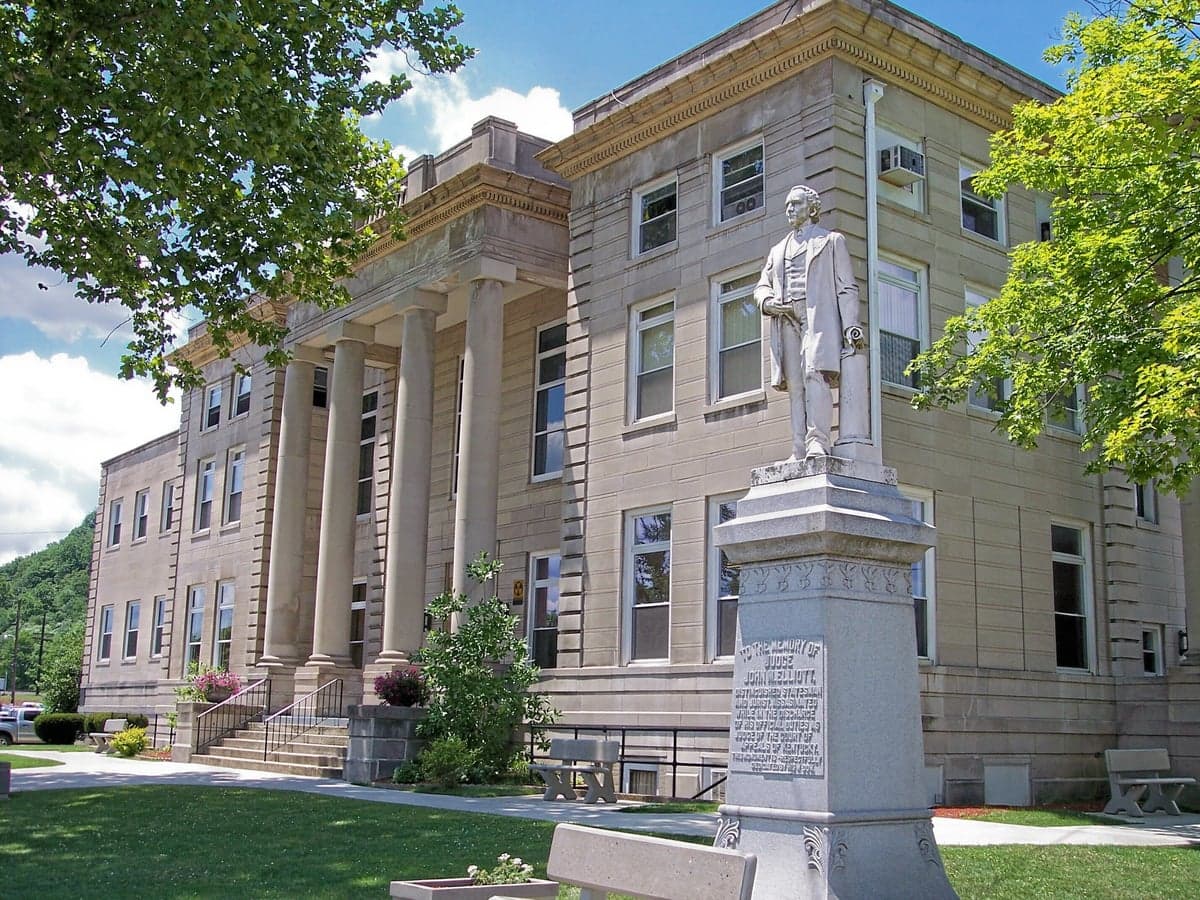
Photo: Wikipedia
Political ClimatePolitical Climate in Boyd County
Showing district-level results — no local-only data available.
Local Political AnalysisPolitical Analysis of Boyd County
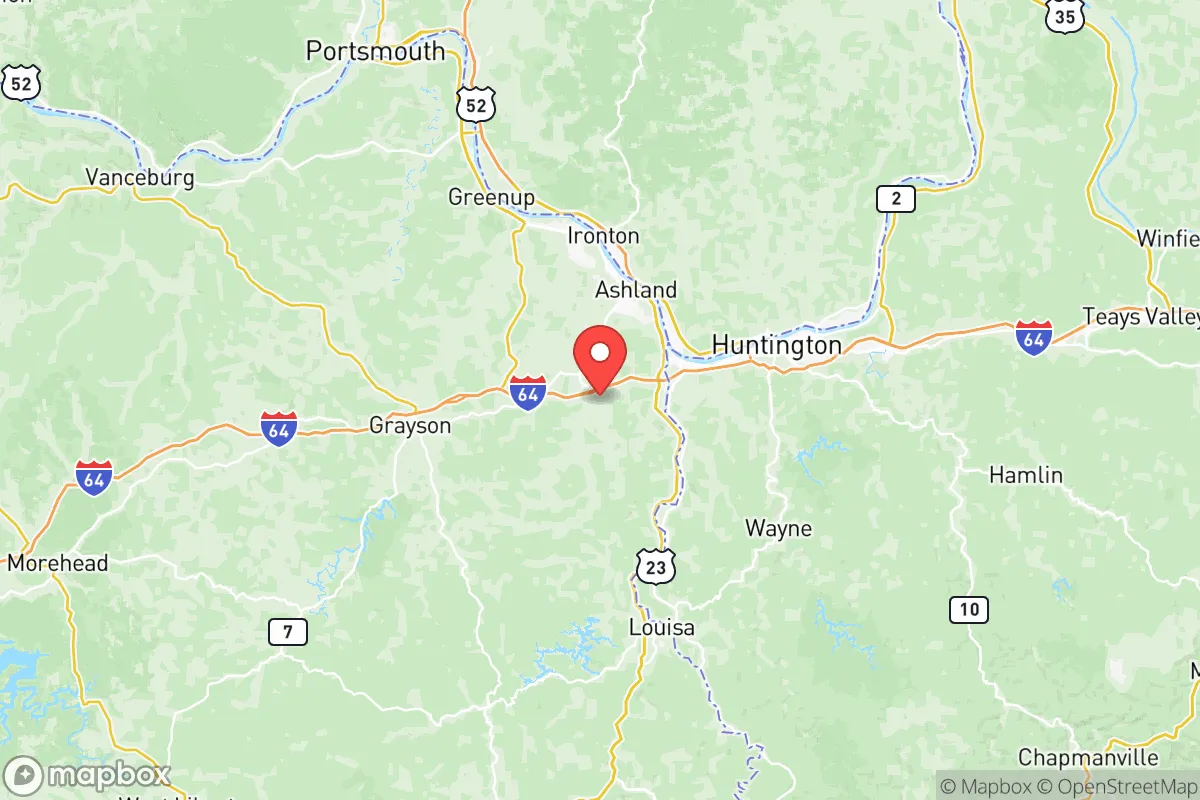
Boyd County is one of the most reliably Republican counties in all of Kentucky, with a Cook Partisan Voting Index (PVI) of R+32—that’s more than double the state’s already solid R+15 rating. This isn’t a recent shift; the county has voted for the GOP presidential candidate by margins of 40 points or more in every election since 2000, and the trend is only getting stronger. The real story, though, is how that deep-red blanket hides some interesting local variation, especially between the county seat of Catlettsburg and the larger city of Ashland.
How it compares
To understand how Boyd County stacks up against the rest of Kentucky, you have to look at the numbers. The state as a whole is R+15, meaning it leans Republican by 15 points relative to the national average. Boyd County’s R+32 is more than double that, placing it in the top 10% of the most conservative counties in the commonwealth. For context, neighboring Greenup County is R+28, and Lawrence County to the east is R+37—so Boyd sits right in the middle of a deeply conservative region. But within Boyd, the picture isn’t uniform. Ashland, the largest city and a former industrial hub, has a noticeable Democratic presence, especially in its older, union-heavy precincts near the AK Steel plant. In the 2020 presidential election, a handful of Ashland precincts—like those around the 5th Ward—came within 5 points of flipping blue, driven by union households and older voters who remember the area’s strong labor history. Meanwhile, Catlettsburg and the rural precincts around Westwood and Summit routinely deliver 75-80% of their votes to Republican candidates. The swing precincts are mostly in the suburban fringe of Ashland, where newer subdivisions are drawing families from both the city and the countryside, creating a more mixed political environment.
What this means for residents
For conservative residents, Boyd County is about as comfortable as it gets. Local offices—county judge, sheriff, school board—are almost entirely held by Republicans, and the county’s GOP machine is well-organized. You’ll find strong support for gun rights, low taxes, and a general skepticism of state-level mandates from Frankfort. For liberal residents, the reality is more nuanced. While you won’t find many openly progressive candidates winning elections, Ashland provides a social and cultural buffer. The city has a small but active Democratic club, and issues like public education funding and opioid recovery programs tend to draw bipartisan support. The biggest practical difference is in policy: the county commission rarely raises taxes, and zoning laws are minimal, which keeps housing costs low but also means development can feel haphazard. Socially, the area is welcoming in a live-and-let-live way, but overt political activism—especially on national issues—is rare and often met with polite indifference.
One cultural distinction worth noting is the area’s relationship with organized labor. Boyd County has a deep union history, particularly in the steel and railroad industries, and that legacy still influences local politics. Even in deep-red precincts, you’ll find support for pro-union candidates at the local level, which creates a unique blend of fiscal conservatism and working-class solidarity. That’s starting to fade as the industrial base shrinks, but it’s still a defining feature of the county’s political identity. Looking ahead, the trajectory is clear: Boyd County will remain a Republican stronghold, but the margins in Ashland may tighten as younger, more diverse residents move in. The rural precincts, however, are only getting redder.

State Political ClimatePolitical Climate in Kentucky
State Political AnalysisPolitical Environment in the State
Kentucky is a deeply red state with a Cook PVI of R+15, meaning it votes about 15 points more Republican than the national average in presidential elections. The dominant coalition is a mix of rural, small-town, and suburban conservatives, with the GOP holding supermajorities in both chambers of the state legislature and all but one statewide office. Over the last 20 years, the state has shifted hard right: in 2000, Kentucky was a swing state that went for George W. Bush by just 4 points; by 2024, Donald Trump carried it by over 30 points. This trajectory reflects a broader realignment where culturally conservative, working-class white voters—who make up a large share of the electorate—have moved decisively into the Republican column, while the state’s few urban centers have become Democratic strongholds.
Urban vs. rural divide
The political map of Kentucky is a textbook study in urban-rural polarization. The Democratic base is almost entirely confined to Louisville (Jefferson County) and Lexington (Fayette County), which together cast about a quarter of the state’s votes. Louisville, home to the state’s largest population of Black voters and a growing professional class, reliably goes Democratic by 20-30 points. Lexington, anchored by the University of Kentucky, is more moderate but still leans blue. The rest of the state is overwhelmingly Republican. The Northern Kentucky suburbs (Boone, Kenton, Campbell counties) across the Ohio River from Cincinnati were once swing territory but have trended red since 2016. Bowling Green, the third-largest city, is a conservative stronghold in a deeply red region. The eastern coalfields (Pike, Floyd, Harlan counties) were historically Democratic but flipped hard to Trump in 2016 and have stayed there, driven by anger over coal industry decline and cultural issues. Owensboro in the west is reliably red, while Paducah and Ashland follow the same pattern. The only notable exception is Frankfort, the state capital, which leans Democratic due to state government employees and a small liberal arts college population.
Policy environment
Kentucky’s policy environment is shaped by a conservative supermajority that has been in place since 2017. The state has a flat income tax that is being phased down from 5% to 4% by 2026, with a goal of eventual elimination. Sales tax is 6%, but groceries and prescription drugs are exempt. Property taxes are low, with no state-level property tax and local rates averaging around 0.8% of assessed value. The state is a right-to-work state and has a "stand your ground" self-defense law. Education policy has been a flashpoint: in 2022, the legislature passed a school choice bill creating education opportunity accounts, though the state Supreme Court struck it down in 2023 on constitutional grounds. A new constitutional amendment to allow school choice funding is expected on the 2026 ballot. Kentucky has some of the strictest abortion laws in the nation—a near-total ban with no exceptions for rape or incest, only to save the mother’s life—enacted via a trigger law that took effect after Dobbs. Voter ID is required, and early voting was expanded in 2021 to include three days of no-excuse in-person absentee voting, though mail-in voting remains restricted to those with a valid excuse.
Recent policy direction
Over the past five years, Kentucky has moved aggressively on several fronts that matter to relocators. On gun and self-defense law, the state passed constitutional carry (permitless carry) in 2019, and in 2023 it enacted a law prohibiting local governments from enacting their own gun ordinances—preempting Louisville’s attempt to ban assault weapons. On parental and education rights, the 2022 "Parents’ Bill of Rights" (SB 150) requires schools to notify parents of any changes to a student’s services or mental health, and bans classroom instruction on sexual orientation and gender identity in grades K-5. On medical and bodily autonomy, the near-total abortion ban is the headline, but the state also has a 2023 law restricting gender-affirming care for minors, including puberty blockers and hormone therapy. On property rights, Kentucky is a "Dillon’s Rule" state, meaning local governments have only the powers explicitly granted by the state—this limits local zoning and land-use control, which developers generally favor. On taxation, the phased income tax reduction is the major story, with the legislature aiming for zero by the early 2030s. On voting and ballot access, the 2021 law (SB 1) tightened voter ID requirements and limited drop boxes, but also expanded early voting—a mixed bag that reflects the GOP’s desire to balance security with convenience.
Civil unrest & political movements
Kentucky has seen its share of political flashpoints. The 2020 protests in Louisville following the death of Breonna Taylor were among the largest in the nation, with months of demonstrations, property damage, and a heavy National Guard presence. That event galvanized local activist groups like the Kentucky Alliance Against Racist and Political Repression, but also fueled a backlash that helped Republicans flip several Louisville-area state house seats in 2022. On the right, the "Constitutional Sheriffs" movement has a presence in rural counties, with some sheriffs publicly refusing to enforce certain state or federal gun laws. Immigration politics are less heated than in border states, but there is a small but vocal group pushing for stricter enforcement, particularly around the growing Latino communities in Louisville and Shelbyville. There is no serious secession or nullification movement, though some rural counties have passed symbolic "Second Amendment sanctuary" resolutions. Election integrity controversies flared after 2020, with the state GOP launching a "forensic audit" of the 2020 election in 2021 that found no evidence of widespread fraud but was used to justify the 2021 voting law changes. A new resident would notice the political divide most acutely in the stark difference between Louisville’s progressive city council and the state legislature’s conservative agenda.
Projection
Over the next 5-10 years, Kentucky is likely to remain solidly red, but the margins may narrow slightly in the suburbs. In-migration is modest—the state grew about 3% from 2020 to 2024—and is concentrated in the Louisville and Lexington metros, as well as the Northern Kentucky suburbs. These areas are becoming more diverse and more educated, which could slowly shift them toward the center. However, the rural population is aging and shrinking, and the state’s political map is so gerrymandered that the GOP supermajority is likely safe through 2030. The biggest wildcard is the future of coal country: if the energy transition accelerates, the eastern part of the state could see further economic decline and political radicalization. On policy, expect continued tax cuts, further restrictions on abortion (possibly a 6-week ban), and a renewed push for school choice via constitutional amendment. A new resident moving in now should expect a state where conservative values dominate state policy, but where local politics in the two big cities offer a very different experience—a blue island in a red sea.
Bottom line for a new resident: If you’re a conservative, you’ll find a state government that aligns with your values on taxes, guns, education, and abortion. If you’re a liberal, you’ll find a welcoming community in Louisville or Lexington, but you’ll be living under state laws you likely oppose, with little chance of changing them in the near term. The practical takeaway is that Kentucky offers low taxes and a low cost of living, but the trade-off is a political environment where the state legislature has the final say on most issues, and local control is limited. Choose your county carefully—your day-to-day experience will vary dramatically between Jefferson County and Pike County.
* Values derived from national, state, county, city and local statistics and may differ in a specific area. Last updated: 2026-06-15T09:35:03.000Z
Narrative content on this page is AI-generated and may contain mistakes. Verify any details that matter before acting on them.
ReloMaps may earn a commission from affiliate links at no extra cost to you.

