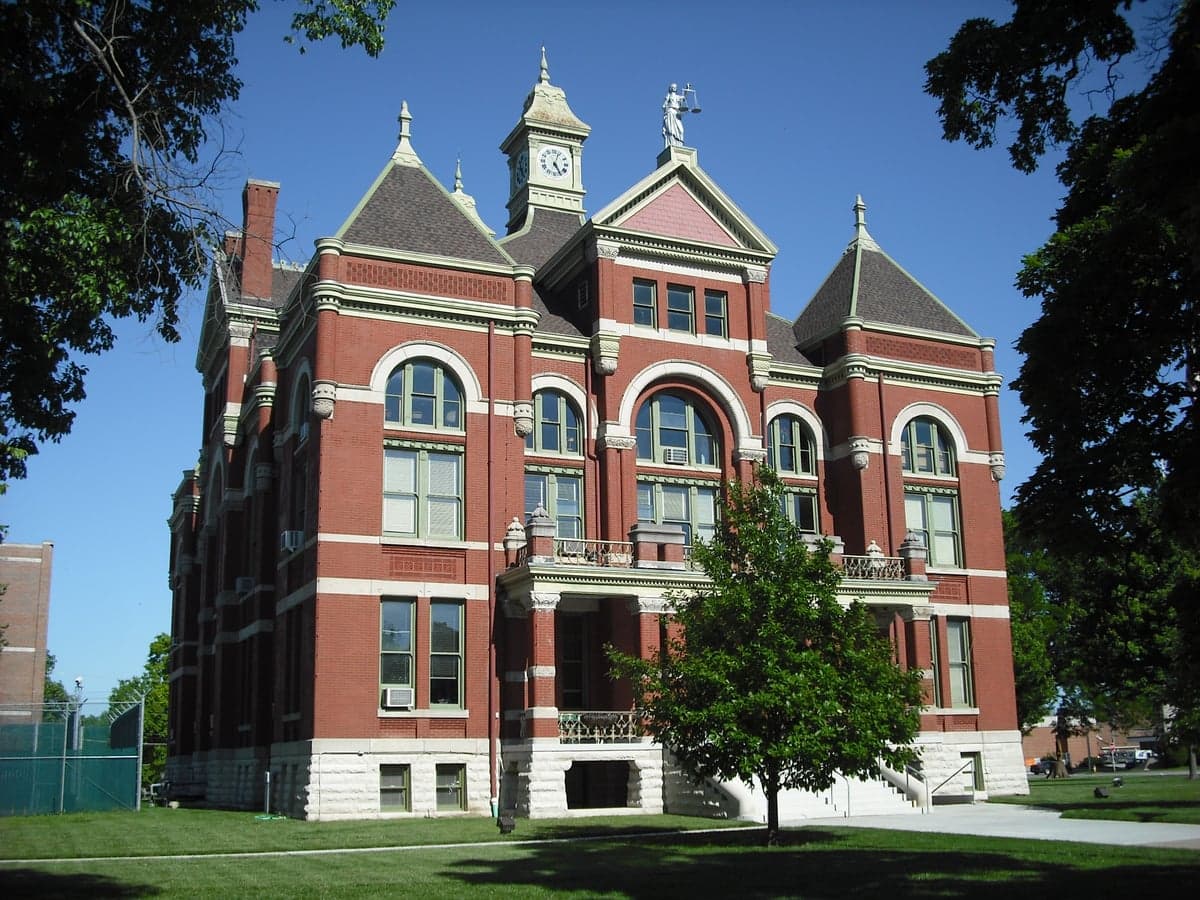
Photo: Wikipedia
Personal Sovereignty in Franklin County
Viable for self-reliance. Generally workable, though some barriers may limit total independence.
What does Personal Sovereignty tell us?
Personal Sovereignty measures your capacity for self-reliance and independence with minimal government friction. Higher scores mean fewer barriers between you and the way you want to live... but it assumes you have the space you need and good neighbors.
What does this tell us?
Personal Sovereignty measures your capacity for self-reliance and independence with minimal government friction. Higher scores mean fewer barriers between you and the way you want to live... but it assumes you have the space you need and good neighbors.
State Policy
Energy independence: Self-sufficient (80% of energy produced in-state)
Personal Liberty
Homesteading

Personal Liberty Analysis
Franklin County, Kansas, offers a notably high degree of personal sovereignty, grounded in the state’s strong tradition of local control and limited government intervention. The county’s regulatory posture is light, its tax burden is among the lowest in the region, and its legal framework strongly supports self-defense, parental rights, and property autonomy. For individuals and families seeking to minimize government involvement in daily life—from how they educate their children to how they build on their land—Franklin County presents a compelling environment that contrasts sharply with more heavily regulated urban centers in the Kansas City or Lawrence metro areas.
Tax burden and regulatory posture: How Franklin County compares to surrounding areas
Franklin County’s tax environment is a major draw for those prioritizing financial autonomy. The county’s mill levy is consistently lower than in neighboring Douglas County (home to Lawrence) and Johnson County (suburban Kansas City). Property taxes on a median-value home in Franklin County are roughly 20-25% lower than in those more populous counties, according to 2025 Kansas Department of Revenue data. There is no local income tax, and the state’s flat income tax rate of 5.25% applies uniformly. The regulatory posture is similarly light-touch. Zoning is minimal outside of the incorporated cities of Ottawa (the county seat), Wellsville, Pomona, Williamsburg, and Richmond. Unincorporated areas have no county-wide building codes, meaning property owners in rural sections near Princeton or Lane can construct sheds, workshops, or dwellings without permits, as long as basic septic and well regulations are met. This stands in stark contrast to the strict permitting and inspection regimes found in Lawrence or Overland Park.
Self-defense and gun law specifics: Constitutional carry and castle doctrine in Kansas
Kansas is a constitutional carry state, meaning no permit is required to carry a concealed firearm for anyone legally allowed to possess one. Franklin County fully aligns with this framework. The county sheriff’s office in Ottawa issues concealed carry permits for reciprocity purposes, but there is no local ordinance restricting open or concealed carry beyond state law. The state’s castle doctrine is robust: there is no duty to retreat in any place where a person is lawfully present, and the use of deadly force is presumed justified if an intruder has unlawfully entered a dwelling, vehicle, or occupied structure. Franklin County’s gun culture is deeply ingrained; shooting ranges and gun shops are common, particularly along the US-59 corridor between Ottawa and Garnett. The county has no local ammunition taxes, no magazine capacity restrictions, and no waiting periods beyond the federal background check. For a reader prioritizing self-defense rights, Franklin County offers one of the most permissive legal environments in the Midwest.
Self-reliance and homesteading viability: Lot sizes, zoning, and off-grid feasibility
Homesteading and off-grid living are highly viable in Franklin County, especially outside its incorporated towns. In unincorporated areas, minimum lot sizes for rural residential parcels are typically 1 to 5 acres, but larger tracts of 10 to 40 acres are common and affordable—often priced at $3,000 to $6,000 per acre as of early 2026. There are no county-level restrictions on rainwater collection, composting toilets, or solar panel installation. Off-grid feasibility is strong: the county’s rural areas have ample groundwater for wells, and the Kansas Corporation Commission does not require connection to the electrical grid if a property owner generates their own power. However, within city limits—particularly in Ottawa and Wellsville—zoning codes are more restrictive. Ottawa, for example, requires minimum lot sizes of 6,000 square feet in residential zones and has building permit requirements for any structure over 120 square feet. In contrast, properties near Richmond or Williamsburg face virtually no such constraints, making those areas far more attractive for those seeking maximum self-reliance. The county’s agricultural zoning also allows for keeping livestock—chickens, goats, even cattle—on parcels as small as 3 acres, provided setback rules are followed.
Personal liberties: Parental rights, medical autonomy, speech, and property
Franklin County operates within Kansas’s broader legal framework, which strongly favors parental rights and medical autonomy. The state has no vaccine mandates for school attendance beyond standard childhood immunizations, and parents can opt out for medical or religious reasons with minimal paperwork. Kansas law also prohibits mask mandates by local health departments without county commission approval, a stance that has been consistently upheld since 2021. In terms of medical autonomy, the state does not require a prescription for most over-the-counter medications, and telemedicine access is broad. Free speech protections are robust; the county has no local ordinances restricting political signage, leafleting, or public assembly beyond state traffic and noise laws. Property rights are similarly strong: Kansas’s eminent domain laws are among the most restrictive in the nation, requiring a public purpose and just compensation, and Franklin County has not pursued any controversial takings in recent memory. The county’s school board in Ottawa USD 290 has maintained a policy of transparency in curriculum materials, and parental notification for any health services provided on campus is standard practice.
Overall, Franklin County ranks among the top 20% of Kansas counties for personal sovereignty, according to a 2025 analysis by the Kansas Policy Institute. Its combination of low taxes, minimal regulation, strong self-defense laws, and high homesteading feasibility places it well ahead of more urbanized counties like Douglas or Johnson. For a conservative-leaning individual or family seeking a place where government footprint is small and personal autonomy is the default, Franklin County—particularly its rural stretches near Princeton, Lane, and Richmond—offers a level of freedom that is increasingly rare in the broader Kansas City region.

* Values derived from national, state, county, city and local statistics and may differ in a specific area. Last updated: 2026-07-02T20:13:31.000Z
Narrative content on this page is AI-generated and may contain mistakes. Verify any details that matter before acting on them.
ReloMaps may earn a commission from affiliate links at no extra cost to you.

