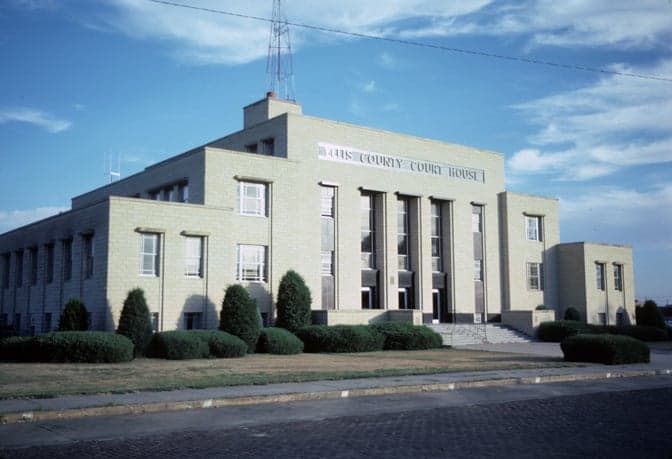
Photo: Wikipedia
Political ClimatePolitical Climate in Ellis County
Showing district-level results — no local-only data available.
Local Political AnalysisPolitical Analysis of Ellis County
Ellis County, Kansas, is a reliably Republican stronghold, carrying a Cook Partisan Voting Index (PVI) of R+16, which is significantly more conservative than the state of Kansas as a whole, which sits at R+9. This means that in a typical election, Republican candidates can expect to win by a margin roughly seven points wider in Ellis County than they do statewide. The county has been trending redder over the past decade, driven largely by the rural and small-town character of its communities, though there are subtle variations in political leanings between its towns and precincts.
How it compares
Compared to the rest of Kansas, Ellis County is a deeper shade of red. While the state's R+9 PVI reflects a mix of urban, suburban, and rural areas—with places like Johnson County and Lawrence providing a counterbalance—Ellis County's R+16 is more uniform. The county seat, Hays, is the largest city and the political bellwether. Hays itself leans Republican but is more moderate than the surrounding rural areas. For example, precincts in central Hays, particularly around the Fort Hays State University campus, have shown a slight Democratic lean in recent presidential elections, often breaking 45-48% for Democratic candidates. In contrast, the smaller towns like Victoria, Gorham, and Catharine are deeply conservative, regularly voting 70% or more for Republican candidates. The swing precincts are not in the rural areas but in the newer subdivisions on the outskirts of Hays, where voters tend to be more moderate and can shift the county's overall margin by a few points in a close race.
What this means for residents
For conservative residents, Ellis County feels like a natural fit. Local government, county commission, and school board seats are overwhelmingly held by Republicans, and conservative values are reflected in public policy, from tax rates to land-use regulations. A conservative can expect to see their views represented in local news, church sermons, and community gatherings. For liberal residents, the reality is more nuanced. While they are a clear minority, they are not isolated. The presence of Fort Hays State University brings a steady stream of younger, more progressive faculty and students, creating pockets of liberal thought, especially in Hays. Liberal residents often find community through university events, local arts organizations, and a few downtown coffee shops. They may feel their voices are less heard in county-level decisions, but they can still participate actively in city council races in Hays, where a more moderate candidate can sometimes win. The key is that political disagreement here is generally civil; it's a small county where people know each other, and partisan divides rarely override personal relationships.
Cultural and policy distinctions
One of the most telling cultural distinctions in Ellis County is the strong influence of the Catholic Church, particularly in towns like Victoria and Hays. This religious heritage shapes local policy debates, especially around social issues like abortion and education, where the county's stance is consistently conservative. Another distinction is the county's deep-rooted agricultural and energy economy. The oil and gas industry is a major employer, and this directly influences political priorities: residents strongly favor policies that support energy development and oppose heavy environmental regulations. You'll also notice a strong sense of local independence. There's a general skepticism of state-level mandates from Topeka, whether they come from a Republican or Democratic governor. This means that while the county votes Republican, it's not a rubber stamp for the state party; local leaders often push back on state policies they see as infringing on local control, especially regarding land use and school funding. In practice, this creates a political climate that is conservative but pragmatic, where the focus is on what works for the community rather than strict party ideology.

State Political ClimatePolitical Climate in Kansas
State Political AnalysisPolitical Environment in the State
Kansas is a solidly Republican state with a Cook PVI of R+9, but that blanket label hides a deeply divided political landscape that has shifted significantly over the past two decades. The state’s dominant coalition is a mix of rural conservatives, suburban moderates, and a growing libertarian-leaning wing, but the real story is the widening gap between the fast-growing, more moderate suburbs of Johnson County and the deeply red, shrinking rural counties. Over the last 10-20 years, Kansas has swung from a reliably red state with a moderate Republican tradition to a more polarized, hard-right stronghold in the legislature, even as its statewide elections have remained competitive, with Democrats winning the governorship in 2018 and 2022.
Urban vs. rural divide
The political map of Kansas is a classic tale of two states. The eastern third, anchored by the Kansas City metro area, is the state’s blue and purple heart. Johnson County, the state’s wealthiest and most populous county, has been trending Democratic for years—it voted for Joe Biden in 2020 and has sent moderate Republicans and Democrats to the legislature. Wyandotte County (Kansas City, Kansas) and Douglas County (Lawrence, home to the University of Kansas) are solidly Democratic. In contrast, the rest of the state is overwhelmingly Republican. Sedgwick County (Wichita) is a bellwether—it leans red but has a sizable moderate and Democratic base, especially in the city itself. The rural west and central plains, places like Garden City, Dodge City, and Hays, are deeply conservative, often voting 70-80% Republican. The divide isn’t just about party—it’s about culture. Johnson County residents are more likely to prioritize education funding and moderate social policies, while rural voters focus on gun rights, agricultural policy, and opposition to government overreach. The state’s recent political fights—over tax cuts, school funding, and abortion—have all been shaped by this urban-rural tension.
Policy environment
Kansas’s policy environment is a mix of conservative ambition and practical moderation. The state has a flat income tax rate of 5.7% (as of 2025), a result of the 2012 “Brownback tax cuts” that slashed rates and eliminated taxes on pass-through business income, leading to massive budget shortfalls before being partially reversed in 2017. The state sales tax is 6.5%, but local add-ons can push it over 10% in some cities. Property taxes are relatively high compared to neighboring states, funding local schools and services. Education policy is a perennial battleground: the Kansas Supreme Court has repeatedly ruled that the state’s school funding formula is inadequate, forcing the legislature to increase spending. On social issues, Kansas is conservative: it has a near-total abortion ban (the “Value Them Both” amendment was rejected by voters in 2022, but the legislature passed a ban on most abortions after 22 weeks and has strict regulations on clinics). Gun laws are among the most permissive in the nation—constitutional carry (no permit needed to carry a concealed firearm) was enacted in 2015, and there are no state-level red flag laws. Election laws have tightened: a 2021 law requires photo ID for voting, limits ballot drop boxes, and shortens the mail-in ballot window. The state also has a right-to-work law and is a “no cause” eviction state, meaning landlords can evict tenants without giving a reason after a lease ends.
Recent policy direction
The last five years have seen Kansas lurch rightward on most fronts, but with notable exceptions. Gun and self-defense law expanded further in 2023 with a law allowing concealed carry on public college campuses (though private universities can opt out). Parental and education rights have been a flashpoint: the legislature passed a “Parents’ Bill of Rights” in 2023, requiring schools to notify parents about curriculum changes and allowing them to opt their children out of certain materials. A 2022 law banned transgender girls from participating in girls’ sports in K-12 schools. Medical and bodily autonomy is sharply restricted: the abortion ban includes no exceptions for rape or incest, only to save the mother’s life. Medical marijuana remains illegal, though a limited CBD program exists. Property rights are strong—Kansas is a “Dillon’s Rule” state, meaning local governments have only the powers explicitly granted by the state, but there’s been a push to limit local zoning authority over renewable energy projects. Taxation is trending downward: the 2024 session saw a cut to the state income tax rate from 5.7% to 5.5% (phased in) and an expansion of the child tax credit. Voting and ballot access has tightened: the 2021 law also banned the mailing of unsolicited absentee ballot applications, a practice used widely during the pandemic. On privacy and surveillance, Kansas has no statewide data privacy law, but a 2023 law restricts the use of facial recognition technology by law enforcement without a warrant. The overall direction is toward more individual liberty on guns and property, less on bodily autonomy, and a cautious approach to government transparency.
Civil unrest & political movements
Kansas has seen its share of political flashpoints, but they tend to be more institutional than street-level. The most visible recent unrest was the 2022 abortion rights protests after the Dobbs decision, which drew thousands to the Statehouse in Topeka and to rallies in Overland Park and Lawrence. These were largely peaceful but intense, with counter-protests from anti-abortion groups. The 2020 Black Lives Matter protests in Wichita and Kansas City, Kansas saw some property damage and arrests, but were smaller than in major coastal cities. On the right, the “Free State” movement has a long history in Kansas, but modern libertarian and constitutionalist groups are active, especially in rural areas like Leavenworth and Emporia, where “sovereign citizen” rhetoric occasionally surfaces. Immigration politics are less heated than in border states, but Garden City and Dodge City have large immigrant populations (mostly from Central America and Southeast Asia), and local law enforcement generally avoids entanglement with federal immigration authorities—there are no sanctuary city policies, but also no aggressive enforcement. Election integrity controversies flared after 2020, with a few county-level audits and a failed push for a full hand recount in 2022. The most notable political movement is the rise of the “Moderate Republican” faction in Johnson County, which has successfully blocked some of the most extreme legislation and kept the state from becoming a one-party autocracy. A new resident would notice the political divide mostly in conversations—rural Kansans are proud of their independence, while suburbanites are more concerned with schools and taxes.
Projection
Over the next 5-10 years, Kansas is likely to become more politically competitive, but not necessarily more liberal. The key driver is demographic: Johnson County is growing fast, attracting young professionals and remote workers from the coasts, and it will continue to trend Democratic. This will make statewide races tighter—the governorship and Senate seat are already in play. However, the state legislature is gerrymandered to favor rural areas, so the GOP will likely maintain control there. The real wildcard is the state’s fiscal health: the tax cuts of the 2010s left Kansas with chronic underfunding of schools and infrastructure, and the next recession could force a reckoning. On social issues, the abortion ban is likely to remain, but there may be incremental expansions of exceptions (e.g., for rape) if public pressure builds. Gun laws will stay permissive, but a federal red flag law could override state policy. The libertarian streak in Kansas—skepticism of both big government and social engineering—will continue to shape policy, meaning the state will resist both progressive overreach and theocratic impulses. Someone moving in now should expect a state that is politically divided but functional, where your experience depends heavily on where you live: a liberal bubble in Lawrence, a moderate suburb in Overland Park, or a conservative small town in the west.
For a new resident, the bottom line is that Kansas offers a high degree of personal freedom in many areas—gun rights, low taxes, limited regulation—but also significant restrictions on others, especially reproductive rights. The political climate is stable but contentious, and your day-to-day life will be shaped more by your local community than by Topeka. If you’re conservative, you’ll find a welcoming environment in most of the state; if you’re liberal, you’ll find your people in the eastern cities and suburbs, but you’ll need to accept that state policy will often run against your preferences. The state’s trajectory is toward more polarization, but also more competition, which means your vote will matter more here than in a deep blue or deep red state.
* Values derived from national, state, county, city and local statistics and may differ in a specific area. Last updated: 2026-07-08T01:56:41.000Z
Narrative content on this page is AI-generated and may contain mistakes. Verify any details that matter before acting on them.
ReloMaps may earn a commission from affiliate links at no extra cost to you.

