
Photo: Wikipedia
Personal Sovereignty in Ellis County
Viable for self-reliance. Generally workable, though some barriers may limit total independence.
What does Personal Sovereignty tell us?
Personal Sovereignty measures your capacity for self-reliance and independence with minimal government friction. Higher scores mean fewer barriers between you and the way you want to live... but it assumes you have the space you need and good neighbors.
What does this tell us?
Personal Sovereignty measures your capacity for self-reliance and independence with minimal government friction. Higher scores mean fewer barriers between you and the way you want to live... but it assumes you have the space you need and good neighbors.
State Policy
Energy independence: Self-sufficient (80% of energy produced in-state)
Personal Liberty
Homesteading

Personal Liberty Analysis
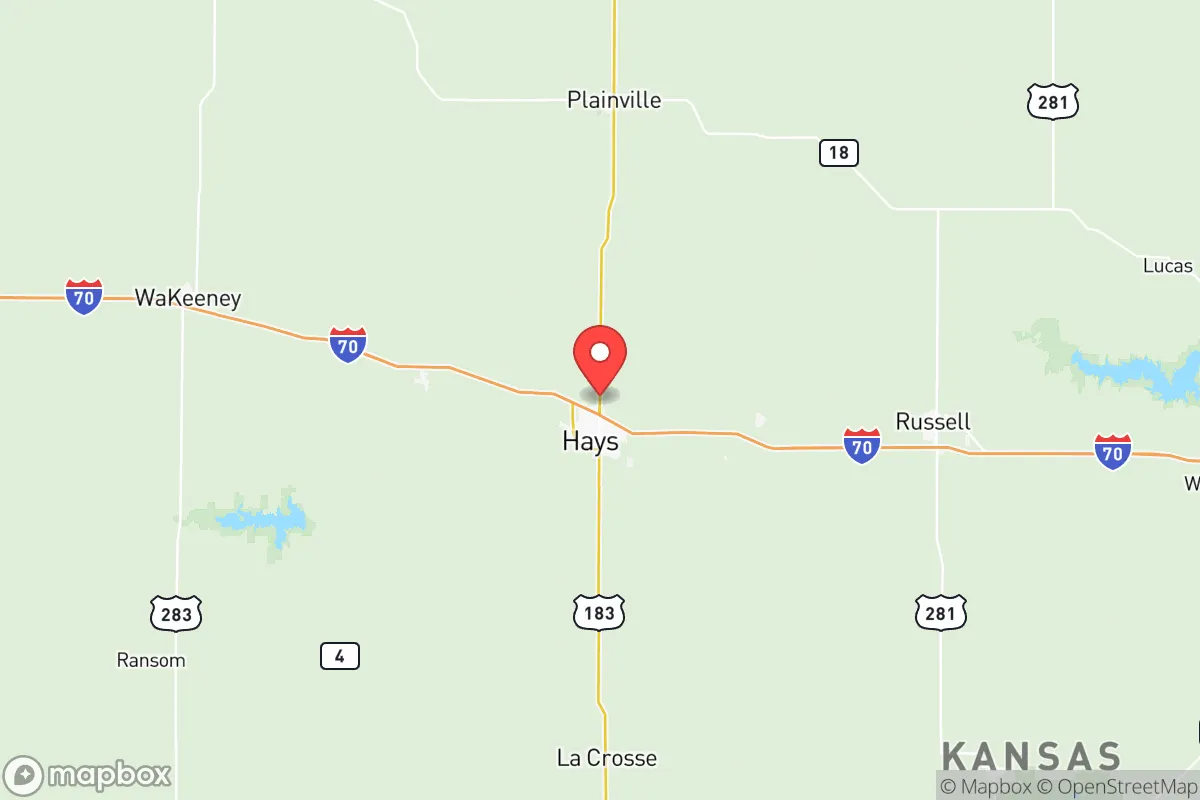
Ellis County, Kansas, anchored by the city of Hays, offers a personal sovereignty environment that is distinctly more hands-off than what many relocating families and individuals encounter in coastal or metropolitan areas. The county’s regulatory posture, tax structure, and cultural norms consistently prioritize individual decision-making over government intervention, making it a compelling option for those who value self-reliance. While not a libertarian utopia, the practical autonomy available here—from firearm laws to homesteading feasibility—places Ellis County among the more freedom-respecting jurisdictions in the Great Plains region.
Tax burden and regulatory posture: How Ellis County compares to Kansas and the nation
Ellis County’s tax burden is moderate by national standards but notably lighter than in high-tax states like California, New York, or Illinois. The county’s property tax rate averages around 1.2% of assessed value, which is slightly below the Kansas state median. For a $200,000 home, that translates to roughly $2,400 annually—a figure that undercuts many suburban counties in the Northeast and West Coast. The state of Kansas imposes a flat income tax rate of 5.7% as of 2026, but Ellis County itself levies no additional local income tax. Sales tax in Hays, the county seat, is 8.5% (state plus local), which is typical for rural Kansas but higher than in unincorporated areas like Victoria or Schoenchen, where only the state rate of 6.5% applies. Regulatory posture is consistently light-touch. Ellis County operates under Kansas’s “Dillon’s Rule” framework, meaning local governments have only powers expressly granted by the state, but in practice, county commissioners and city councils in Hays, Ellis, and Pfeifer rarely impose additional business licensing or zoning hurdles beyond what state law requires. Building permits in unincorporated areas are minimal, and home-based businesses face few restrictions compared to urban counties. The county’s approach to land use is permissive: agricultural and residential uses mix freely outside city limits, and there is no county-wide planning commission that dictates property aesthetics or setbacks.
Self-defense and gun law specifics: What the Second Amendment looks like in Ellis County
Kansas is a constitutional carry state, and Ellis County fully reflects that posture. No permit is required to carry a concealed firearm for any law-abiding adult 21 or older. The county sheriff’s office in Hays issues concealed carry licenses for reciprocity purposes, but the process is shall-issue and typically completed within 30 days. Open carry is legal without a permit statewide, and Ellis County has no local ordinances restricting it—unlike some Kansas cities such as Lawrence or Kansas City. Stand-your-ground laws apply, with no duty to retreat in any place where a person has a legal right to be. Castle doctrine protections extend to vehicles and occupied structures. Gun ranges are accessible: the Hays Shooting Sports Complex offers a public 300-yard rifle range and pistol bays, while private land in areas like Catherine and Munjor is commonly used for informal target practice. The county’s gun culture is practical rather than performative; firearms are viewed as tools for self-defense, hunting, and varmint control. There are no magazine capacity restrictions, no firearm registration requirements, and no waiting periods for purchases. For a family moving from a restrictive state like California or New Jersey, the legal environment here represents a significant expansion of personal sovereignty in self-defense matters.
Self-reliance and homesteading viability: Lot sizes, zoning, and off-grid feasibility
Ellis County’s geography and zoning code make it one of the more viable areas in Kansas for homesteading and off-grid living. Outside the incorporated limits of Hays, Ellis, and Victoria, there is no county-wide zoning that restricts building materials, minimum square footage, or the keeping of livestock. A typical rural parcel in the county runs 5 to 40 acres, with prices ranging from $2,000 to $4,000 per acre as of 2026—significantly cheaper than comparable land in Colorado or Texas. Off-grid feasibility is high: the county does not mandate connection to municipal water or sewer systems outside city limits. Wells and septic systems are standard, and solar panel installation requires no special permit beyond a standard electrical inspection. Rainwater collection is unrestricted. The county’s building code applies only to structural safety (foundation, framing, electrical), not to aesthetics or energy source. In areas like Schoenchen and Pfeifer, residents commonly heat with wood or propane, garden on half-acre plots, and keep chickens or goats without bureaucratic interference. The only notable restriction is that dwellings must meet International Residential Code standards for habitation, which is typical statewide. For those seeking a self-reliant lifestyle with minimal government oversight, the unincorporated parts of Ellis County offer a permissive environment that rivals more famous homesteading destinations like the Missouri Ozarks.
Personal liberties: Parental rights, medical autonomy, speech, and property
Kansas law provides strong protections for parental rights, and Ellis County’s school districts—primarily Hays USD 489 and Victoria USD 432—operate with a presumption of parental authority. The state’s Parents’ Bill of Rights, enacted in 2023, guarantees parents the right to direct their child’s education, medical care, and moral upbringing. School boards in Ellis County have not adopted controversial curriculum materials, and opt-out policies for sex education or sensitive content are straightforward. Medical autonomy is similarly robust: Kansas does not mandate COVID-19 or childhood vaccination for school attendance (though standard immunizations are required unless a medical or religious exemption is filed). The state has no mask mandates or business closure orders in effect as of 2026, and Ellis County commissioners have publicly stated they will not enforce any future federal health mandates. Free speech protections are standard under the First Amendment, and the county has no local hate speech ordinances or permit requirements for public gatherings. Property rights are strongly protected: Kansas is a “right to farm” state, meaning agricultural operations are shielded from nuisance lawsuits if they predate nearby residential development. Eminent domain is rarely used for private economic development, and the county assessor’s office in Hays is known for reasonable valuations. For a family or individual who values the ability to make decisions about their children’s education, their own healthcare, and their land without government second-guessing, Ellis County’s legal and cultural climate is distinctly favorable.
Overall, Ellis County ranks among the top 20% of U.S. counties for personal sovereignty, particularly when measured against the regulatory density of the Northeast, West Coast, and Front Range urban corridor. The combination of constitutional carry, permissive land-use rules, low property taxes, and strong parental rights creates an environment where individual autonomy is the default rather than the exception. While not as deregulated as some rural counties in Alaska or Nevada, Ellis County offers a practical, middle-America version of freedom that is immediately accessible to relocating families—especially those coming from states where government oversight touches daily life more heavily. For the reader who prioritizes self-reliance and minimal interference, this county warrants serious consideration.

* Values derived from national, state, county, city and local statistics and may differ in a specific area. Last updated: 2026-07-08T01:56:41.000Z
Narrative content on this page is AI-generated and may contain mistakes. Verify any details that matter before acting on them.
ReloMaps may earn a commission from affiliate links at no extra cost to you.

