Photo: Wikipedia
Political ClimatePolitical Climate in Johnstown, OH
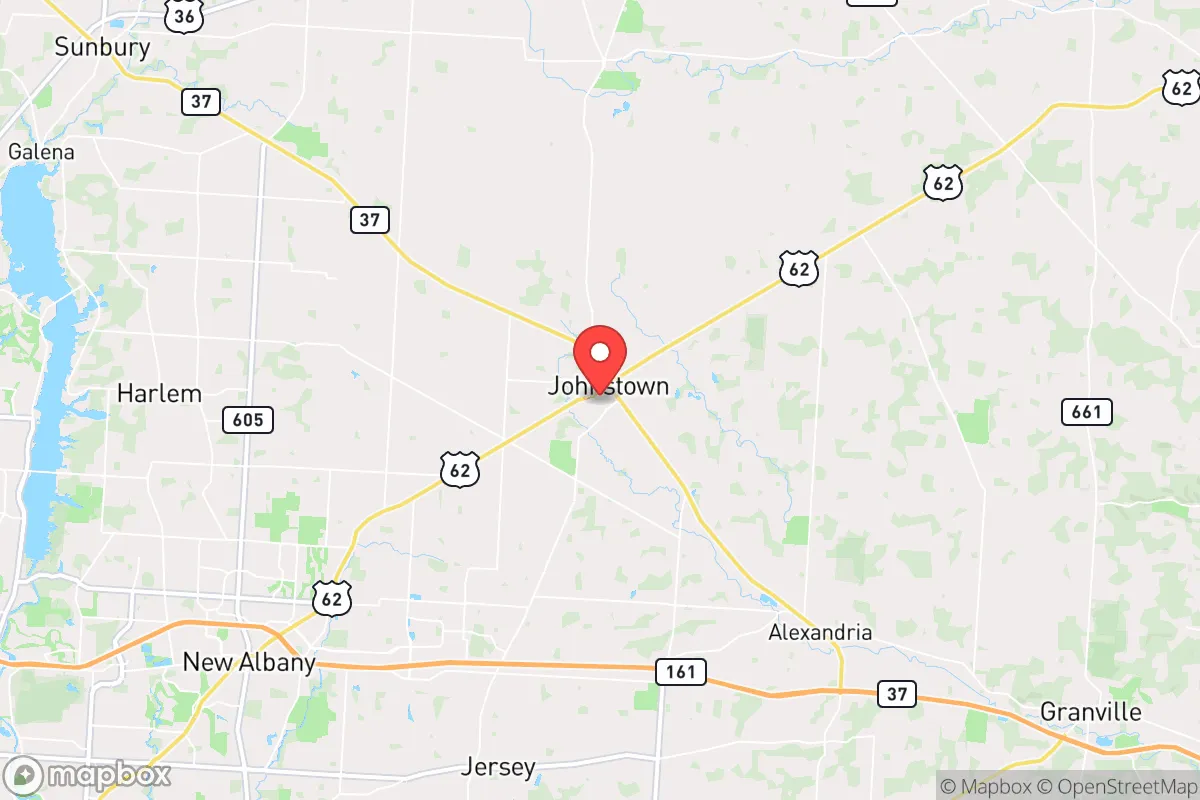
District shown is the primary district for this city’s centroid. Cities may span multiple districts.
Local Political AnalysisPolitical Analysis of Johnstown, OH
Johnstown, Ohio, is about as reliably Republican as any community in the state, with a Cook PVI of R+16 that puts it well to the right of the state’s already R+5 lean. That’s not a recent shift, either—this area has been solidly red for decades, and the numbers have only gotten more lopsided as the surrounding Licking County has grown and suburbanized. If you’re looking at a precinct map, Johnstown is a deep, dark red island in a county that’s trending redder, while places like Newark to the east or Columbus to the west offer a more mixed picture. The trajectory here is pretty clear: Johnstown is getting more conservative, not less, as new development brings in families who prioritize low taxes and a slower pace of life.
How it compares
Compared to Ohio as a whole, Johnstown is a political outlier even within a red state. The state’s R+5 PVI means Ohio is a competitive swing state at the presidential level—think 2020’s 8-point margin for Trump—but Johnstown’s R+16 is closer to what you’d see in deep-red rural counties like Mercer or Holmes. That gap matters: a Democrat running for statewide office might win Ohio by a few points, but they’d lose Johnstown by 20 or more. The contrast is even sharper when you look at nearby cities. Columbus, just 30 minutes west, has a PVI of D+20, making it one of the most liberal cities in the Midwest. Newark, about 15 miles east, is R+8—still red, but not as deep as Johnstown. So if you live here, you’re in a conservative bubble, but you’re also within easy driving distance of some of the most progressive areas in the state.
What this means for residents
For conservative residents, Johnstown is pretty close to ideal. Local elections are almost always decided in the Republican primary, and the school board, township trustees, and county commissioners all lean right. You’ll find plenty of churches, gun-friendly policies, and a general expectation that government stays small. For liberal residents, it’s a different story. You’re not going to be harassed or anything—this isn’t that kind of place—but you’ll be in a clear minority. There’s no real progressive infrastructure, no Democratic club, and your vote in local races won’t carry much weight. That said, Columbus is close enough that you can find your community there, and the cost of living in Johnstown is low enough that some liberals tolerate the political mismatch for the financial upside. The practical reality is that the area’s politics shape daily life in subtle ways: the local paper leans conservative, the public library is quiet on political issues, and most community events are church-affiliated or non-political.
One cultural distinction worth noting is that Johnstown’s conservatism is more of the practical, small-town variety than the fire-breathing, culture-war kind. People here care about taxes, schools, and property values more than national political drama. The big policy fights you see in Columbus or Washington don’t really land here with the same intensity. That might change as the area grows—new subdivisions are popping up, and some of the newcomers are bringing a more activist conservative style—but for now, Johnstown remains a place where politics is important but not all-consuming. If you’re moving here, you’ll find a community that’s politically homogeneous but not hostile, and that’s a rare balance in 2026.

State Political ClimatePolitical Climate in Ohio
State Political AnalysisPolitical Environment in the State
Ohio is a classic swing state that has shifted decisively to the right over the past decade, now carrying a Cook Partisan Voting Index of R+5. The state voted for Donald Trump by 8 points in both 2016 and 2020, and by a wider 11-point margin in 2024, cementing a trajectory that began with Barack Obama winning the state twice before it snapped back hard. The dominant coalition is a mix of working-class voters in small cities and rural areas, combined with a growing exurban and suburban conservative base, while the Democratic strongholds have shrunk to the urban cores of Cleveland, Columbus, and Cincinnati, plus a handful of college towns.
Urban vs. rural divide
The political map of Ohio is a textbook study in the urban-rural split. The three major metros — Cuyahoga County (Cleveland), Franklin County (Columbus), and Hamilton County (Cincinnati) — reliably vote Democratic, but their influence is diluted by the rest of the state. The real action is in the collar counties and exurbs: Delaware County, just north of Columbus, voted for Trump by 20 points in 2024, while Warren County northeast of Cincinnati went +35 for Trump. These are some of the fastest-growing areas in the state, filled with families and businesses fleeing the urban cores. Meanwhile, the Appalachian counties in the southeast — places like Meigs, Vinton, and Monroe — are among the most Republican in the nation, often voting 75-80% for Trump. The Democratic base is increasingly concentrated in the cities and a few college towns like Athens (home to Ohio University) and Oberlin, but even Columbus is seeing its suburbs drift rightward. The net effect is a state that looks purple on paper but feels red in practice, especially outside the 270 freeway loops.
Policy environment
Ohio's policy environment is broadly conservative but with some notable exceptions. The state has a flat income tax rate of 3.5% as of 2025, down from a top rate of nearly 5% a decade ago, and the state legislature is actively working toward eliminating the income tax entirely. Sales tax is 5.75% at the state level, with local add-ons pushing it to 7-8% in most cities. Property taxes are moderate but vary widely by district — expect to pay around 1.5% of assessed value in most areas. The state is a right-to-work state in practice if not in law, with a 2011 law (SB 5) that restricted collective bargaining for public employees being repealed by voters in a 2011 referendum, but union membership has continued to decline. Education policy is a major flashpoint: Ohio has one of the largest school voucher programs in the country, the EdChoice program, which allows students in underperforming public schools to use state funding for private or charter schools. The state also passed a "Parents' Bill of Rights" in 2023 (HB 8) that requires schools to notify parents about curriculum changes and medical services. On healthcare, Ohio expanded Medicaid under the Affordable Care Act in 2014, and that expansion remains in place, covering about 800,000 residents. Election laws have tightened: the state passed voter ID requirements in 2023 (SB 23) requiring a photo ID to vote in person, and reduced the window for absentee ballot requests from 90 days to 28 days before an election.
Recent policy direction
The last five years have seen Ohio move aggressively on several fronts. On gun rights, the state passed permitless carry (HB 227) in 2022, allowing any adult who can legally possess a firearm to carry it concealed without a license. Stand-your-ground laws have been on the books since 2008, and there is no state-level red flag law. On education and parental rights, HB 8 (2023) requires schools to adopt policies for notifying parents about "sexuality content" and prohibits instruction on sexual orientation or gender identity in grades K-3, similar to Florida's "Don't Say Gay" law. The state also passed a ban on gender-affirming care for minors (HB 68) in 2024, overriding a veto from Governor Mike DeWine. On abortion, Ohio became a national battleground: after the Supreme Court overturned Roe v. Wade in 2022, the state's 2019 "heartbeat bill" (SB 23) banning abortion after six weeks took effect, but voters overwhelmingly passed Issue 1 in November 2023, enshrining abortion rights in the state constitution with 57% of the vote. This was a major defeat for the Republican supermajority legislature, which had tried to raise the amendment passage threshold to 60% in a failed August 2023 special election. On taxes, the state has cut income taxes every year since 2019, with the goal of reaching a flat 2.75% rate by 2027. On voting, the photo ID requirement and reduced absentee window have been controversial, but the state also expanded early voting hours in 2024. Property rights are generally strong, with no statewide rent control and limited zoning reform, though some cities like Columbus have passed inclusionary zoning ordinances.
Civil unrest & political movements
Ohio has seen its share of political flashpoints. The 2020 protests in Columbus and Cleveland over George Floyd's death were large but largely peaceful, though there were instances of property damage and looting in downtown Columbus. The state has a strong and visible activist presence on both sides: the Ohio Organizing Collaborative and the Ohio Progressive Alliance are active on the left, while the Ohio Conservative Alliance and the Buckeye Firearms Association are powerful on the right. Immigration politics are relatively muted compared to border states, but there have been controversies over sanctuary policies — Cincinnati and Columbus have declared themselves "sanctuary cities" limiting cooperation with ICE, which has drawn legislative pushback. The state legislature passed a law in 2024 (HB 140) requiring local governments to cooperate with federal immigration enforcement or risk losing state funding. Election integrity has been a persistent issue: the 2020 election in Ohio was widely considered secure, but the 2024 election saw allegations of irregularities in Cuyahoga County, though no major fraud was proven. The most visible political movement in recent years has been the anti-abortion side's reaction to Issue 1's passage — there have been ongoing efforts to restrict abortion through other means, including a 2024 law requiring parental consent for minors seeking abortion, which is currently being challenged in court. The state also saw a significant "parents' rights" movement during the COVID-19 school closures, particularly in suburban districts like Olentangy and Mason, where school board meetings became heated over mask mandates and curriculum.
Projection
Over the next 5-10 years, Ohio is likely to continue its rightward drift, but with important caveats. The urban cores are losing population — Cleveland has lost about 5% of its residents since 2020 — while the exurbs and smaller cities are growing. Places like Delaware, Powell, and Liberty Township are seeing new subdivisions and commercial development, attracting families from higher-cost states like California and Illinois. This in-migration tends to be conservative-leaning, reinforcing the state's red shift. However, the passage of Issue 1 in 2023 shows that voters are willing to break with the legislature on specific issues, particularly abortion rights. The Republican supermajority is likely to remain in place through the 2030 redistricting cycle, meaning continued conservative policy on taxes, guns, and education. The wild card is Columbus: the city is growing rapidly, adding about 15,000 residents per year, and its Franklin County base is becoming more diverse and Democratic. If Columbus continues to grow while the rest of the state holds steady, it could eventually make Ohio more competitive at the statewide level. But for the foreseeable future, expect Ohio to be a solidly Republican state in presidential elections, with a conservative policy environment that is somewhat moderated by voter-initiated ballot measures on specific issues.
For a new resident, the bottom line is this: Ohio offers a conservative policy environment with low and falling taxes, strong gun rights, and a business-friendly regulatory climate, but with a safety valve in the form of citizen-initiated ballot measures that can override the legislature on hot-button issues like abortion. The state is politically stable — no one is predicting a sudden flip to blue — but it's not a monolith. If you live in Cleveland, Columbus, or Cincinnati, you'll experience a more liberal environment, especially on social issues. If you live in the suburbs or rural areas, you'll find a deeply conservative community that aligns with the state's overall direction. The key practical takeaway is that Ohio's politics are predictable and stable, with no major surprises expected in the next decade, making it a safe bet for someone who wants a conservative-leaning state without the extremes of the Deep South or the volatility of a true swing state like Arizona or Georgia.
* Values derived from national, state, county, city and local statistics and may differ in a specific area. Last updated: 2026-07-15T00:20:41.000Z
Narrative content on this page is AI-generated and may contain mistakes. Verify any details that matter before acting on them.
ReloMaps may earn a commission from affiliate links at no extra cost to you.

