Photo: Wikipedia
Demographics of Jefferson, CO
Affluence Level in Jefferson, CO
An upper-middle-class area. Household wealth, education levels, and homeownership run ahead of national benchmarks.
People of Jefferson, CO
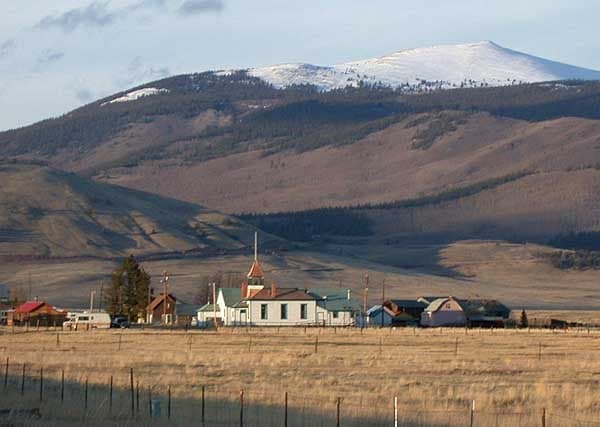
The people of Jefferson, Colorado today form a small, predominantly white community of 1,773 residents, with a notable East and Southeast Asian minority of 9.5% and a Hispanic population of 10.8%. The city is characterized by a high college attainment rate of 37.7% and a very low foreign-born share of just 1.8%, reflecting a stable, largely native-born population. Distinctive markers include a quiet, family-oriented atmosphere and a demographic profile that is more educated and less diverse than Colorado as a whole.
How the city was settled and grew
Jefferson was originally settled in the mid-19th century as a mining and agricultural supply point along the South Platte River, drawing Anglo-American homesteaders and prospectors during the Colorado Gold Rush. The town was formally platted in 1860 and grew slowly as a service hub for nearby ranches and mines. The original population was overwhelmingly of Northern European descent—English, German, and Irish—who built the early homes and businesses in the Historic Downtown Jefferson district, centered around Main Street. By the early 20th century, a small number of Mexican laborers arrived to work on railroad maintenance and in the beet fields, settling in what became known as the Riverbend Flats area south of the railroad tracks. The city remained a tiny, homogeneous farming community through the 1950s, with fewer than 500 residents.
Modern era (post-1965)
The post-1965 era brought modest change. The 1965 Hart-Cellar Act had little direct effect on Jefferson itself—the foreign-born share remains minimal—but the broader Denver metro area’s growth began to spill over. In the 1970s and 1980s, Jefferson attracted a wave of domestic in-migrants from the Midwest and California, drawn by lower housing costs and mountain access. These newcomers, mostly white and college-educated, settled in the Pine Ridge Estates subdivision on the town’s western edge, which was developed in the 1980s. The most significant demographic shift occurred in the 1990s and 2000s, when a small but visible East and Southeast Asian population—primarily of Chinese and Vietnamese ancestry—moved into the Meadow Creek neighborhood, attracted by proximity to tech and engineering jobs in the Denver-Boulder corridor. The Hispanic population, which had been present since the early 1900s, grew modestly from 8% to 10.8% between 2000 and 2020, concentrated in the older Riverbend Flats area. The Black population remains negligible at 0.6%, and there is no recorded Indian subcontinent population. The city’s white share, while still dominant at 79.1%, has declined from over 90% in 1990, reflecting the arrival of Asian and Hispanic families.
The future
Jefferson’s population is likely to remain small and stable, with slow growth driven by infill development rather than large-scale migration. The East and Southeast Asian community, while small, appears to be plateauing rather than expanding rapidly, as the Denver suburbs to the north offer more housing and job options. The Hispanic population is expected to grow gradually, potentially reaching 12-14% by 2040, but will likely remain concentrated in Riverbend Flats and the newer Sunset Mesa subdivision. The white population, while still the majority, will continue its slow decline as older residents age out and younger families move to larger metro areas. The city is not tribalizing into distinct enclaves—neighborhoods remain relatively integrated—but the Pine Ridge Estates area is becoming more uniformly white and affluent, while Riverbend Flats retains a working-class, Hispanic character. The foreign-born share is unlikely to rise significantly above 2-3%, given the lack of major employers or affordable housing stock to attract new immigrants.
For someone moving in now, Jefferson is becoming a quieter, more homogeneous small town with a stable, educated core and a modest but persistent Hispanic and Asian presence. It is not a place of rapid demographic change or cultural friction, but rather a community where long-term residents and newcomers alike value low crime, good schools, and mountain proximity. The city’s future is one of slow, organic growth—not transformation—making it a predictable choice for conservative-leaning families seeking stability over diversity.

* Values derived from national, state, county, city and local statistics and may differ in a specific area. Last updated: 2026-05-28T15:55:53.000Z
Narrative content on this page is AI-generated and may contain mistakes. Verify any details that matter before acting on them.
ReloMaps may earn a commission from affiliate links at no extra cost to you.

