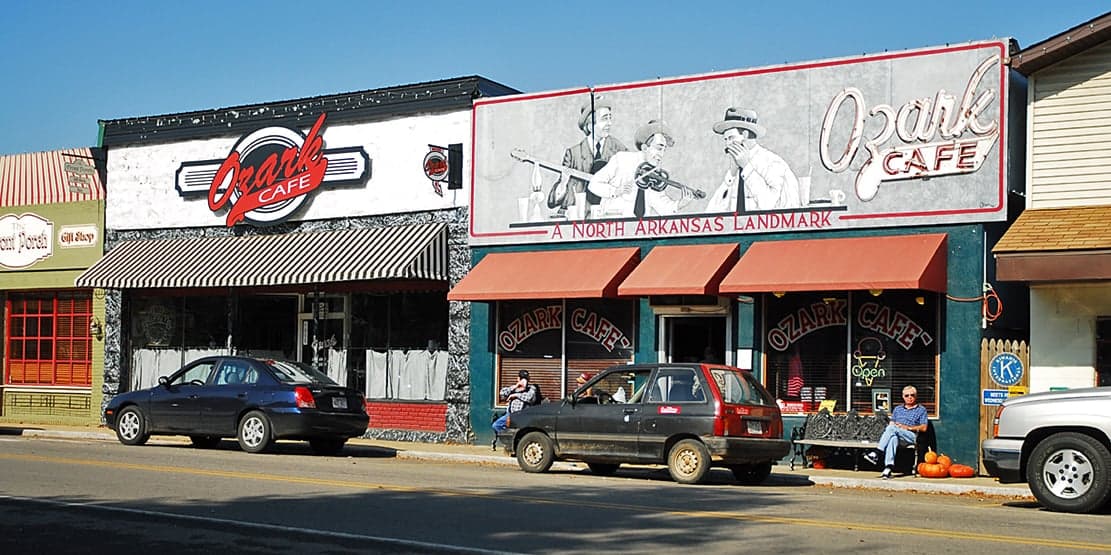
Photo: Wikipedia
Demographics of Jasper, AR
Affluence Level in Jasper, AR
A low-income area with significant economic hardship. Household wealth and educational attainment are well below national averages.
People of Jasper, AR
Jasper, Arkansas, is a small Ozark mountain community of 462 residents where the population is overwhelmingly white (87.0%) with a growing Hispanic minority (10.2%) and a small Black community (2.4%). The town has no foreign-born residents and a notably low college-educated share at just 4.0%, reflecting its working-class, rural character. Life here centers on the Newton County seat's courthouse square, the Buffalo National River tourism economy, and a culture shaped by generations of Scots-Irish hill families who arrived before the Civil War. This is a place where family surnames still match the original land grants, and newcomers are often asked which local family they belong to.
How the city was settled and grew
Jasper was founded in the early 1840s as the county seat of Newton County, carved from Carroll County in 1842. The original settlers were almost entirely Scots-Irish and English yeoman farmers who moved south from Tennessee, Kentucky, and Missouri along the old Cherokee Trace, seeking cheap land in the Boston Mountains. The town was named for a local veteran of the War of 1812, William Jasper, and grew slowly as a trading post and legal hub for the surrounding valleys. The first wave built homes in what is now the Courthouse Square Historic District, where the 1920s Newton County Courthouse still anchors the town, and along the ridge lines of Old Jasper Heights, where several original log cabins from the 1850s remain in private hands. The arrival of the railroad never reached Jasper — the rugged terrain kept the town isolated until Arkansas Highway 7 was paved through the mountains in the 1930s. That highway, later named a National Scenic Byway, brought the second significant wave: Depression-era families from the Dust Bowl plains who settled in the Highway 7 Corridor south of town, working as timber cutters and small-scale poultry farmers. Through the mid-20th century, Jasper's population hovered around 300, with nearly every resident tracing lineage to those original Scots-Irish and Dust Bowl families.
Modern era (post-1965)
The post-1965 era brought modest but measurable change to Jasper. The creation of the Buffalo National River in 1972 transformed the local economy from subsistence farming to tourism, drawing a new wave of in-migrants: retired veterans, outdoor recreation workers, and a small number of back-to-the-land homesteaders who bought cheap acreage in the 1970s. These newcomers concentrated in the Buffalo River Overlook District on the town's eastern edge, where vacation rental cabins and guide services now line the bluffs. The Hispanic population, now 10.2% of Jasper's residents, began arriving in the 1990s and 2000s, almost entirely as migrant labor for the region's poultry processing plants in nearby Green Forest and Berryville. These families settled in the South Jasper Flats area along the lower end of Main Street, where several Hispanic-owned grocery stores and a Pentecostal church now serve the community. The Black population, at 2.4%, is a very recent addition — a handful of families who moved in during the 2010s, largely employed by the National Park Service or the Newton County school district, and they live scattered across the West Hill Addition, a small residential subdivision built in the 1980s. Notably, Jasper has zero Asian, Indian, or foreign-born residents; the town remains almost entirely native-born American, and the racial shift since 1965 has been driven almost exclusively by Hispanic in-migration, not international immigration.
The future
Jasper's population is slowly diversifying, but the pace is glacial. The Hispanic share has grown from roughly 3% in 2000 to 10.2% today, driven by second-generation families staying in the area rather than new arrivals; many of these younger Hispanic residents are now fully English-speaking and attend the Newton County schools alongside their white peers. The white population is aging — the median age in Newton County is over 50 — and younger white residents are leaving for college and jobs in Fayetteville or Springfield, Missouri, a pattern that will likely continue. The Buffalo River Overlook District is seeing the most new construction, as short-term rental investors buy up lots, but this is seasonal housing, not permanent population growth. The South Jasper Flats area is the only part of town with a visible younger demographic, as Hispanic families have larger households and are more likely to have school-age children. Over the next 10-20 years, Jasper will likely remain a small, predominantly white town with a growing Hispanic minority that could reach 15-18% of the population. The college-educated share, at just 4.0%, is unlikely to rise significantly unless remote work brings a new wave of telecommuters — a trend that has so far bypassed Jasper in favor of larger towns like Harrison or Eureka Springs.
Jasper is becoming a slightly more diverse, slightly younger town at its margins, but the core character remains deeply rooted in its Scots-Irish Ozark heritage. For a family or individual moving in now, the practical reality is a community where church attendance, hunting seasons, and the Buffalo River define the social calendar, and where the growing Hispanic population is integrated into schools and local businesses without significant friction. The town offers a stable, safe, low-cost life, but newcomers should expect a place where the population is barely growing, the economy depends on tourism and poultry, and the nearest Walmart is a 45-minute drive away in Harrison.

* Values derived from national, state, county, city and local statistics and may differ in a specific area. Last updated: 2026-10-12T12:28:49.000Z
Narrative content on this page is AI-generated and may contain mistakes. Verify any details that matter before acting on them.
ReloMaps may earn a commission from affiliate links at no extra cost to you.

