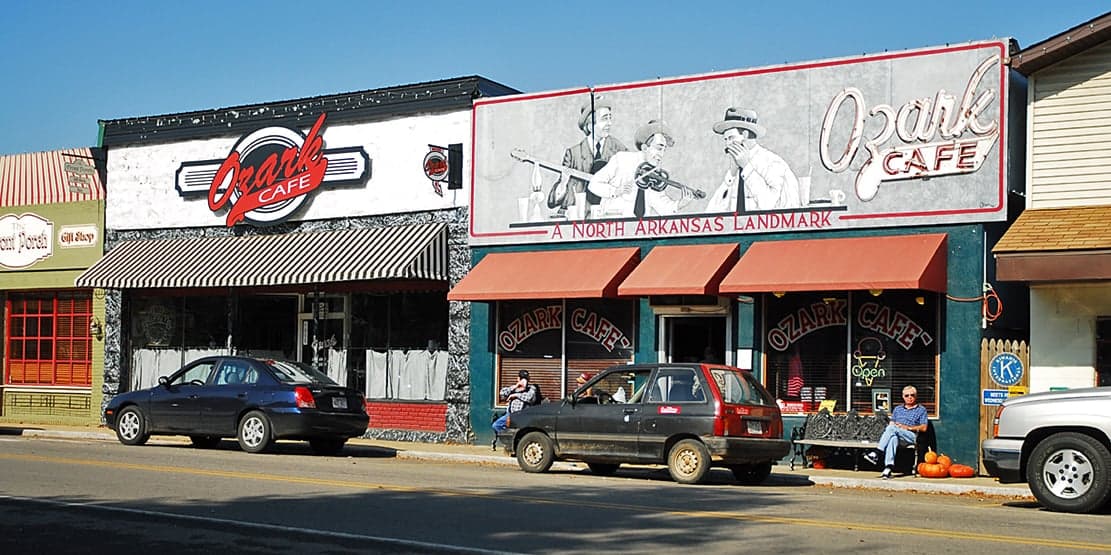
Photo: Wikipedia
Political ClimatePolitical Climate in Jasper, AR
District shown is the primary district for this city’s centroid. Cities may span multiple districts.
Local Political AnalysisPolitical Analysis of Jasper, AR
Jasper, Arkansas, sits in the heart of the Ozarks with a political identity that is deeply, reliably conservative — even by Arkansas standards. The area carries a Cook Partisan Voting Index (PVI) of R+20, meaning it votes about 20 points more Republican than the national average. That puts it a solid four points to the right of the state of Arkansas as a whole, which sits at R+16. In practice, this isn’t a purple patch of the map; it’s a place where Republican candidates routinely win by double digits, and the real political action happens in the primary, not the general election.
How it compares
To understand Jasper’s lean, it helps to look at the broader Arkansas landscape. The state’s R+16 PVI already makes it one of the most reliably red states in the country, but Jasper and the surrounding Newton County are a notch further right. The contrast is sharpest when you look east toward the Fayetteville-Springdale corridor, where Washington County has trended more competitive in recent cycles — a mix of university influence from the University of Arkansas and a growing professional class has made that area noticeably less conservative than the rest of the state. Jasper, by contrast, has none of that urban or academic pull. It’s a small mountain town where the economy leans on timber, tourism, and small-scale agriculture, and the cultural values align closely with the rural Southern identity that dominates the region. Even compared to nearby Harrison to the north or Clarksville to the south, Jasper tends to vote more uniformly Republican, with fewer of the moderate pockets you sometimes find in slightly larger county seats.
What this means for residents
For conservative residents, the political climate in Jasper is about as comfortable as it gets. Local offices, from the county judge to the quorum court, are almost entirely held by Republicans, and the policy priorities — low taxes, limited regulation, strong Second Amendment protections — are baked into the area’s identity. You won’t find much debate about that at the coffee shop or the hardware store. For liberal or moderate residents, the reality is different but not hostile. Jasper isn’t a place where you’ll be confronted or harassed for your views, but you will be in a clear minority, and you’ll likely find that most political conversations simply don’t happen in mixed company. That said, the area’s small size means relationships matter more than party labels; a neighbor who helps you haul firewood is still a neighbor, regardless of who they voted for. The trajectory here is stable — there’s no sign of the kind of demographic shifts that are slowly changing politics in other parts of the state, so the R+20 lean is likely to hold for the foreseeable future.
Culturally, Jasper is defined more by its geography than its politics. The Buffalo National River and the Ozark National Forest draw a steady stream of visitors, and that tourism economy creates a subtle tension between a desire to preserve the area’s quiet, traditional way of life and the need to accommodate outsiders. That’s the real policy debate in Jasper — not partisan squabbles, but how to balance growth with conservation. It’s a distinctly local conversation, and it’s one where a resident’s stance often has more to do with how long their family has been in the hills than with any national party platform. For anyone moving here, the takeaway is simple: if you’re conservative, you’ll feel right at home; if you’re not, you’ll find a welcoming community that just happens to vote overwhelmingly against your preferred candidates.

State Political ClimatePolitical Climate in Arkansas
State Political AnalysisPolitical Environment in the State
Arkansas has been a reliably Republican state for the past decade and a half, carrying a Cook Partisan Voting Index of R+16, meaning it votes about 16 points more Republican than the nation as a whole. The shift was seismic: as recently as 2008, Barack Obama won the state’s six electoral votes, but by 2012 Mitt Romney flipped it, and Donald Trump carried it by 27 points in 2020 and by roughly 30 points in 2024. The dominant coalition today is a mix of rural and small-town voters, evangelical Protestants, and a growing contingent of out-of-state transplants settling in the northwest corner of the state, all of whom have pushed the legislature into a solidly conservative, often supermajority, posture.
Urban vs. rural divide
The political map of Arkansas is a tale of two regions, with the northwest and the central corridor pulling in opposite directions. The Little Rock metro area, anchored by Pulaski County, is the state’s lone Democratic stronghold — it voted for Hillary Clinton in 2016 and Joe Biden in 2020, though by shrinking margins. The city itself, along with the suburbs of North Little Rock and Sherwood, is where most of the state’s Black voters and white-collar professionals live, and it consistently sends the only Democrats to the state legislature. Meanwhile, the real engine of Republican growth is Northwest Arkansas: the corridor from Fayetteville to Springdale to Rogers to Bentonville, home to Walmart’s headquarters and the University of Arkansas. This region was once competitive, but it has trended hard right as corporate transplants and retirees have moved in — Benton and Washington Counties now routinely deliver 60-65% Republican margins. The rest of the state, from Jonesboro in the northeast to Texarkana in the southwest, is deeply red, with counties like Searcy and White routinely hitting 80% Republican. The divide isn’t just urban versus rural; it’s the I-40 corridor versus everything else, with the Delta counties along the Mississippi River (like Phillips and Lee) remaining Democratic-leaning due to high Black populations, but with turnout too low to matter statewide.
Policy environment
Arkansas’s policy environment is unambiguously conservative, shaped by a legislature that has held a Republican supermajority in both chambers since 2012. The state has no income tax on capital gains for most filers, and the top marginal income tax rate was cut from 7% to 4.9% in 2023, with further cuts scheduled. Sales tax is around 6.5% statewide, but local add-ons push it higher in cities like Little Rock and Fayetteville. The regulatory posture is business-friendly — Arkansas is a right-to-work state, and permitting for new construction is notoriously fast, especially in the northwest. Education policy has been a flashpoint: the LEARNS Act of 2023, signed by Governor Sarah Huckabee Sanders, created a universal school voucher program, eliminated teacher tenure, and raised starting teacher pay to $50,000. Healthcare is a mixed bag — the state expanded Medicaid under the private option, but it has also imposed work requirements on able-bodied adults, and abortion is banned except to save the mother’s life, with no exceptions for rape or incest. Election laws are strict: voter ID is required, early voting runs for 15 days, and absentee ballots require a notarized signature or a copy of a photo ID. For a relocator, the practical takeaway is that Arkansas is a low-tax, low-regulation state where the government is actively trying to shrink its footprint, but where social policy is firmly in the hands of the conservative majority.
Recent policy direction
The last three years have seen Arkansas move decisively on a full spectrum of liberty issues, and the direction is unmistakable. On gun rights, the state became a Second Amendment sanctuary in 2021, and in 2023 it passed a permitless carry law, allowing any adult 18 or older to carry a concealed firearm without a license. On parental and education rights, the LEARNS Act is the headline — it not only created vouchers but also banned “indoctrination” in classrooms and required schools to post all instructional materials online for parental review. On speech, the legislature passed a law in 2023 requiring public libraries to create a process for challenging materials deemed “obscene,” and several counties have since moved to restrict LGBTQ-themed books. On privacy and surveillance, Arkansas banned TikTok on government devices in 2023 and passed a law requiring parental consent for minors to create social media accounts. On medical and bodily autonomy, the state has a near-total abortion ban, and in 2023 it banned gender-affirming care for minors, overriding a veto from the governor’s own party to do so. On property rights, the state passed a law in 2021 prohibiting foreign nationals from certain countries from buying agricultural land. On taxation, the income tax cuts are ongoing, and the state is phasing out the corporate franchise tax entirely. On voting, the legislature has tightened absentee ballot rules and shortened the cure period for mismatched signatures. The pattern is consistent: Arkansas is moving toward a model of maximum individual liberty on guns, property, and taxes, while imposing strict state control on social issues, education content, and medical choices for minors.
Civil unrest & political movements
Arkansas doesn’t see the kind of street-level political violence that makes national headlines, but it has its flashpoints. The most visible organized movement on the right is the county-level “sanctuary county” movement — over half of Arkansas’s 75 counties have declared themselves Second Amendment sanctuaries, and a handful have passed resolutions opposing federal gun control. On the left, the most active organizing is around abortion access and LGBTQ rights, centered in Little Rock and Fayetteville; there have been regular protests at the state capitol since the 2023 abortion ban, and the ACLU of Arkansas has filed multiple lawsuits that are still winding through the courts. Immigration politics are quieter than in border states, but the legislature passed a law in 2023 requiring local law enforcement to cooperate with federal immigration authorities, and a 2024 law made it a felony for a city to declare itself a sanctuary city. Election integrity has been a recurring theme — the 2022 secretary of state race was dominated by claims of voter fraud, and the state has since purged over 100,000 inactive voter registrations. A new resident would notice the political energy mostly in the form of yard signs, church bulletin announcements, and county fair booths — it’s a state where politics is lived through civic institutions rather than street protests.
Projection
Over the next five to ten years, Arkansas is likely to get more Republican, not less. The demographic trends are clear: the northwest corridor is growing at nearly double the state average, and the transplants moving in — many from California, Texas, and Illinois — are overwhelmingly conservative-leaning, drawn by low taxes and housing costs. The Delta counties are losing population, which shrinks the Democratic base. The only countervailing force is the growth of Fayetteville, which is a college town with a younger, more liberal population, but it’s a drop in the bucket against the rural and exurban growth elsewhere. The legislature will likely remain under Republican supermajority control through at least 2030, and the governor’s mansion is safe for the GOP for the foreseeable future. Expect further income tax cuts, continued school choice expansion, and more preemption of local ordinances — the state has already stripped Little Rock of its ability to raise its minimum wage or ban plastic bags. For a new resident, the practical implication is that Arkansas in 2035 will look very much like Arkansas in 2025, only more so: lower taxes, fewer regulations, and a social policy environment that is firmly conservative.
For a relocator, the bottom line is that Arkansas is a state where your political preferences will be either comfortably affirmed or quietly tolerated, depending on which side you land. If you’re conservative, you’ll find a state government that is actively working to lower your taxes, protect your gun rights, and give you more control over your kids’ education. If you’re liberal, you’ll find a state where your vote is unlikely to change statewide outcomes, but where cities like Little Rock and Fayetteville offer like-minded communities, and where the cost of living is low enough that you can afford the trade-off. The state is not politically competitive, and it’s not trending toward competitiveness — but it is stable, predictable, and, for most residents, a place where politics doesn’t intrude on daily life as much as it does in swing states. If you’re moving for jobs, land, or family, Arkansas will deliver on those fronts; just know that the political climate is baked in, and it’s not changing anytime soon.
* Values derived from national, state, county, city and local statistics and may differ in a specific area. Last updated: 2026-10-12T12:28:49.000Z
Narrative content on this page is AI-generated and may contain mistakes. Verify any details that matter before acting on them.
ReloMaps may earn a commission from affiliate links at no extra cost to you.

