Photo: Wikipedia
Political ClimatePolitical Climate in Woodbury County
Showing district-level results — no local-only data available.
Local Political AnalysisPolitical Analysis of Woodbury County
Woodbury County, anchored by Sioux City, is a Republican stronghold with a Cook PVI of R+15, making it significantly more conservative than Iowa as a whole, which sits at R+6. This isn't a new development; the county has been trending red for decades, but the shift has accelerated since the 2010s, driven largely by the rural precincts outside the urban core. While Sioux City itself provides a slight moderating influence, the county's overall trajectory is firmly rightward, with Democrats struggling to maintain relevance outside of a few specific wards.
How it compares
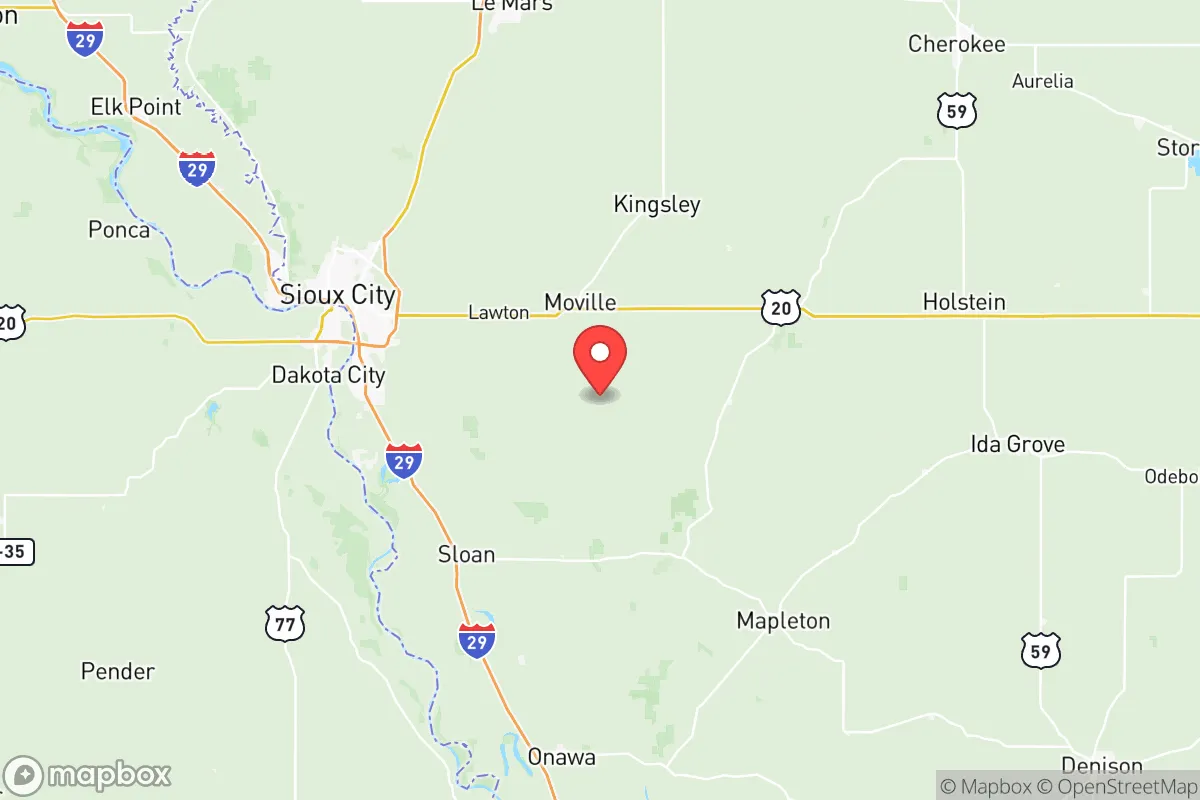
The R+15 rating places Woodbury County among the most Republican counties in northwest Iowa, far outpacing the state's overall R+6 lean. To put it in perspective, while Iowa is a competitive swing state in presidential elections, Woodbury County is reliably red. The difference is stark when you look at the map: the city of Sioux City, particularly its central and eastern neighborhoods, still leans blue, with precincts like those around Morningside College and the downtown core occasionally breaking for Democrats. However, the surrounding towns—Sergeant Bluff, Lawton, Moville, and Hinton—are deeply conservative, often voting 70% or more for Republican candidates. The swing precincts are few and far between; the most notable are in the fast-growing western edge of Sioux City near the interstate, where newer residents from more moderate areas have created a slightly more competitive environment. Still, these precincts are trending red, not blue.
What this means for residents
For conservative residents, the political climate is comfortable and affirming. Local offices—from the county board of supervisors to the sheriff's office—are almost entirely held by Republicans, and policy decisions reflect that, from tax rates to land-use regulations. The local Republican Party is well-organized and active, with regular events and a strong presence in the community. For liberal residents, the reality is more challenging. While Sioux City itself offers some refuge, progressive candidates rarely win countywide races, and issues like abortion access or environmental regulation are non-starters in local politics. That said, the county's Democratic Party maintains a small but dedicated base, primarily in Sioux City's older neighborhoods and among union households tied to the meatpacking plants. The practical effect is that liberal residents often focus their energy on city-level politics or state legislative races, where the district lines are drawn to give them a fighting chance in a few seats.
Culturally, Woodbury County is defined by its agricultural and industrial roots, with a strong emphasis on family, faith, and hard work. The county's politics are deeply intertwined with the local economy, which is dominated by agribusiness and manufacturing. This means that policy debates often center on issues like property taxes, ethanol mandates, and right-to-work laws, rather than the social issues that dominate national headlines. One notable distinction from the rest of Iowa is the county's significant Latino population, concentrated in Sioux City's south side, which has begun to shift some precincts toward the center-left, though not enough to change the overall balance. Looking ahead, the county's political trajectory seems set: as long as the rural precincts continue to grow more conservative and the urban core remains stagnant, Woodbury County will remain a deep red island in a purple state.

State Political ClimatePolitical Climate in Iowa
State Political AnalysisPolitical Environment in the State
Iowa has shifted from a classic purple swing state to a solidly Republican one, carrying a Cook PVI of R+6 after trending rightward for nearly two decades. The state voted for Barack Obama in 2008 and 2012, then flipped hard for Donald Trump in 2016 and 2020, and backed Trump again in 2024 by a comfortable margin. This realignment has been driven by a collapse of Democratic support in rural areas and small towns, combined with a slow but steady Republican consolidation in the suburbs, while only a handful of urban counties and college towns have grown more Democratic. For a relocator, the practical reality is that state government is firmly under unified Republican control, and the policy direction has been consistently conservative since about 2017.
Urban vs. rural divide
The political map of Iowa is a textbook case of the urban-rural split. The Democratic strongholds are concentrated in just a handful of places: Polk County (Des Moines), Johnson County (Iowa City), and Story County (Ames). These three counties contain the state's largest city, the flagship University of Iowa, and Iowa State University, and they vote blue by margins of 15 to 30 points. Outside those islands, the rest of the state is reliably red. The rural northwest and southwest, including counties like Sioux County and Plymouth County, are among the most Republican in the nation, often voting 70-80% for the GOP. The suburbs around Des Moines, such as Ankeny and Waukee, have been a key battleground; they were swing areas a decade ago but have moved rightward, particularly on cultural and education issues. Meanwhile, the Mississippi River counties in the east, like Dubuque and Scott County (Quad Cities), have trended Republican as union-aligned blue-collar voters shifted away from the Democratic Party. The net effect is a state where Democrats are almost entirely confined to three metro areas, giving Republicans a structural advantage in statewide races.
Policy environment
Iowa's policy environment reflects its Republican trifecta. The state has a flat income tax rate of 3.8%, down from a progressive top rate of 8.98% in 2021, with a scheduled phase-down to 3.5% by 2027. Property taxes are relatively low compared to the national average, and there is no inheritance tax. The regulatory posture is business-friendly, with a right-to-work law on the books and no state-level minimum wage above the federal $7.25. Education policy has been a flashpoint: Iowa enacted a universal school voucher program in 2023, allowing any student to use public funds for private school tuition. The state also passed a law banning instruction on gender identity and sexual orientation through grade six, and requiring schools to notify parents if a student requests a name or pronoun change. On healthcare, Iowa expanded Medicaid under the Affordable Care Act but has since imposed work requirements for able-bodied adults, and the state has some of the most restrictive abortion laws in the country, banning the procedure after about six weeks of pregnancy. Election laws have been tightened, with reduced early voting windows, stricter voter ID requirements, and a ban on drop boxes for absentee ballots.
Recent policy direction
The last five years have seen a rapid acceleration of conservative legislation. On gun rights, Iowa became a permitless carry state in 2021, meaning any legal resident can carry a concealed firearm without a permit or training. On parental rights and education, the 2023 "Parents Bill of Rights" law requires schools to obtain parental consent before administering surveys on mental health or sexuality, and it mandates that instructional materials be posted online for public review. On speech and privacy, the state passed a law in 2024 restricting the use of TikTok on government devices and public university networks. On medical and bodily autonomy, the six-week abortion ban took effect in 2023 after a court ruling, with no exceptions for rape or incest. On property rights, Iowa has a strong eminent domain protection law passed in 2006, limiting the use of condemnation for private economic development. On taxation, the 2022 tax reform bill accelerated income tax cuts and eliminated the inheritance tax entirely. On voting and ballot access, the 2021 election integrity law shortened the absentee ballot request window to 15 days before an election and required absentee ballots to be received by election day, not just postmarked. The overall direction is toward lower taxes, expanded gun rights, school choice, and tighter election procedures.
Civil unrest & political movements
Iowa has not seen the kind of large-scale civil unrest seen in coastal states, but there have been notable flashpoints. The 2020 Black Lives Matter protests in Des Moines and Iowa City were significant, with several nights of demonstrations and some property damage, but they were smaller than in major metros. The state has been a focal point for the anti-vaccine mandate movement, with large rallies at the state capitol in 2021 and 2022. Immigration politics are less visible here than in border states, but there have been controversies over meatpacking plant raids, particularly in Postville and Storm Lake, where immigrant labor is concentrated. There is no sanctuary city policy anywhere in Iowa; in fact, a 2024 state law requires local law enforcement to cooperate with federal immigration authorities. Election integrity controversies have been relatively muted compared to states like Arizona or Georgia, though the 2020 audit of Linn County (Cedar Rapids) drew attention after discrepancies were found and later resolved. The most visible political movement in recent years has been the Moms for Liberty chapter activity in suburban school board races, particularly in Ankeny and Waukee, where fights over library books and curriculum have been intense.
Projection
Over the next five to ten years, Iowa is likely to become more Republican, not less. The demographic trends are working against Democrats: the state's population is aging, rural areas are depopulating, and the young college graduates who do stay tend to cluster in Des Moines and Iowa City but not in numbers large enough to flip statewide races. In-migration is modest and comes mostly from neighboring Midwest states, not from high-cost blue states, so there is no liberal influx to shift the balance. The Republican Party's grip on the legislature is strong enough to withstand a bad cycle, and the state's congressional delegation is likely to remain 4-0 or 3-1 Republican. The wild card is the suburbs: if the GOP overplays cultural issues like book bans and transgender restrictions, they could alienate moderate suburban women in places like West Des Moines and Cedar Falls. But for now, the trajectory is clearly rightward. A relocator moving in now should expect a state where conservative policy continues to deepen, with lower taxes, expanded school choice, and further restrictions on abortion and transgender rights.
For a new resident, the bottom line is that Iowa offers a stable, predictable conservative governance environment with low taxes and a business-friendly climate. Liberal residents will find themselves in a clear minority outside of Des Moines, Iowa City, and Ames, and will face a policy landscape that is actively moving against their preferences on abortion, education, and gun rights. Conservative residents will find a state where their values are reflected in law and where the political trajectory is aligned with their priorities. The practical takeaway is that Iowa is no longer a swing state; it is a reliably red state with a few blue islands, and anyone moving here should understand that reality before they arrive.
* Values derived from national, state, county, city and local statistics and may differ in a specific area. Last updated: 2026-06-26T15:41:10.000Z
Narrative content on this page is AI-generated and may contain mistakes. Verify any details that matter before acting on them.
ReloMaps may earn a commission from affiliate links at no extra cost to you.

