Photo: Wikipedia
Demographics of Woodbury County
Affluence Level in Woodbury County
A middle-class area roughly in line with national averages across income, home values, education, and employment.
People of Woodbury County
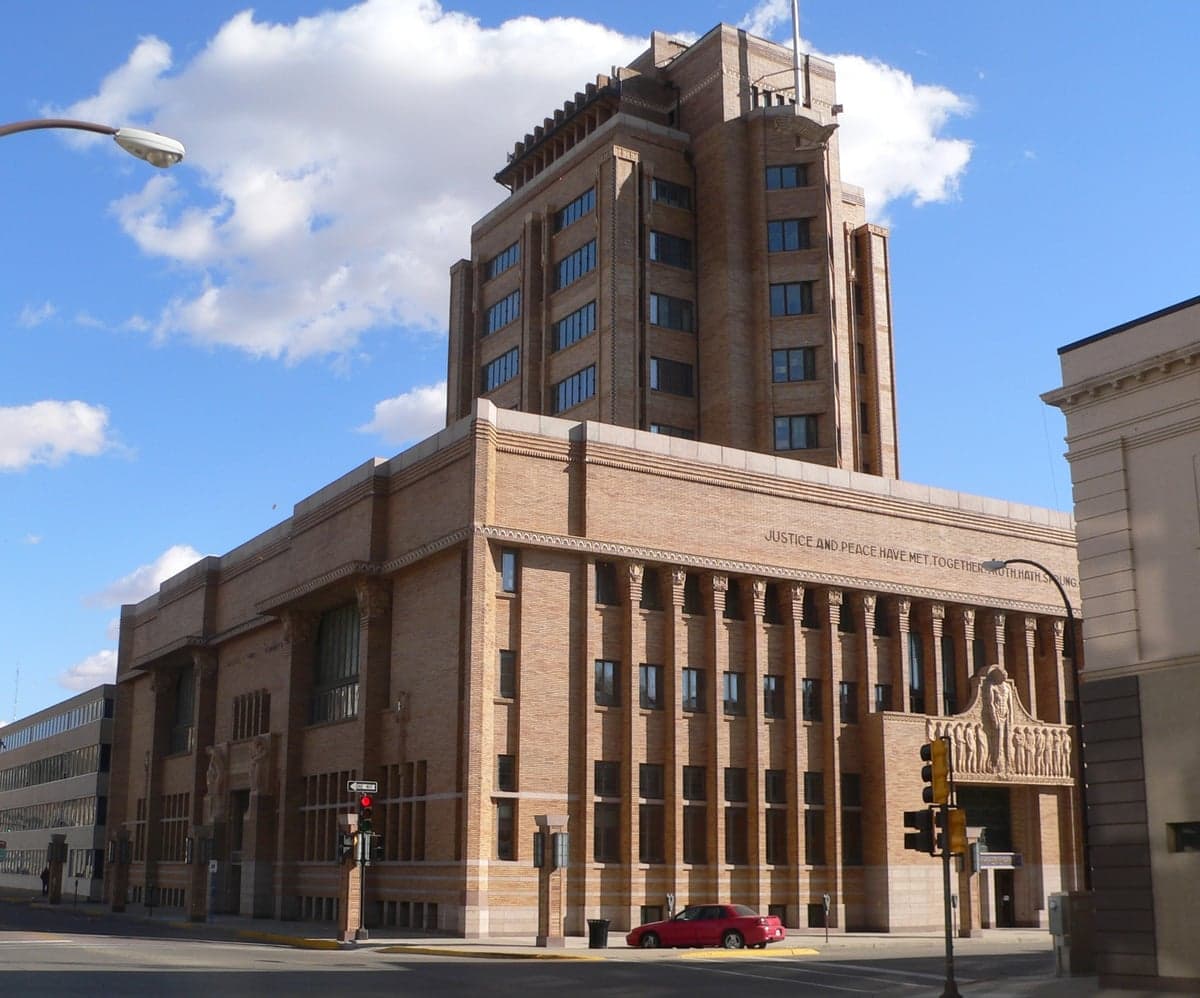
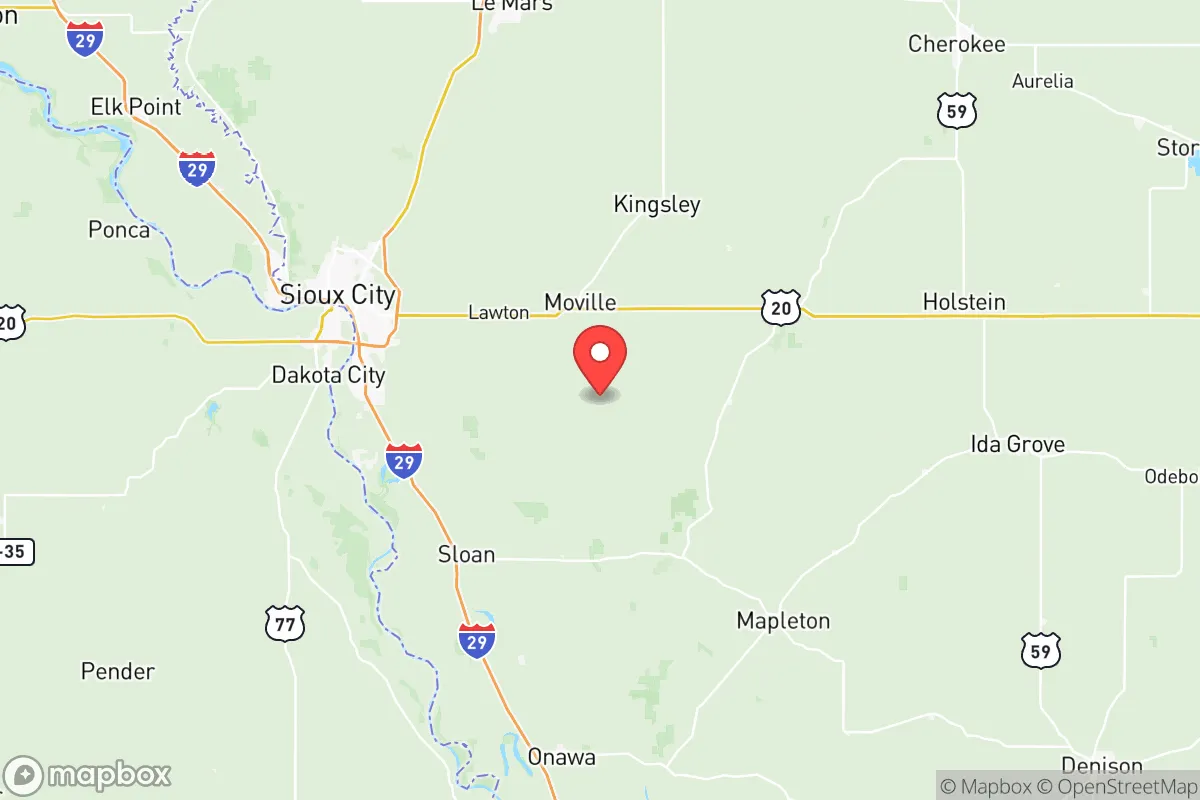
Woodbury County, anchored by the Missouri River city of Sioux City, is home to 105,760 residents who form a distinct blend of Midwestern industrial heritage and emerging diversity. The county is 68.4% white, with a significant Hispanic population of 18.4%, a Black community of 4.5%, and East/Southeast Asian residents at 2.4%, creating a demographic profile that is more diverse than much of rural Iowa. This is a region shaped by waves of European immigration, a meatpacking-driven economic base, and recent refugee resettlement, giving it a working-class character that remains politically and culturally conservative relative to the state's urban centers.
Settlement & growth (pre-1960)
Before Euro-American settlement, the land that became Woodbury County was home to the Omaha, Ponca, and Yankton Sioux nations, who used the Missouri River floodplain for hunting and seasonal agriculture. The region was part of the Louisiana Purchase of 1803, and the first permanent American presence came with the establishment of Fort Atkinson in present-day Washington County, Nebraska, just across the river, in 1820. The 1851 Treaty of Traverse des Sioux and subsequent land cessions opened the area to American settlers, and Woodbury County was formally organized in 1853.
The first major wave of settlers were Yankees and Mid-Atlantic migrants from New York, Ohio, and Pennsylvania, who arrived in the 1850s and 1860s, drawn by cheap federal land under the Preemption Act and later the Homestead Act of 1862. They founded the county seat of Sioux City in 1854, which quickly became a river port and supply hub for westward expansion. The city's location at the confluence of the Floyd, Big Sioux, and Missouri Rivers made it a natural trading post, and by 1870, Sioux City had grown to over 3,000 residents.
The second and larger wave came from Northern and Central Europe between 1870 and 1910. German immigrants were the largest group, settling throughout the county, with significant concentrations in Sioux City's Morningside neighborhood and the farming communities of Lawton and Moville. Danish immigrants established a strong presence in Danbury, which was named for their homeland, and in the surrounding rural townships. Swedish and Norwegian immigrants clustered in Sergeant Bluff and Salix, where Lutheran churches and ethnic societies persisted for generations. Irish immigrants, many fleeing the Great Famine, arrived in the 1850s and 1860s and concentrated in Sioux City's Riverside neighborhood, working on the railroads and in the stockyards.
The third major wave was Eastern European, arriving between 1890 and 1920. Polish immigrants settled heavily in Sioux City's Pierce Street corridor, establishing St. Casimir's Catholic Church as a cultural anchor. Russian Germans (ethnic Germans who had lived in the Volga region of Russia) arrived in the 1890s and 1900s, drawn by the promise of farmland and religious freedom. They concentrated in Anthon and Oto in the county's western reaches, where they maintained their distinct dialect and Mennonite and Lutheran traditions well into the 20th century.
The economic engine that drove all this settlement was the meatpacking industry. By 1900, Sioux City was the nation's third-largest livestock market, trailing only Chicago and Kansas City. The Sioux City Stockyards, established in 1887, employed thousands of workers from every immigrant group, creating a multi-ethnic working class that was unusual for Iowa at the time. The industry's demand for labor continued through the Great Depression and World War II, when the city's packing plants ran at full capacity to supply the military.
Modern era (post-1965)
The 1965 Hart-Cellar Act fundamentally reshaped Woodbury County's demographics, though the changes took decades to fully manifest. The first post-1965 arrivals were Mexican and Mexican-American workers, who had been a small presence since the 1920s but began arriving in larger numbers in the 1970s and 1980s, drawn by the meatpacking industry's continued demand for labor. They settled primarily in Sioux City's West Side and Riverside neighborhoods, establishing Spanish-language churches, grocery stores, and community organizations. Today, the Hispanic population stands at 18.4%, making Woodbury County one of the most Hispanic counties in Iowa outside of the Des Moines area.
The second major post-1965 shift was the arrival of refugee populations, beginning in the 1980s. Southeast Asian refugees, primarily Vietnamese and Lao, arrived after the Vietnam War ended in 1975, resettled through church sponsorship programs. They concentrated in Sioux City's East Side and Morningside neighborhoods, where they opened restaurants and small businesses. The East/Southeast Asian population now stands at 2.4%, with a visible commercial corridor along Gordon Drive.
The 1990s and 2000s brought a third wave: African refugees, particularly from Liberia, Sudan, and Somalia, resettled through Catholic Charities and Lutheran Services in Iowa. They joined a small but established Black community that had existed since the Great Migration of the 1910s-1940s, when African Americans moved from the rural South to work in the packing plants. The Black population now stands at 4.5%, concentrated in Sioux City's central and north-central neighborhoods.
Domestic migration has been more modest. Woodbury County has not experienced the Sun Belt-style growth seen in other parts of the country. Instead, it has seen a slow population decline from its peak of 103,877 in 1970, followed by a slight recovery to 105,760 today. The county has lost population in its rural townships, with Anthon, Oto, and Danbury all shrinking, while Sioux City has held relatively steady. Suburbanization has been limited, with Sergeant Bluff (population 4,500) and Lawton (population 900) absorbing some spillover from Sioux City, but no major exurban boom has occurred.
The future
Woodbury County is becoming more diverse, but slowly. The Hispanic population is projected to grow from 18.4% to roughly 22-25% by 2040, driven by both immigration and higher birth rates among Hispanic families. The East/Southeast Asian and Black populations are likely to hold steady or grow modestly, as refugee resettlement continues through existing community organizations. The white population, which is older and has a lower birth rate, will continue to shrink as a share of the total, though it will remain the majority for the foreseeable future.
The geographic pattern of settlement is likely to remain concentrated in Sioux City, with the county's rural areas continuing to depopulate. New immigrant communities are dispersing somewhat, with Hispanic families moving into previously white neighborhoods in Morningside and the East Side, but the core ethnic enclaves in Riverside and the West Side will persist. The county's cultural identity is evolving from a purely European-American, meatpacking-town character to a more multi-ethnic, service-oriented one, though the pace of change is slow enough that long-time residents often describe it as "still the same Sioux City, just with more taquerias."
For someone moving in now, Woodbury County offers a relatively affordable cost of living, a strong sense of local identity, and a population that is gradually becoming more diverse without the rapid, disruptive change seen in larger metropolitan areas. The county's future is one of slow demographic evolution, not revolution, and its character will remain recognizably Midwestern and working-class for at least another generation.

* Values derived from national, state, county, city and local statistics and may differ in a specific area. Last updated: 2026-06-26T15:41:10.000Z
Narrative content on this page is AI-generated and may contain mistakes. Verify any details that matter before acting on them.
ReloMaps may earn a commission from affiliate links at no extra cost to you.

