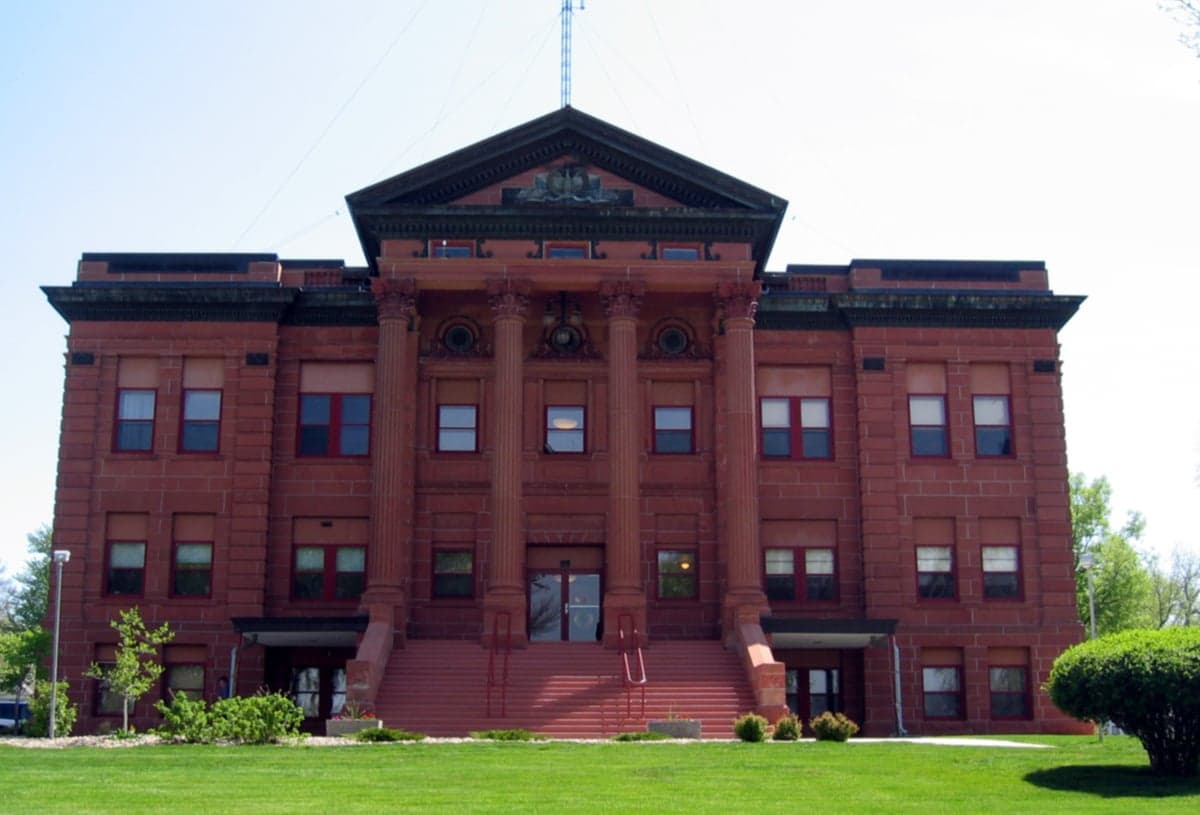
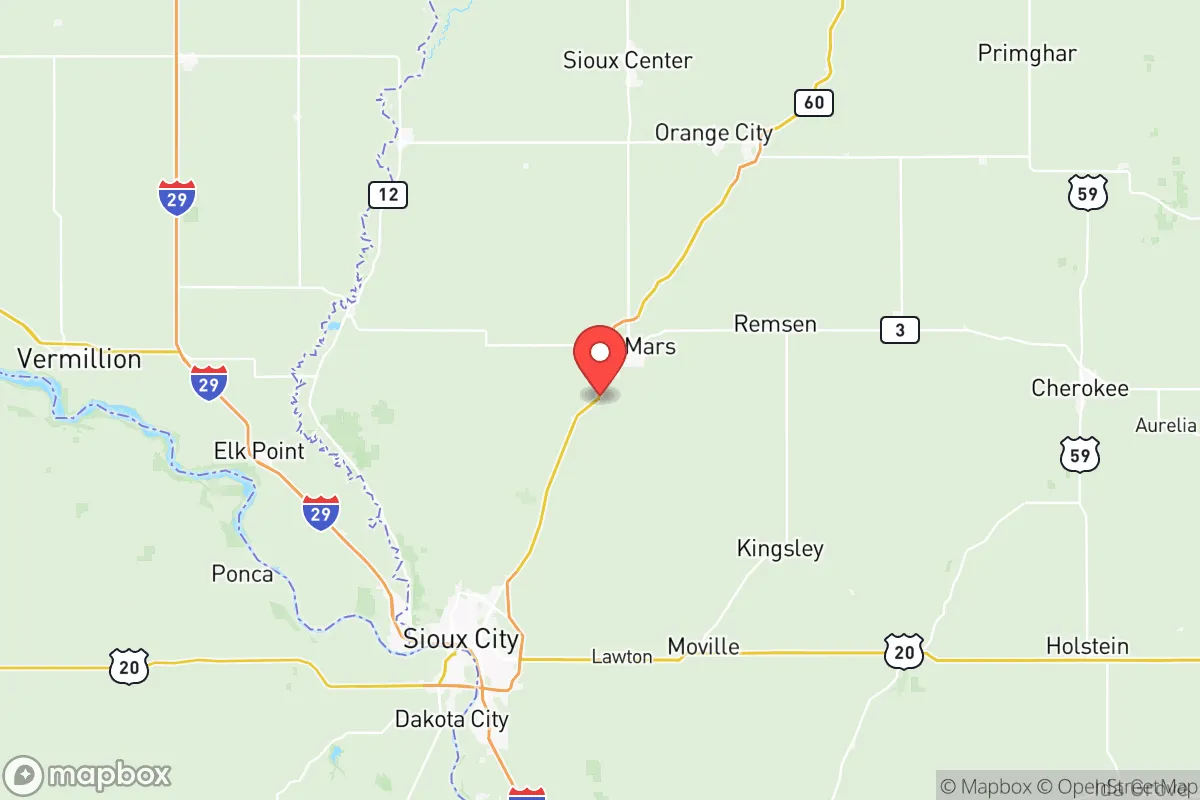
Photo: Wikipedia
Political ClimatePolitical Climate in Plymouth County
Showing district-level results — no local-only data available.
Local Political AnalysisPolitical Analysis of Plymouth County
Plymouth County, Iowa, is a reliably Republican stronghold with a Cook Partisan Voting Index (PVI) of R+15, making it significantly more conservative than the state of Iowa as a whole, which sits at R+6. The county has voted for the Republican presidential candidate in every election this century, often by margins exceeding 20 points, and the local GOP holds nearly every elected office. While the overall trend is deeply red, there are subtle variations across the county’s towns and townships that reveal a more nuanced political landscape than the countywide numbers suggest.
How it compares
The R+15 PVI means Plymouth County is about nine points more Republican than the state average. To put that in perspective, while Iowa as a whole has become more competitive in recent cycles—flipping between Obama, Trump, and back to Trump—Plymouth County has only drifted further right. The county’s rural character and agricultural economy drive this divergence; the state’s urban centers like Des Moines and Iowa City pull the state PVI left, while Plymouth County’s small towns and farm communities anchor it firmly in the GOP column. Within the county, Le Mars, the county seat and home to the Wells Enterprises ice cream headquarters, is the most reliably Republican town, often delivering 65-70% of its vote to GOP candidates. Akron and Remsen are similarly conservative, with Akron’s older population and Remsen’s strong Catholic heritage reinforcing traditional Republican values. The only notable exception is Merrill, a small town of about 700 people, which has occasionally swung toward Democrats in local races, particularly when a popular independent or Democratic candidate runs for county supervisor. Hinton and Struble are more mixed, with Hinton’s younger families and Struble’s proximity to Sioux City creating a slightly more moderate electorate, though still solidly red.
What this means for residents
For conservative residents, Plymouth County offers a deeply comfortable political environment. Local government, school boards, and county commissions are overwhelmingly Republican, meaning policy debates tend to focus on tax cuts, agricultural regulations, and Second Amendment rights rather than progressive social issues. The county’s Republican lean also means that national GOP candidates rarely need to campaign here, but local offices are hotly contested in primaries, where the real political action happens. For liberal residents, the reality is more isolating. There is no organized Democratic Party infrastructure in the county; the local Democratic central committee is largely inactive, and progressive candidates often struggle to find volunteers or donors. A liberal resident in Le Mars or Akron might feel politically invisible, though the county’s small size means most people are neighborly regardless of party. The biggest practical impact is on local policy: the county has consistently opposed state-level efforts to expand Medicaid or increase renewable energy mandates, and it has passed symbolic resolutions supporting gun rights and opposing abortion restrictions. These positions reflect the majority view but can feel alienating for the minority.
Culturally, Plymouth County’s politics are deeply tied to its agricultural identity and its strong Dutch and German heritage, which emphasize self-reliance, community, and fiscal conservatism. The county’s annual events—like Le Mars’ Ice Cream Days and the Plymouth County Fair—are non-political but reinforce a shared rural identity that transcends party lines. The biggest political fault line in recent years has been over wind energy development, which has split the county: some farmers see it as a lucrative cash crop, while others view it as an intrusion on the landscape and a threat to property values. This issue has created rare cross-party alliances, with both conservative and liberal landowners opposing new turbine projects. Looking ahead, Plymouth County’s political trajectory is likely to remain deeply red, though the growing influence of Sioux City’s metro area—just across the county line in Woodbury County—could slowly moderate the county’s politics as more commuters move into towns like Hinton and Merrill. For now, though, Plymouth County remains one of Iowa’s most reliably conservative corners, a place where the GOP’s dominance is as predictable as the corn harvest.

State Political ClimatePolitical Climate in Iowa
State Political AnalysisPolitical Environment in the State
Iowa has shifted from a classic purple swing state to a solidly Republican one, carrying a Cook PVI of R+6 after trending rightward for nearly two decades. The state backed Donald Trump by 8 points in both 2016 and 2020, and while Democrats still hold sway in a handful of urban counties, the GOP now controls the governorship, both U.S. Senate seats, three of four U.S. House seats, and supermajorities in the state legislature. The trajectory has been unmistakable: as recently as 2012, Iowa voted for Barack Obama by 6 points, but a combination of rural realignment, cultural shifts, and population sorting has turned the state reliably red at the presidential level.
Urban vs. rural divide
The political map of Iowa is a textbook case of the urban-rural split. The state's two major metros—Des Moines (Polk County) and Iowa City (Johnson County)—are Democratic strongholds. Polk County voted for Biden by 17 points in 2020, while Johnson County, home to the University of Iowa, went for Biden by a staggering 38 points. These two counties alone produce a massive Democratic vote margin, but they are surrounded by a sea of deep-red rural territory. The rest of the state's 99 counties are overwhelmingly Republican, with many—like Plymouth County in the northwest and Decatur County in the south—voting for Trump by 30 to 40 points. The suburbs of Des Moines, such as Ankeny and Waukee, have trended slightly more competitive in recent cycles, but they still lean Republican overall, unlike the deep-blue suburbs of Minneapolis or Chicago. The real story is the collapse of Democratic support in small-town and agricultural Iowa: counties that voted for Obama in 2008 and 2012 flipped hard to Trump in 2016 and stayed there in 2020.
Policy environment
Iowa's policy environment reflects its Republican trifecta. The state has a flat income tax rate of 3.8% (phasing down to 3.5% by 2027), no inheritance tax, and relatively low property taxes compared to neighboring states like Illinois and Minnesota. The regulatory posture is business-friendly, with a right-to-work law on the books and no state-level minimum wage above the federal $7.25. Education policy has been a flashpoint: in 2023, Governor Kim Reynolds signed a universal school voucher program (Education Savings Accounts) allowing any Iowa family to use public funds for private school tuition, a major win for school-choice advocates. Healthcare policy is more mixed—Iowa expanded Medicaid under the Affordable Care Act in 2014, but the state has also pursued work requirements for able-bodied adults on the program. Election laws have tightened: the state now requires voter ID at the polls, reduced early voting days from 40 to 29, and closed polls earlier on Election Day. Absentee ballot requests are no longer automatically mailed, and drop boxes are restricted.
Recent policy direction
The last three years have seen a flurry of legislation that signals where Iowa is headed. On gun rights, Iowa became a permitless carry state in 2021, allowing any legal gun owner to carry a concealed firearm without a permit. On parental rights and education, the state passed a law in 2023 banning instruction on sexual orientation and gender identity in K-6 classrooms, and requiring schools to notify parents if a student requests a name or pronoun change. A 2024 law restricts transgender minors from accessing gender-affirming medical care, including puberty blockers and hormone therapy. On speech and privacy, Iowa has no broad surveillance law, but a 2022 bill restricted the use of facial recognition technology by law enforcement without a warrant. Property rights remain strong, with no state-level rent control and a relatively low property tax cap. On voting, the 2021 election integrity law shortened the absentee ballot request window and banned private funding for election administration. The overall direction is toward more conservative cultural policy, lower taxes, and tighter election procedures.
Civil unrest & political movements
Iowa has seen its share of political activism, though large-scale civil unrest is rare. The most visible flashpoints have been around education and LGBTQ+ issues. In 2022 and 2023, protests erupted at the Iowa State Capitol over the transgender care ban and the school voucher bill, with both progressive groups like One Iowa and conservative groups like The Family Leader holding competing rallies. Immigration politics are less heated than in border states, but a 2024 law made it a state crime for someone to be in Iowa if they are in the U.S. illegally, mirroring Texas-style enforcement. There is no sanctuary city movement of note; Iowa City and Des Moines have more welcoming rhetoric but no formal sanctuary policies. Election integrity controversies flared after 2020, with some rural county GOP officials questioning results, but no widespread fraud was found. The state's caucuses remain a national political spectacle every four years, drawing candidates and media attention that can feel like a circus to locals.
Projection
Over the next 5-10 years, Iowa is likely to stay on its current trajectory—becoming more Republican, more culturally conservative, and more tax-competitive. The demographic trends favor the GOP: rural counties are aging and shrinking, but the urban growth in Des Moines and its suburbs is not enough to flip the state blue, especially as those suburbs drift rightward. In-migration is modest, with most newcomers coming from other Midwestern states like Illinois and Minnesota, often drawn by lower taxes and housing costs. The state's population is projected to grow slowly, with the Des Moines metro area adding the most new residents. A relocator moving in now should expect a state where conservative policies on education, guns, and taxes are entrenched, but where the urban centers of Des Moines and Iowa City will remain liberal enclaves with their own cultural and political dynamics. The GOP supermajority is unlikely to be seriously challenged in the next decade, barring a major national realignment.
For a new resident, the bottom line is straightforward: if you lean conservative, you'll find a state government that aligns with your values on taxes, school choice, gun rights, and cultural issues. If you lean liberal, you'll find a welcoming community in Des Moines or Iowa City, but you'll be living under a state government that is actively pursuing policies you likely oppose. The political climate is stable, predictable, and increasingly one-sided—a far cry from the swing-state drama of the 2000s. Whether that's a selling point or a warning depends entirely on where you stand.
* Values derived from national, state, county, city and local statistics and may differ in a specific area. Last updated: 2026-06-30T01:30:17.000Z
Narrative content on this page is AI-generated and may contain mistakes. Verify any details that matter before acting on them.
ReloMaps may earn a commission from affiliate links at no extra cost to you.

