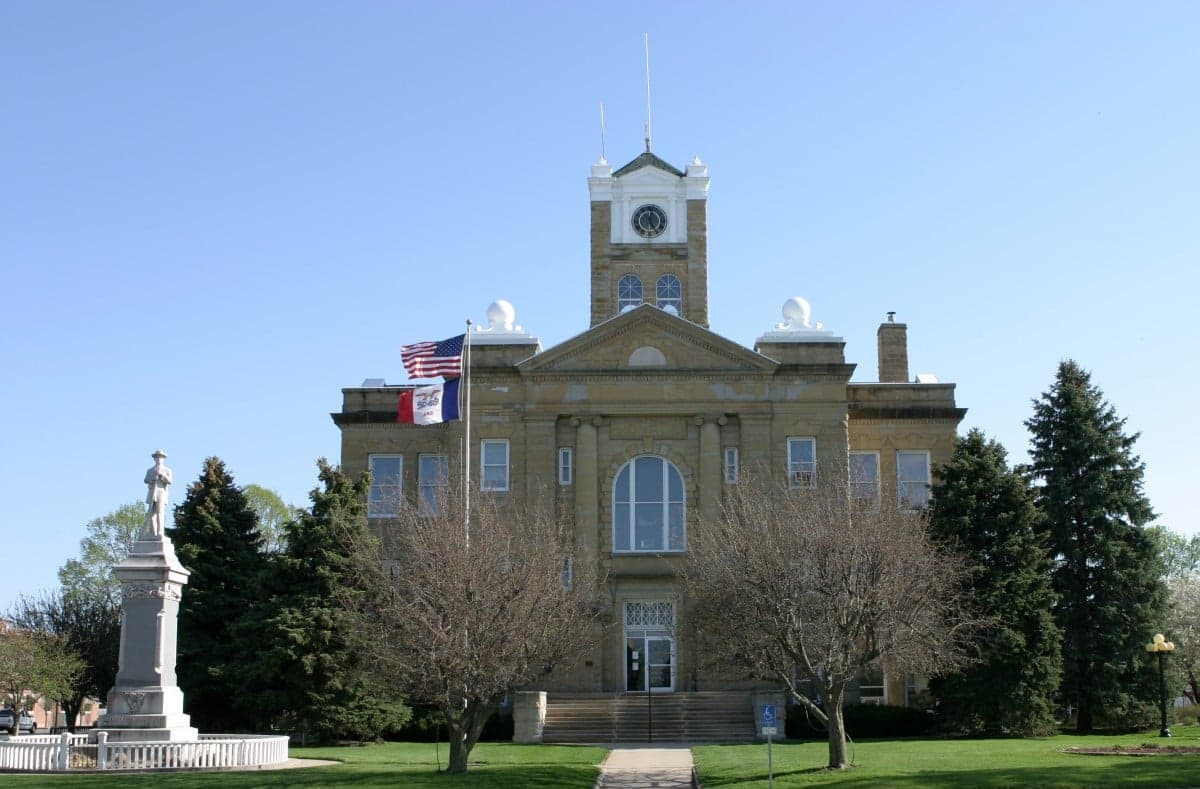
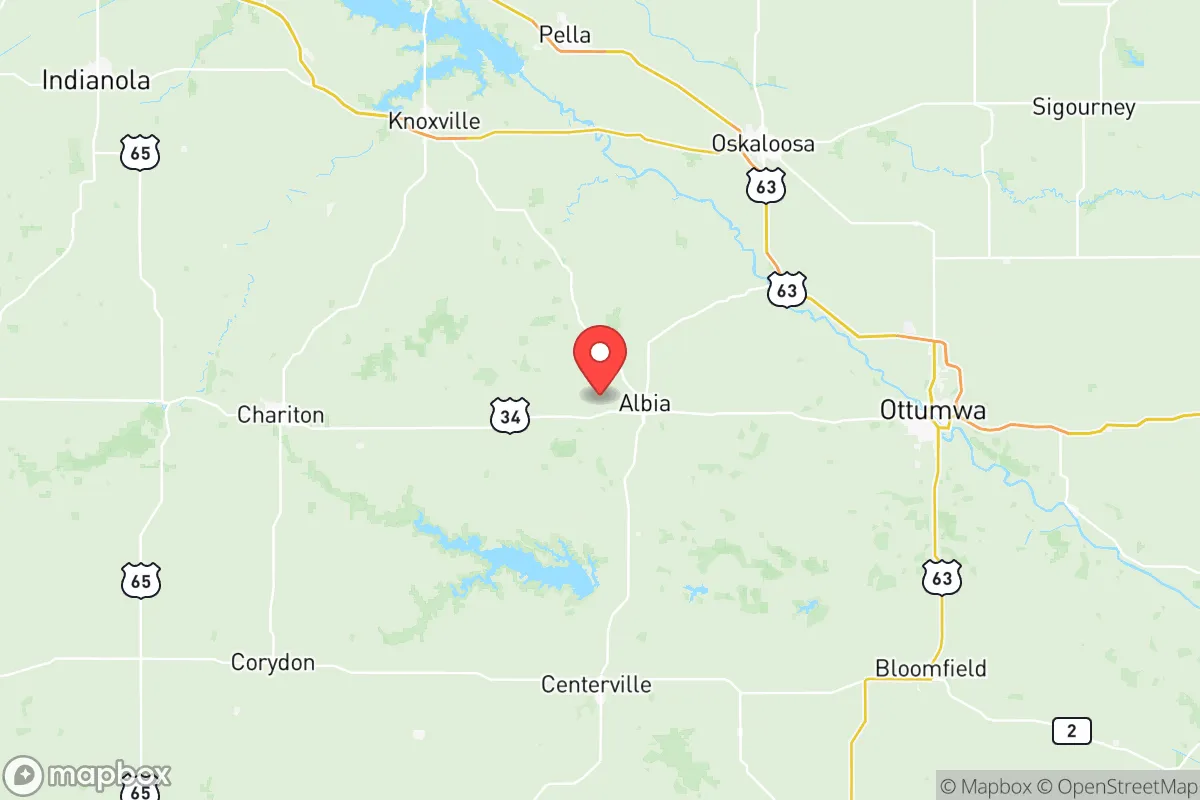
Photo: Wikipedia
Political ClimatePolitical Climate in Monroe County
Showing district-level results — no local-only data available.
Local Political AnalysisPolitical Analysis of Monroe County
Monroe County sits at R+2 on the Cook Political Index, making it a genuine swing county in a state that’s shifted decisively red. That’s a far cry from Iowa’s statewide R+6, and it means the county has been a stubborn blue dot in an increasingly Republican region — though the trajectory is unmistakably rightward. The county seat, Albia, has historically been the Democratic anchor, powered by union households and a working-class base that’s been loyal to the party since the farm crisis era. But the surrounding towns — Lovilia, Melrose, and the rural townships — have trended Republican for a decade-plus, and the gap between Albia’s precincts and the countryside has widened with every cycle.
How it compares
The R+2 rating puts Monroe County roughly 8 points to the left of Iowa as a whole, a gap that’s been remarkably consistent even as both have moved right. In 2020, Donald Trump carried the county by a narrow margin, but Albia’s precincts — especially those around the old coal-mining neighborhoods and the hospital district — still went for Joe Biden. That’s a stark contrast to neighboring Appanoose and Lucas counties, which are R+15 or worse and haven’t been competitive in a generation. The swing precincts are the ones just outside Albia’s city limits: places like the Bluff Creek and Avery townships, where a mix of retired miners, young families, and a growing number of remote workers have created a genuine toss-up dynamic. In 2024, those precincts split almost evenly, and local races there were decided by double digits in both directions.
What this means for residents
For conservatives, the county’s lean means their votes matter more here than almost anywhere else in southern Iowa. A Republican candidate who can peel off even a small share of Albia’s union vote can flip the county, and that’s exactly what’s happened in recent statehouse races. For liberals, it’s a more defensive posture: Albia remains a reliable base, but the margins have shrunk, and the county’s Democratic Party organization has had to work harder to turn out voters in the rural precincts. In practice, that means local politics are less about ideology and more about personal relationships — the county supervisors, the school board, and the hospital board are all still decided by who shows up at the county fair and who’s known as a straight shooter. Neither side can take the county for granted, which keeps the discourse more civil than in deep-red neighboring counties.
What this means for residents
The cultural divide in Monroe County tracks the urban-rural split you’d expect, but it’s softened by a shared history. The county’s coal-mining legacy — Albia was a hub for the old Iowa coal fields — created a labor culture that still resonates, even as the mines have been gone for decades. That’s why you’ll see union yard signs next to Trump flags in some of the same driveways. The policy distinctions are real, though: the county has been more willing to fund public schools and the local hospital than its neighbors, and there’s a pragmatic streak on issues like road maintenance and broadband expansion. But on cultural flashpoints — gun rights, abortion, and school curriculum — the county has moved with the state, and the rural precincts are as conservative as anywhere in Iowa. The long-term outlook is for continued rightward drift, but the county’s small size and tight-knit communities mean the political climate will likely stay more personal and less polarized than the state’s urban-rural divide suggests.

State Political ClimatePolitical Climate in Iowa
State Political AnalysisPolitical Environment in the State
Iowa has shifted from a classic purple swing state to a solidly Republican state, carrying a Cook PVI of R+6 after backing Donald Trump by double digits in both 2016 and 2020. The state’s political center of gravity has moved decisively toward the rural and small-town electorate, while the urban cores of Des Moines, Iowa City, and Cedar Rapids have become Democratic strongholds that can no longer offset the GOP’s dominance elsewhere. Over the last two decades, the state has undergone a dramatic realignment—once home to competitive Senate races and a coveted first-in-the-nation caucus that rewarded moderation, Iowa now behaves more like its neighbors Missouri and Kansas than the swing state it was in 2008.
Urban vs. rural divide
The political map of Iowa breaks down along a stark urban-rural axis. The Des Moines metro, anchored by Polk County, is the state’s Democratic engine, delivering roughly 60% of its vote to Joe Biden in 2020. Johnson County, home to the University of Iowa in Iowa City, is the most liberal jurisdiction in the state, routinely voting 75%+ Democratic. Linn County (Cedar Rapids) and Black Hawk County (Waterloo) round out the blue island in the eastern part of the state, driven by unionized manufacturing workers and university faculty. But the rest of the state has moved hard to the right. The critical shift has been in the suburban and exurban ring around Des Moines—places like Ankeny, Waukee, and Johnston—which were once competitive swing territory but have voted increasingly Republican since 2016. Meanwhile, the rural northwest and southwest corners of the state, including Sioux City, Council Bluffs, and the small towns of the 4th Congressional District, are now among the most conservative areas in the Midwest. The 2022 midterms crystallized this divide: Republican Chuck Grassley won re-election by 12 points while losing Polk and Johnson Counties by wide margins, relying on a 30-point blowout in the rural 4th District to carry the day.
Policy environment
Iowa’s policy environment reflects its Republican trifecta—the party controls the governorship and both legislative chambers, and has since 2017. The state has no income tax on Social Security benefits, and the 2022 Tax Cuts and Jobs Act-style reform signed by Governor Kim Reynolds is phasing down the individual income tax to a flat 3.9% by 2026, with a corporate rate cut to 5.5%. Property taxes are comparatively low, though local levies vary widely between Des Moines and rural counties. The regulatory posture is business-friendly, with a right-to-work law on the books and a tort reform cap on non-economic damages. Education policy has been a flashpoint: Iowa enacted a school choice program in 2023 that provides universal education savings accounts (ESAs) worth roughly $7,600 per student, allowing families to use public funds for private or homeschool expenses. Healthcare is a mixed bag—the state expanded Medicaid under the Affordable Care Act in 2014, but has since imposed work requirements for able-bodied adults and contracted with private managed-care organizations. Election laws have tightened: Iowa now requires absentee ballots to be requested earlier, shortens the early voting window, and closes polls at 8 PM on Election Day, changes that Republicans argue improve integrity and Democrats argue suppress turnout.
Recent policy direction
The last five years have seen Iowa move aggressively on a broad front of cultural and liberty issues. On guns, Iowa became a permitless carry state in 2021, allowing any legal adult to carry a concealed firearm without a permit or training. On education and parental rights, the 2023 ESA law was paired with a ban on instruction about sexual orientation and gender identity through sixth grade, mirroring Florida’s “Don’t Say Gay” law. The state also passed a law requiring schools to notify parents of any changes to a student’s gender identity or pronoun usage. On abortion, the Iowa Supreme Court upheld a six-week heartbeat ban in 2024, which Governor Reynolds signed into law after a previous version was struck down; the law bans most abortions once cardiac activity is detected, with narrow exceptions for rape, incest, and medical emergencies. On property rights, Iowa has a strong eminent domain protection law that restricts the use of condemnation for private economic development, a response to the 2005 Kelo decision. On privacy and surveillance, Iowa has not passed a comprehensive consumer data privacy law, leaving residents with fewer protections than states like California or Virginia. Voting access has been tightened, but Iowa still allows same-day voter registration and does not require a photo ID to vote, though a voter ID law passed in 2017 is being phased in.
Civil unrest & political movements
Iowa has not seen the large-scale civil unrest of coastal states, but it has had its share of political flashpoints. The 2020 Black Lives Matter protests in Des Moines and Iowa City were relatively small and peaceful compared to Portland or Minneapolis, but they did trigger a backlash that helped fuel the GOP’s rural turnout. The state has been a battleground over immigration politics: Iowa passed a law in 2024 making it a state crime to enter Iowa after being deported, and requiring law enforcement to cooperate with federal immigration authorities, a direct challenge to sanctuary city policies—though Iowa has no sanctuary cities to speak of. The most visible organized movement on the right has been around school boards and library content, with conservative groups like Moms for Liberty gaining traction in suburban districts like Ankeny and West Des Moines, successfully pushing for book removals and curriculum changes. On the left, the Iowa Citizens for Community Improvement and the AFL-CIO have organized around wage and labor issues, but their influence has waned as union membership has declined. Election integrity controversies have been relatively muted compared to Arizona or Georgia, though the 2020 election did see a Republican-led audit of the results in the state’s most populous counties, which found no evidence of widespread fraud. The state’s first-in-the-nation caucus status has been a double-edged sword—it brought national attention and candidate visits, but also exposed Iowa to criticism after the 2020 Democratic caucus results were delayed due to a faulty app, leading the DNC to strip Iowa of its first-in-the-nation status for 2024.
Projection
Over the next five to ten years, Iowa’s Republican lean is likely to solidify rather than erode. The state’s population is aging and becoming more rural, with the 2020 census showing that 30 of Iowa’s 99 counties lost population over the previous decade. In-migration is modest and skews older, with retirees from Illinois and Minnesota moving to places like the Iowa Great Lakes region in Dickinson County and the river towns along the Mississippi. The Des Moines metro is growing, but the new arrivals are a mix of young professionals who lean Democratic and suburban families who lean Republican, and the net effect has been a wash. The state’s rural counties are becoming more Republican as Democratic-leaning voters age out and are replaced by younger, more conservative transplants. The wildcard is the University of Iowa and Iowa State University—if the state’s brain drain reverses and more young people stay, the urban cores could grow their influence, but current trends suggest the opposite. Expect the state to remain R+6 or move further right, with the 2026 governor’s race likely to be a test of whether Democrats can compete in a state where they have lost the last four statewide races. A new resident moving to Iowa in 2026 should expect a state that is firmly Republican at the state level, with conservative policies on taxes, guns, abortion, and education that are unlikely to be reversed in the next decade.
For a new resident, the bottom line is that Iowa offers a stable, low-tax, culturally conservative environment where the politics are predictable and the pace of change is slow. If you are a conservative, you will find a state government that shares your priorities on taxes, school choice, gun rights, and abortion restrictions, and you will be in the majority in most of the state outside of the Des Moines and Iowa City metros. If you are a liberal, you will find welcoming communities in the urban cores, but you should expect to be in the minority at the state level, with limited ability to influence policy. The practical takeaway is that Iowa is a place where politics are less contentious than in many states—the fights are real, but they are fought in the legislature and at the ballot box, not in the streets. It is a state where your vote matters less in the general election but matters a great deal in the Republican primary, which is where the real political action happens. For families, the school choice law and low crime rates are tangible benefits; for singles, the low cost of living and easy access to outdoor recreation in places like the Loess Hills or the Amana Colonies are the draws. Iowa is not a state that will surprise you politically—it is a state that will confirm what you already believe, whichever side you are on.
* Values derived from national, state, county, city and local statistics and may differ in a specific area. Last updated: 2026-10-16T00:50:11.000Z
Narrative content on this page is AI-generated and may contain mistakes. Verify any details that matter before acting on them.
ReloMaps may earn a commission from affiliate links at no extra cost to you.

