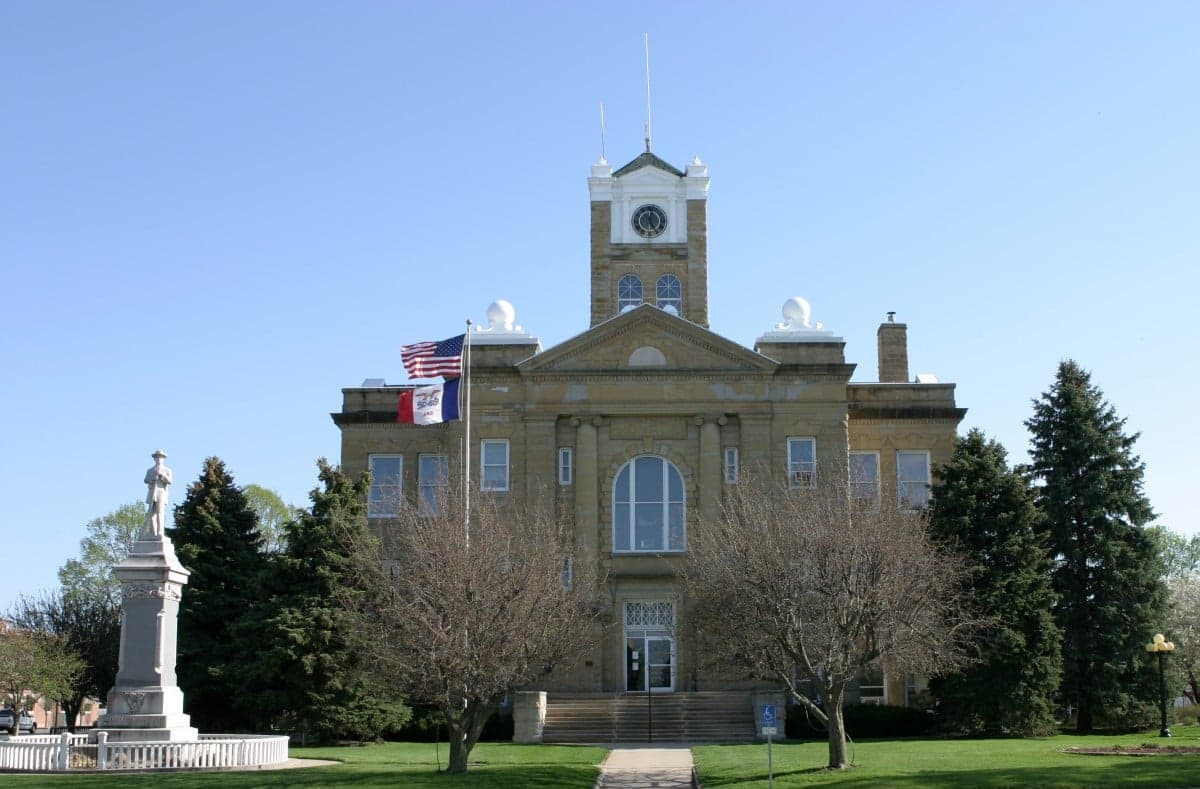
Photo: Wikipedia
Demographics of Monroe County
Affluence Level in Monroe County
A middle-class area roughly in line with national averages across income, home values, education, and employment.
People of Monroe County
Monroe County, Iowa, is one of the most demographically stable and culturally homogeneous counties in the state, with a population of 7,546 that is 95.1% white and 0.0% foreign-born. This is a working-class, rural community anchored by the county seat of Albia and the smaller towns of Lovilia and Melrose, where family roots often trace back five or more generations. The county’s identity is defined less by newcomer influx and more by persistence—a place where the descendants of 19th-century settlers still dominate the voter rolls, church pews, and school boards.
Settlement & growth (pre-1960)
Before American settlement, the land that became Monroe County was contested territory of the Sac and Fox (Meskwaki) nations, who used the Des Moines River valley for hunting and seasonal camps. The U.S. government forcibly removed these groups through treaties in the 1830s and 1840s, opening the region to white settlement. The county was formally organized in 1846, the same year Iowa achieved statehood, and the earliest permanent settlers were native-born Americans moving west from Ohio, Kentucky, and Virginia—not European immigrants.
These first waves of settlers were largely of Scots-Irish and English stock, drawn by the promise of cheap, fertile prairie land under the Preemption Act of 1841 and later the Homestead Act of 1862. They established the town of Albia in 1845 as the county seat, naming it after a local landowner’s daughter. The arrival of the Burlington and Missouri River Railroad in the 1860s transformed Albia from a frontier outpost into a coal-mining hub, and it was coal—not corn—that drove the county’s next major population wave.
From the 1870s through the 1920s, Monroe County experienced a coal boom that attracted a distinctly different group: immigrants from Southern and Eastern Europe. Italian, Croatian, and Slovenian miners came to work the underground shafts around Albia, Lovilia, and the now-vanished mining camps of Hiteman and Buxton. The town of Buxton, in particular, was a rare integrated community where Black and white miners lived side by side under the management of the Consolidation Coal Company. At its peak around 1910, Buxton’s population of nearly 5,000 made it the largest unincorporated town in Iowa, and its Black residents—many of whom migrated from the South—represented one of the state’s most significant African American communities of that era.
The coal economy collapsed in the 1920s and 1930s as mines played out and the Great Depression tightened its grip. Buxton was abandoned by 1927, and most of its residents dispersed to Albia, Ottumwa, or out of state entirely. The county’s population peaked at roughly 20,000 in 1900 and has declined steadily ever since. The post-war decades saw no new immigrant waves; instead, the county lost young people to urban centers and the military, leaving a population that was overwhelmingly native-born, white, and rural.
Modern era (post-1965)
The 1965 Hart-Cellar Act, which abolished national-origin quotas and opened the door to mass immigration from Asia and Latin America, had virtually no effect on Monroe County. With a foreign-born population of exactly 0.0% in the most recent data, the county remains one of the least immigrant-affected places in the entire Midwest. Where other Iowa counties saw refugee resettlement from Vietnam, Bosnia, or Myanmar, Monroe County saw none of it.
Instead, the modern era has been defined by domestic out-migration and slow demographic aging. The county’s Hispanic population stands at just 0.8%, and the Black population at 0.2%—a far cry from the days when Buxton’s coal camps were racially diverse. The East/Southeast Asian population is 0.8%, and the Indian-subcontinent population is 0.0%. These numbers reflect a community that has not attracted new residents from abroad or from other U.S. regions in any meaningful numbers.
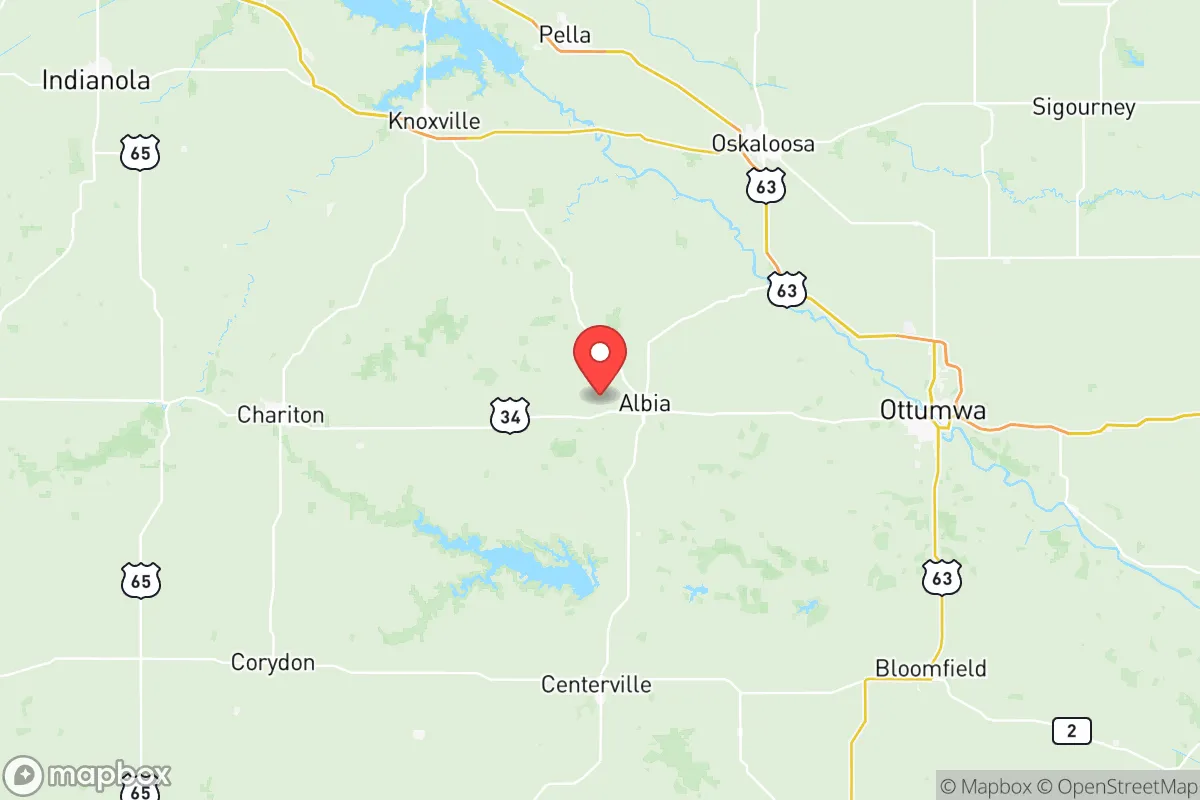
Suburbanization has not reshaped Monroe County the way it has the Des Moines or Iowa City metros. Albia remains a small county seat of roughly 3,700 people, with its economy anchored by the Iowa Department of Corrections’ medium-security prison, the Albia Community School District, and regional healthcare through Monroe County Hospital. Lovilia, with about 500 residents, and Melrose, with about 110, are bedroom communities for workers commuting to Ottumwa (Wapello County) or the larger industrial employers along the Highway 34 corridor. The county’s college-educated share is just 20.0%, reflecting a workforce that has historically relied on manufacturing, corrections, agriculture, and healthcare rather than professional services.
The future
Monroe County’s demographic trajectory points toward continued stability rather than transformation. The population has hovered between 7,500 and 8,000 for the past two decades, and projections suggest it will remain in that range through the 2030s. The county is not becoming more diverse; if anything, the small minority populations that exist are likely to remain static or shrink as younger residents leave for college and do not return.
The most significant demographic pressure is aging. Like much of rural Iowa, Monroe County has a median age in the low-to-mid 40s, and the 65-and-older cohort is growing as the post-war generation ages in place. This will increase demand for senior services, healthcare, and accessible housing in Albia, while school enrollment in the Albia and Twin Cedars districts may continue a slow decline. There is no evidence of a new immigrant wave or a domestic migration surge on the horizon; the county’s remote rural location, lack of major employers, and limited housing stock make it an unlikely destination for relocation.
Culturally, the county remains a bastion of traditional Midwestern values—church attendance is high, hunting and fishing are popular, and the county consistently votes Republican in state and national elections. The descendants of the Scots-Irish farmers and Southern European miners have largely assimilated into a single, cohesive white working-class identity. Newcomers who move to Monroe County are typically retirees seeking low-cost rural living, or families with existing ties to the area.
For someone considering a move to Monroe County, the bottom line is this: you are not moving to a place that is changing—you are moving to a place that has been remarkably consistent for over a century. The diversity that once existed in Buxton’s coal camps is a historical footnote, not a living reality. What you will find is a quiet, safe, affordable rural community where neighbors know each other by name, where the pace of life is slow, and where the population is stable but aging. If you are seeking cultural diversity or rapid growth, this is not the place. If you are seeking a deeply rooted, traditional Iowa community with low crime and strong local institutions, Albia and its surrounding towns offer exactly that.

* Values derived from national, state, county, city and local statistics and may differ in a specific area. Last updated: 2026-10-16T00:50:11.000Z
Narrative content on this page is AI-generated and may contain mistakes. Verify any details that matter before acting on them.
ReloMaps may earn a commission from affiliate links at no extra cost to you.

