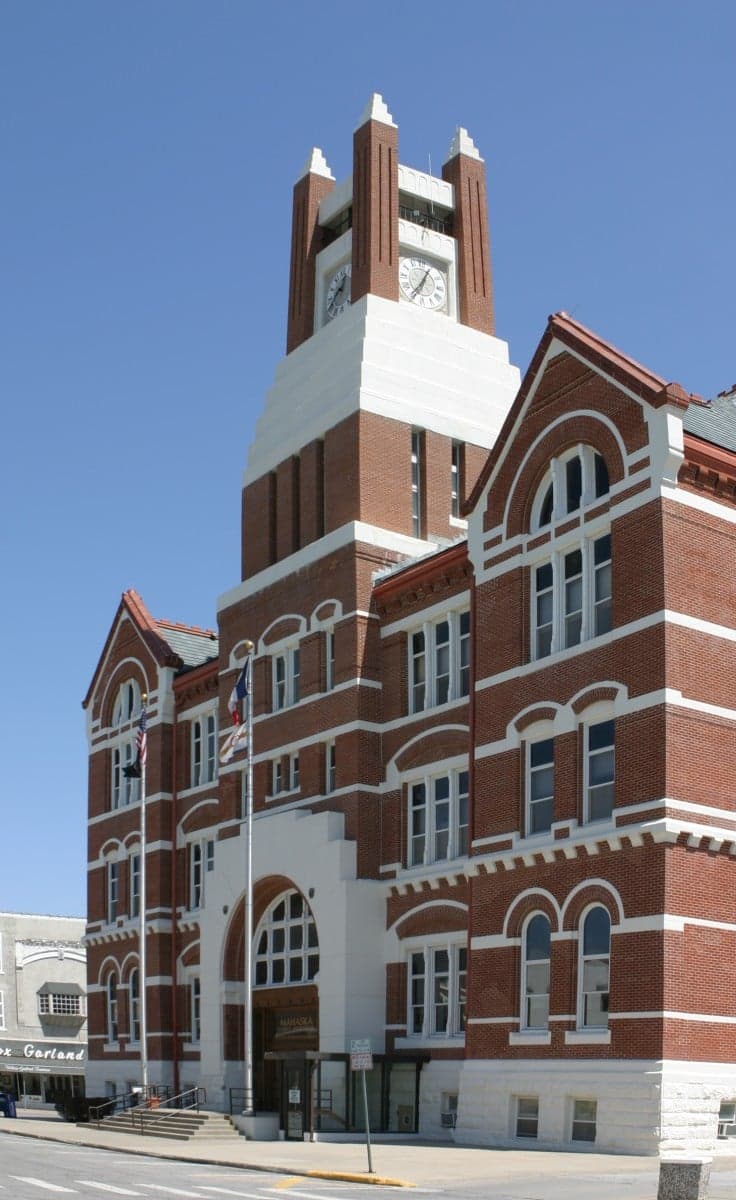
Photo: Wikipedia
Political ClimatePolitical Climate in Mahaska County
Showing district-level results — no local-only data available.
Local Political AnalysisPolitical Analysis of Mahaska County
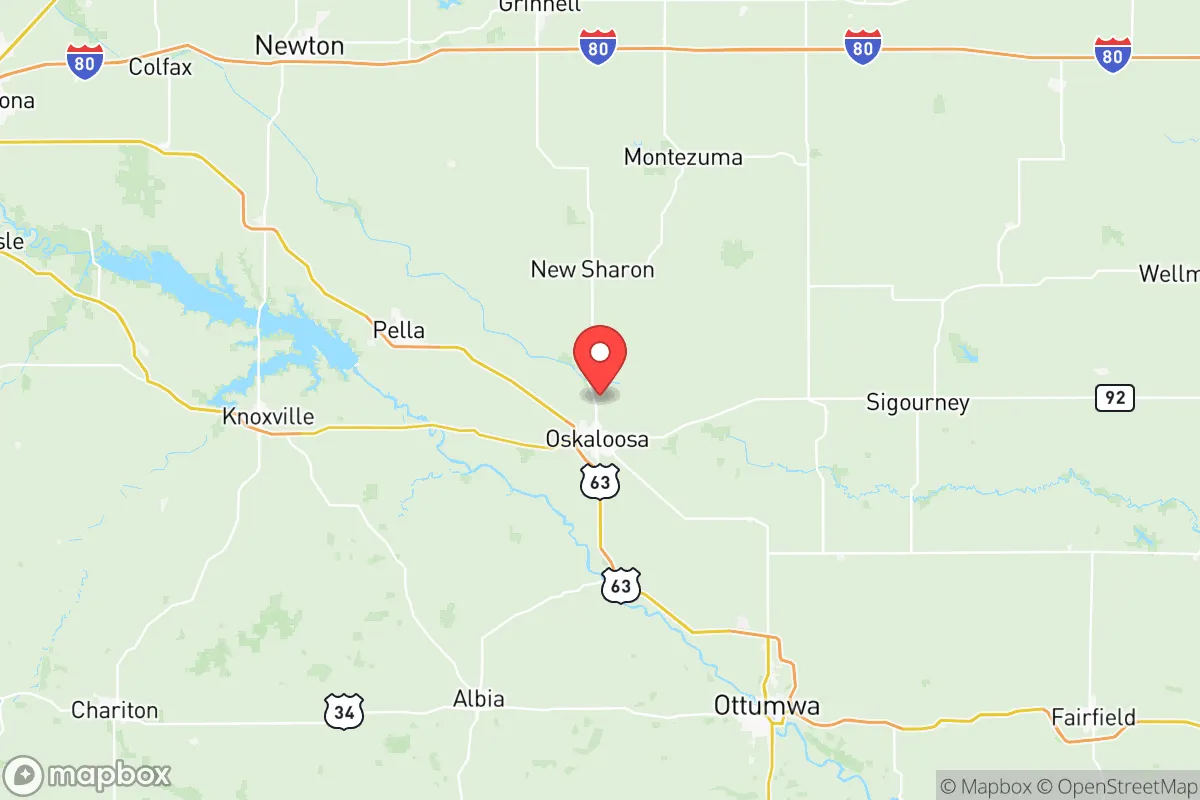
Mahaska County, anchored by Oskaloosa, has long been a reliably Republican stronghold in southeast Iowa, though it's worth noting that its Cook PVI of R+4 actually makes it slightly less conservative than the state of Iowa as a whole, which sits at R+6. This might surprise folks who only drive through the county seat, but the political reality here is more nuanced than the raw numbers suggest. The county has been trending redder in presidential elections since 2000, but local races and the presence of a major university introduce genuine political diversity that you won't find in many neighboring counties.
How it compares to Iowa as a whole
The R+4 rating means Mahaska County is about two points more competitive than the statewide average of R+6, which is a meaningful gap in practical terms. In the 2020 presidential election, Donald Trump carried Mahaska County with roughly 66% of the vote, while he won Iowa overall with about 53% — so the county is actually more Republican in presidential contests than the PVI suggests. The discrepancy comes from down-ballot races: Oskaloosa's precincts, particularly those around William Penn University and the downtown core, have voted for Democratic candidates in state legislative and county supervisor races more often than the statewide average. The rural townships — Beacon, Leighton, and the areas around New Sharon — are deeply red, often pushing 75-80% Republican. The swing precincts are in Oskaloosa's 2nd and 3rd wards, where the presence of university faculty and younger professionals creates a small but consistent blue vote that can tip local races.
What this means for residents
For conservative residents, Mahaska County offers a political environment where their views are the clear majority, especially in the unincorporated areas and smaller towns like Eddyville and Fremont. The county supervisors and school board have been reliably Republican for decades, and the local Republican party organization is active and well-funded. For liberal residents, the picture is more complicated but not hopeless. Oskaloosa provides a small but genuine progressive community centered around the university and the arts scene, and Democratic candidates can be competitive in city council races and the occasional countywide contest if they run strong campaigns. The practical effect of the county's lean is that conservative policy priorities — lower taxes, limited regulation, Second Amendment rights — are reflected in local governance, while progressive residents often find themselves working through community organizations and the university rather than through elected office. The political discourse here is generally civil, though the divide between Oskaloosa's more moderate precincts and the deeply conservative rural townships can create tension during election cycles.
One cultural distinction that sets Mahaska County apart from much of Iowa is the influence of William Penn University, a private liberal arts institution that brings in students and faculty from across the country and internationally. This creates a small but noticeable progressive enclave in Oskaloosa that you don't find in similarly-sized county seats like Albia or Sigourney. The university's presence also means the county has a more active arts and cultural scene than its political lean would suggest, with events and organizations that tend to attract a politically diverse audience. Looking ahead, the county's trajectory will likely follow the broader state trend of rural areas becoming more Republican and small cities with colleges holding steady or shifting slightly left, meaning the gap between Mahaska County and the statewide average may narrow over the next decade.

State Political ClimatePolitical Climate in Iowa
State Political AnalysisPolitical Environment in the State
Iowa has shifted from a classic purple swing state to a solidly Republican one, carrying a Cook PVI of R+6 after trending rightward for nearly two decades. The state voted for George W. Bush in 2004, then flipped to Barack Obama in 2008 and 2012, but since 2016 it has backed Donald Trump by increasing margins — 9 points in 2016, 8 points in 2020, and 13 points in 2024. The dominant coalition is a mix of rural and small-town voters, evangelical Christians, and older working-class whites, while Democrats now rely on a shrinking base in a few urban counties and college towns. For a relocator, this means the state’s politics are increasingly shaped by conservative priorities at the statehouse, even as local dynamics vary widely depending on where you land.
Urban vs. rural divide
The political map of Iowa is a textbook case of the urban-rural split. The Democratic strongholds are Polk County (Des Moines), Johnson County (Iowa City), and Story County (Ames) — home to the state capital, the University of Iowa, and Iowa State University, respectively. These three counties account for roughly a quarter of the state’s population and consistently deliver 60-70% of their votes to Democratic candidates. In contrast, the rest of the state’s 99 counties have moved sharply right. Dallas County, a fast-growing suburban area west of Des Moines, flipped from blue to red after 2016 and now votes Republican by double digits. Sioux County in the northwest, heavily Dutch Reformed and evangelical, is one of the most Republican counties in the nation, routinely giving GOP candidates 80%+ of the vote. Linn County (Cedar Rapids) and Black Hawk County (Waterloo) remain competitive but are trending redder, while Scott County (Quad Cities) has become a genuine toss-up. The practical takeaway: if you move to Des Moines’ east side or Iowa City, you’ll live in a blue bubble; anywhere else, expect a conservative environment.
Policy environment
Iowa’s policy environment has shifted decisively under unified Republican control of the governorship and legislature since 2017. The state has a flat individual income tax rate of 3.8% (phased down from a progressive top rate of 8.53% in 2018), and corporate taxes are being eliminated entirely by 2027. Property taxes are locally set but capped by state law, and there is no estate tax. The regulatory posture is business-friendly, with right-to-work laws and a tort reform cap on noneconomic damages. On education, Iowa enacted a universal school voucher program in 2023, allowing any family to use public funds for private or homeschool expenses — one of the most expansive such programs in the country. Healthcare policy has been mixed: the state expanded Medicaid under the Affordable Care Act but has since privatized management to three managed-care organizations. Election laws have tightened: absentee ballot drop boxes were banned, early voting windows shortened, and voter ID requirements implemented in 2017 and expanded in 2021. For a conservative relocator, the tax and school choice environment is a clear draw; for a liberal one, the voting restrictions and lack of abortion access (see below) are significant drawbacks.
Recent policy direction
The last five years have seen Iowa pass a slate of legislation that reflects a deliberate conservative agenda. On gun and self-defense law, Iowa became a permitless carry state in 2021, allowing any legal gun owner to carry a concealed firearm without a permit or training. On parental and education rights, the 2023 voucher law (Students First Act) is the headline, along with a 2022 law banning instruction on sexual orientation and gender identity in K-6 classrooms (SF 496) and a 2024 law requiring schools to notify parents of any student requests to change pronouns or names. On medical and bodily autonomy, Iowa passed a six-week abortion ban in 2023 (HF 732), which took effect after a court ruling in 2024; there are no exceptions for rape or incest, only for medical emergencies. On property rights, the state has strengthened eminent domain protections for landowners, particularly against carbon pipeline projects, with a 2024 law requiring companies to obtain 90% voluntary easements before using eminent domain. On privacy and surveillance, Iowa passed a consumer data privacy law in 2023 (ICDPA) giving residents rights to access, delete, and opt out of sale of their personal data. On voting and ballot access, the 2021 law (SF 413) reduced early voting from 29 to 20 days, closed polls at 8 p.m. instead of 9 p.m., and banned county auditors from sending absentee ballot request forms unless requested. The overall direction is toward lower taxes, expanded school choice, restricted abortion access, and tighter election procedures — a package that aligns with national conservative priorities.
Civil unrest & political movements
Iowa has seen its share of political flashpoints, though large-scale civil unrest is rare. The most visible recent movement was the 2023-2024 protests against carbon capture pipelines proposed by Summit Carbon Solutions and Navigator CO2, which drew thousands of landowners and activists — mostly rural and conservative — to the state capitol, arguing that eminent domain for private profit violated property rights. The pipeline issue has become a rare cross-partisan cause, uniting libertarian-leaning Republicans and environmentalist Democrats. On the left, the 2020 Black Lives Matter protests in Des Moines and Iowa City were significant but smaller than in major metros, and led to some police reform discussions but no major legislation. Immigration politics have been relatively quiet, though a 2024 law (SF 2340) made it a state crime for someone previously deported to enter Iowa, mirroring Texas-style enforcement. There is no serious secession or nullification movement. Election integrity controversies flared after 2020, with Republican lawmakers citing concerns that led to the 2021 voting restrictions, but no widespread fraud was ever documented. For a new resident, the most noticeable political activism will be the annual Iowa State Fair presidential candidate cattle calls and the intense door-knocking during the first-in-the-nation caucuses — a tradition that may end if the national party changes the primary calendar.
Projection
Over the next 5-10 years, Iowa is likely to become more Republican, not less. The demographic trends driving this are clear: the urban counties (Polk, Johnson, Story) are growing slowly or stagnating, while the rural and exurban counties are holding steady or shrinking. In-migration is modest and tends to be from neighboring Midwestern states with similar politics, not from coastal blue states. The Des Moines metro is the one area that could moderate the trend, as it attracts younger professionals and some remote workers, but even there, the suburbs are reddening. The Republican legislature will likely continue cutting taxes, expanding school choice, and restricting abortion further — possibly a total ban if the federal landscape allows. The wild card is the future of the caucuses: if Iowa loses its first-in-the-nation status, the state’s national political influence will wane, but its internal trajectory won’t change. A relocator moving in now should expect a state that is reliably conservative in statewide elections, with local blue islands that are politically insulated but not growing fast enough to flip the state back to purple.
For a new resident, the bottom line is straightforward: if you’re conservative, Iowa offers low taxes, school choice, gun freedom, and a government that shares your values. If you’re liberal, you’ll find welcoming communities in Des Moines, Iowa City, and Ames, but you’ll be living under a state government that is actively passing laws you likely oppose — on abortion, education, and voting. The state is stable, safe, and politically predictable, which is exactly what many relocators are looking for, regardless of which side they lean toward.
* Values derived from national, state, county, city and local statistics and may differ in a specific area. Last updated: 2026-06-17T19:31:43.000Z
Narrative content on this page is AI-generated and may contain mistakes. Verify any details that matter before acting on them.
ReloMaps may earn a commission from affiliate links at no extra cost to you.

