Photo: Wikipedia
Demographics of Mahaska County
Affluence Level in Mahaska County
A middle-class area roughly in line with national averages across income, home values, education, and employment.
People of Mahaska County
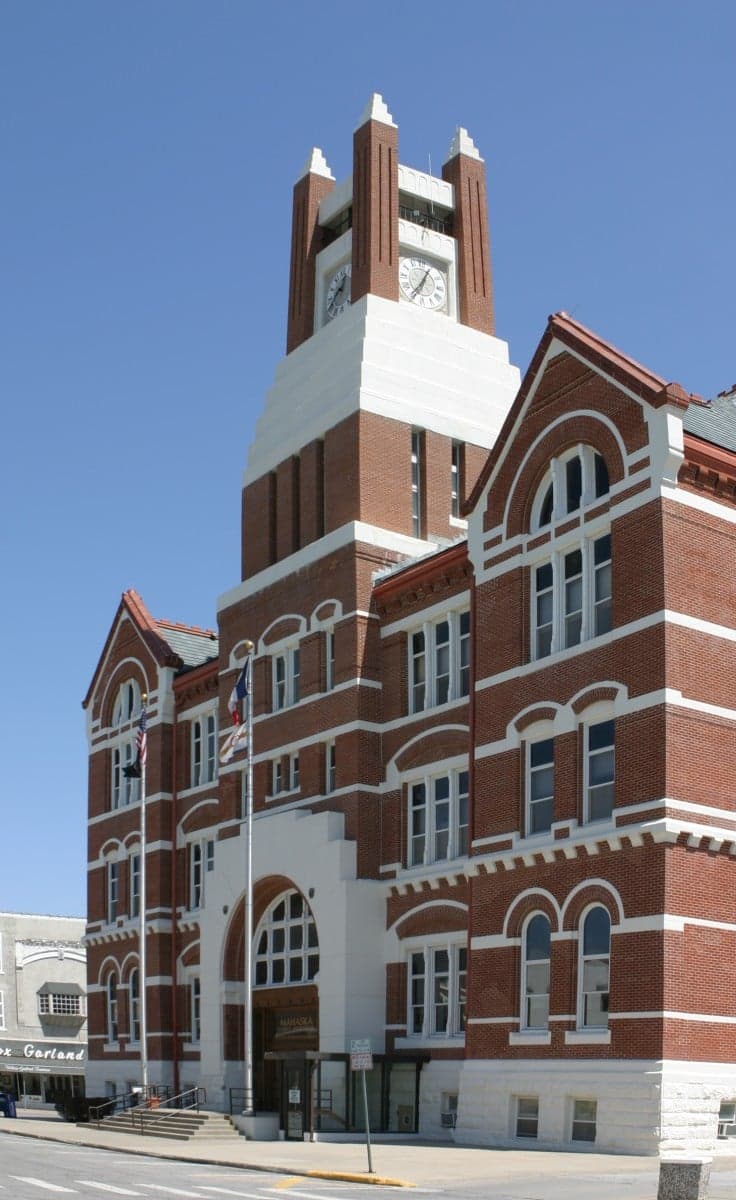
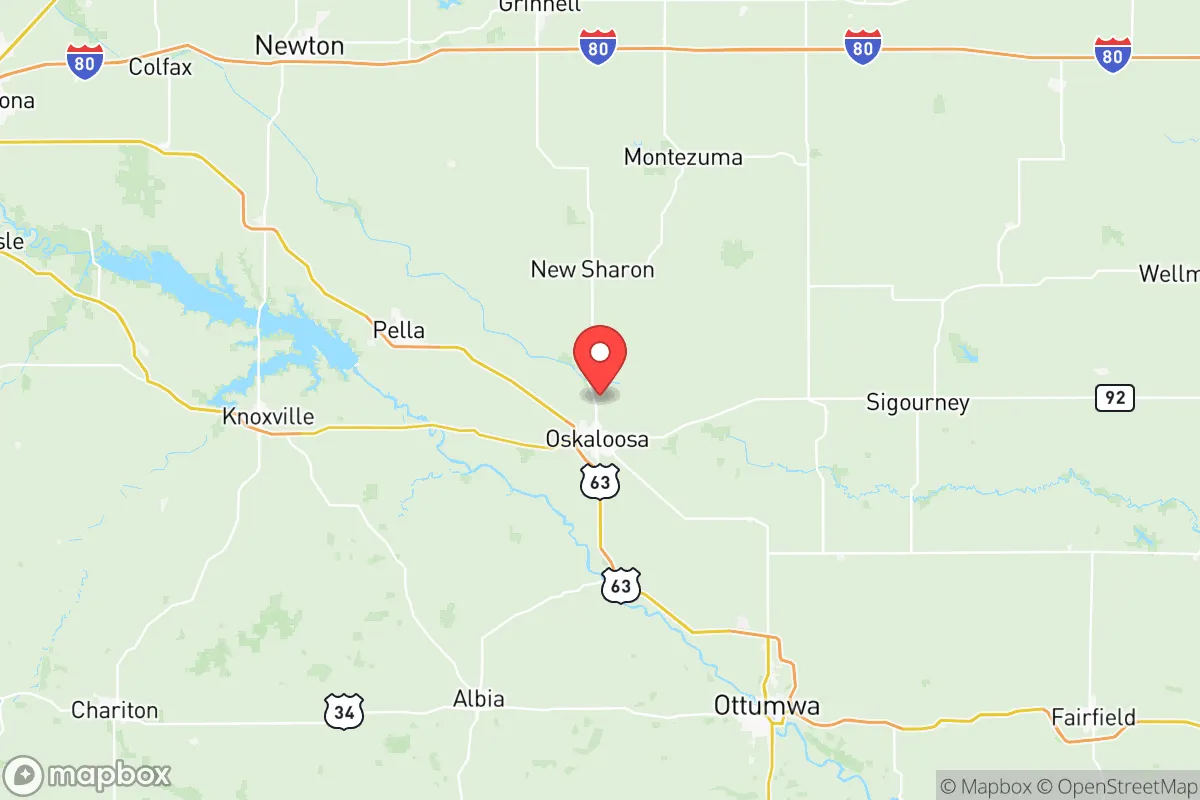
Mahaska County, Iowa, is home to 22,045 residents, a population that is 92.2% white and notably less diverse than the state and national averages, with a foreign-born share of just 1.1%. The county’s character is rooted in its agricultural and industrial past, centered on the historic town of Oskaloosa, which serves as the county seat and the primary hub for commerce, education, and community life. With a college-educated rate of 23.0%, the population is predominantly native-born and stable, reflecting a deep continuity of settlement patterns established over 150 years ago. The people of Mahaska County today are defined by a strong sense of local identity, a legacy of small-town Midwestern values, and a demographic profile that has changed very slowly compared to the rest of the nation.
Settlement & growth (pre-1960)
Before American settlement, the land that is now Mahaska County was inhabited by the Ioway (Báxoje) people, a Siouan-speaking tribe who lived in villages along the Des Moines River and its tributaries. The Ioway were gradually displaced through a series of treaties in the 1830s and 1840s, most notably the 1842 Treaty of Traverse des Sioux, which ceded the last of their Iowa lands to the United States government. The area was opened for Euro-American settlement in 1843, and the first permanent white settlers arrived shortly thereafter, primarily of English, Scots-Irish, and German stock from the older states of Ohio, Indiana, and Pennsylvania.
The county was officially organized in 1844 and named after Mahaska, a prominent Ioway chief. The earliest settlers were drawn by the promise of cheap, fertile prairie land under the Preemption Act of 1841 and later the Homestead Act of 1862. They established small farming communities, with Oskaloosa being platted in 1844 and quickly becoming the commercial and political center. Other early settlements included New Sharon, founded in 1853, and Leighton, platted in 1854, both of which grew as agricultural service towns. The arrival of the Keokuk and Des Moines Railroad in the 1850s transformed Oskaloosa into a regional shipping point for grain and livestock, spurring a population boom that saw the county grow from just over 6,000 in 1850 to over 28,000 by 1900.
The dominant immigrant group during this period was the Dutch, who began arriving in significant numbers in the 1850s and 1860s. They were drawn by the availability of land and the promise of religious freedom, with many coming from the province of Friesland. The Dutch settled heavily in and around Pella, just across the county line in Marion County, but their influence extended into northern Mahaska County, particularly in the town of Peoria and the surrounding rural townships. A smaller but notable wave of German immigrants arrived in the 1860s and 1870s, settling primarily in the southern part of the county around Barnes City and What Cheer, where they worked as farmers and miners in the coal fields that briefly boomed in the late 19th century. The coal mining industry, centered in What Cheer and Beacon, attracted a more diverse workforce, including a small number of Welsh and Irish immigrants, but this industry collapsed by the 1920s, leading to population decline in those towns.
By 1900, the county’s population had peaked at 28,805, and the ethnic composition was overwhelmingly white and native-born, with the largest foreign-born groups being Dutch, German, and Irish. The first half of the 20th century saw little new immigration, and the population began a slow, steady decline as younger residents left for urban jobs in Des Moines and beyond. The Great Depression and the Dust Bowl had a muted effect on Mahaska County compared to the Great Plains, but the mechanization of agriculture reduced the need for farm labor, accelerating the rural-to-urban shift. By 1960, the population had fallen to 22,677, a level very close to today’s figure.
Modern era (post-1965)
The 1965 Hart-Cellar Act, which dramatically reshaped U.S. immigration by eliminating national-origin quotas, had almost no impact on Mahaska County. The county’s foreign-born population has remained below 1.5% for decades, and the new immigrant groups that transformed many American communities—such as Southeast Asians, Latin Americans, and Indians—did not settle here in any meaningful numbers. The county’s demographic story since 1965 is not one of immigration but of domestic stability and gradual aging.
The most significant demographic shift in the modern era has been the continued outmigration of young adults, particularly those with college degrees, who leave for larger metropolitan areas. This has left an older, more settled population. The county’s Hispanic population, while small at 2.4%, has grown modestly since the 1990s, driven by a small number of Mexican and Central American families who work in agriculture, meatpacking, and construction. These families are concentrated in Oskaloosa, where they have formed a small but visible community centered on the local Catholic church. The Black population, at 1.5%, is also concentrated in Oskaloosa, with roots dating to the post-World War II era when a small number of African American families moved to the area for industrial jobs at the Oskaloosa-based Clow Valve Company and other manufacturers.
The East/Southeast Asian population, at 1.2%, is the most recent addition, consisting primarily of a small number of Vietnamese and Korean families who arrived in the 1980s and 1990s, often as refugees or through family reunification. They are dispersed throughout the county, with no single ethnic enclave. The Indian subcontinent population is effectively zero, reflecting the county’s lack of the high-tech or medical-research sectors that attract Indian professionals to other parts of Iowa, such as Iowa City or Des Moines. Suburbanization has been minimal; Oskaloosa remains the dominant population center, and the county’s smaller towns—University Park, Fremont, and Rose Hill—have continued to lose population as their economic bases have eroded.
The future
Mahaska County’s population is projected to remain stable or decline slightly over the next 10 to 20 years, mirroring the broader trend in rural Iowa. The county is not becoming more diverse; the white share of the population has remained above 90% for decades, and the small Hispanic and Asian communities are growing only incrementally. The primary demographic challenge is aging: the median age is rising, and the county’s school-age population has been declining, leading to school consolidations in rural areas. The county’s cultural identity is likely to remain strongly tied to its Dutch and German heritage, with events like the Oskaloosa-based Southern Iowa Fair and the Tulip Time festival in nearby Pella reinforcing a traditional Midwestern character.
New population growth, if it occurs, will likely come from domestic migration of retirees or remote workers seeking lower costs and a slower pace of life, rather than from international immigration. The county’s economic anchors—manufacturing at companies like Vermeer Corporation in Pella and Clow Valve in Oskaloosa—provide stable but not rapidly growing employment. The expansion of William Penn University in Oskaloosa could attract a small number of new residents, but the effect is likely to be modest.
For someone moving in now, Mahaska County offers a deeply rooted, stable community with a strong sense of place and low crime rates, but it is not a place of rapid demographic change or growing diversity. The population is older, predominantly white, and culturally conservative, with a pace of life that reflects its agricultural and small-town heritage. New residents will find a welcoming but insular community where long family histories matter, and where the future looks much like the past.

* Values derived from national, state, county, city and local statistics and may differ in a specific area. Last updated: 2026-06-17T19:31:43.000Z
Narrative content on this page is AI-generated and may contain mistakes. Verify any details that matter before acting on them.
ReloMaps may earn a commission from affiliate links at no extra cost to you.

