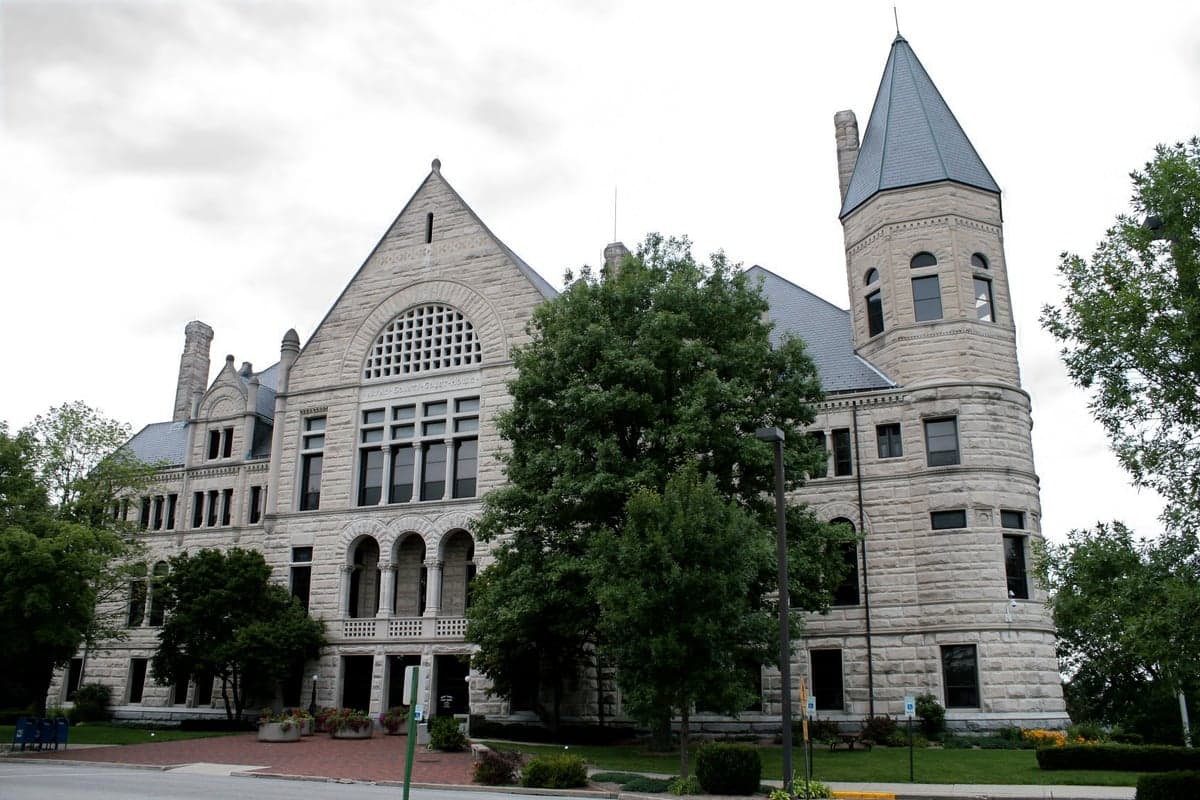
Photo: Wikipedia
Political ClimatePolitical Climate in Wayne County
Showing district-level results — no local-only data available.
Local Political AnalysisPolitical Analysis of Wayne County
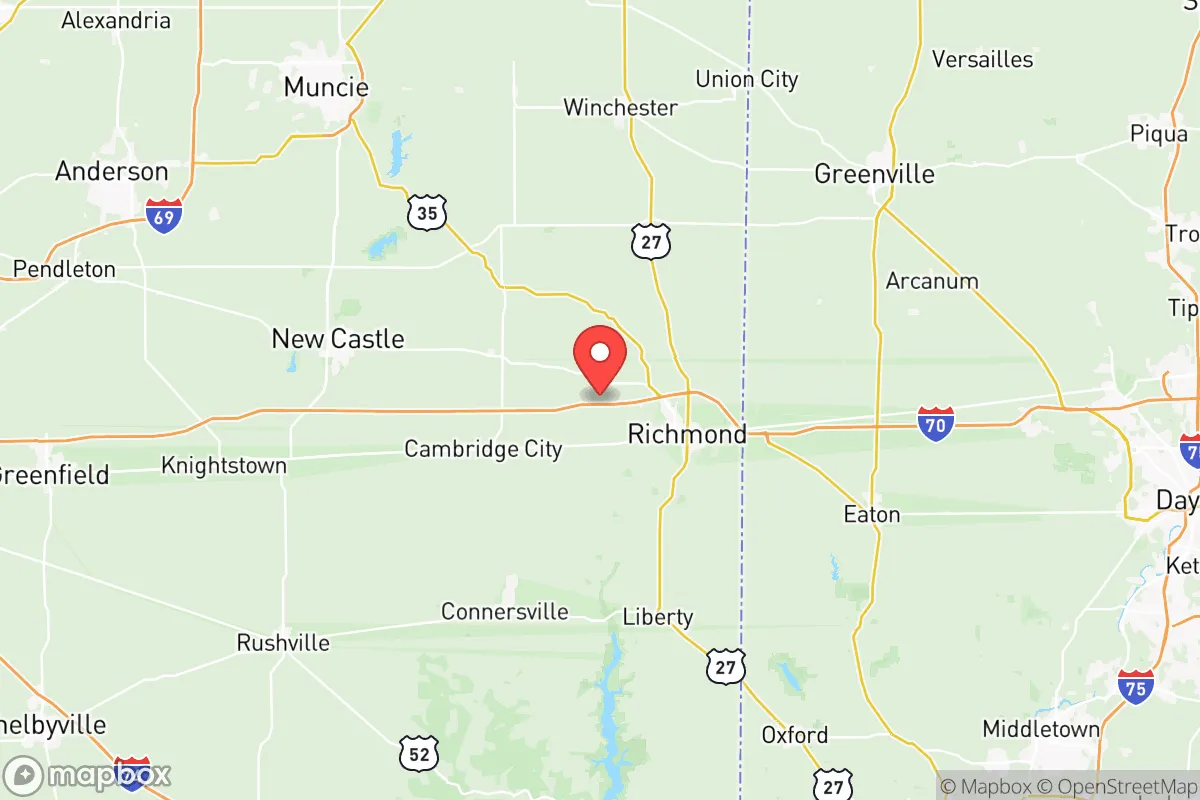
Wayne County, Indiana, is a reliably Republican area with a Cook PVI of R+16, making it significantly more conservative than the state of Indiana as a whole, which sits at R+9. This isn't a new development; the county has been trending red for decades, though the shift has accelerated in the last two presidential cycles. The real story, however, is the sharp divide between the county seat of Richmond, which has a noticeable Democratic presence, and the surrounding rural townships and smaller communities that vote overwhelmingly Republican.
How it compares
The R+16 rating puts Wayne County in the same league as neighboring dark-red counties like Union and Fayette, but it's a full seven points more conservative than the state average. That gap is driven by the rural precincts. In the 2024 election, towns like Cambridge City, Centerville, and Hagerstown routinely delivered 70-75% of their votes for Republican candidates. Meanwhile, Richmond's urban core, particularly precincts around Earlham College and the historic Old Town district, often flips to the Democratic column, sometimes by margins of 60-40 or higher. The swing precincts are in the suburban fringe of Richmond—areas like the northwestern part of the city near I-70 and the Boston area—where races are often decided by a few hundred votes. Statewide, Indiana's R+9 reflects a more balanced mix of urban (Indianapolis), suburban (Hamilton County), and rural (the rest) areas, whereas Wayne County lacks a major blue anchor like Marion County.
What this means for residents
For conservative residents, the political climate is comfortable and affirming. Local offices—county commissioners, sheriff, council—are almost entirely held by Republicans, and policy debates tend to focus on tax cuts, agricultural regulations, and Second Amendment rights. You'll find strong support for the local GOP at the Wayne County Fairgrounds during election season. For liberal residents, the reality is more nuanced. While Richmond provides a small but active Democratic base—centered around Earlham College, local nonprofits, and a handful of progressive churches—they face an uphill battle in countywide races. Socially, most people get along fine regardless of party; the divide is more about policy than personal animosity. That said, liberal residents often feel their voices are marginalized on issues like public transit funding or environmental protections, which rarely gain traction at the county level.
What this means for residents
In practice, the political lean shapes daily life in tangible ways. Property taxes are among the lowest in the state, a direct result of the county's conservative fiscal approach. Gun laws are permissive, and the local sheriff's office is vocal about Second Amendment support. On the cultural side, Wayne County is more traditional than the state average: church attendance is high, and social issues like abortion and LGBTQ+ rights are debated along predictable lines. However, Richmond's status as a regional hub for healthcare (Reid Health) and manufacturing (Belden, Dana Incorporated) means there's a pragmatic streak—economic development often trumps ideological purity. Looking ahead, the county's trajectory seems locked in: as rural areas continue to depopulate and Richmond's population slowly declines, the Republican majority is likely to hold steady or even widen, barring a major demographic shift. For anyone moving here, understanding this political reality is key—it's a place where conservative values dominate policy, but where neighborly civility usually transcends the ballot box.

State Political ClimatePolitical Climate in Indiana
State Political AnalysisPolitical Environment in the State
Indiana leans solidly Republican with a Cook PVI of R+9, but its politics are more nuanced than the label suggests—a mix of Midwestern pragmatism, shifting urban dynamics, and deeply conservative rural strongholds. Over the last 20 years, the state has moved noticeably rightward on social and economic issues while keeping a pragmatic streak on fiscal policy. The 2024 presidential results saw Donald Trump carry Indiana by roughly 19 points, but that margin was thinner in fast-growing suburbs like Hamilton County, where the GOP edge has softened from 30 points a decade ago to about 16 today.
Urban vs. rural divide
The political map breaks down along classic lines: Indianapolis and its inner-ring suburbs are a blue island in a sea of red. Marion County (Indianapolis) voted for Joe Biden in 2020 by about 30 points, but the state’s second-largest concentration of population—Lake County (Gary)—is even more Democratic, tipping Biden by 35 points. On the flip side, rural counties like Jasper, Newton, and Dubois routinely give Republicans 75% of the vote. The real battleground is the suburban ring around Indianapolis: Carmel and Fishers in Hamilton County have grown diverse and more moderate, while Noblesville and Westfield remain deeply red. Fort Wayne (Allen County) and Evansville (Vanderburgh County) lean Republican but with Democratic pockets in the city cores. South Bend (St. Joseph County) and Bloomington (Monroe County) are reliable blue anchors for the state's left—Bloomington's liberal identity drives the overall lean of the region. The rural-urban split in Indiana is wide and getting sharper: cities are diversifying and moving left, while small towns are solidifying into Trump country.
Policy environment
Indiana has a low-tax policy reputation, anchored by a flat personal income tax of 3.15% (phased down from 3.23%), and a 7% corporate income tax. Property taxes are capped at 1% of assessed value for owner-occupied homes. The state is a right-to-work state—though that law was repealed in 2025, a notable shift after more than a decade of anti-union policy. Regulatory posture is business-friendly, with no state-level minimum wage above the federal $7.25. Education policy leans heavily into school choice: Indiana’s voucher program (Choice Scholarship) and charter expansion are among the most robust in the country. On healthcare, the state operates a Medicaid expansion (HIP 2.0) with premiums and copays, a compromise model under then-Governor Mike Pence. Election laws are among the strictest in the Midwest: Indiana requires a photo ID to vote and does not offer no-excuse absentee voting. Same-day registration is not permitted, and early voting is available but limited.
Recent policy direction
The last five years have seen a flurry of conservative legislation. Senate Enrolled Act 1 (2022) banned nearly all abortions in Indiana—no exceptions for rape or incest—making it one of the first states to pass a near-total ban after Dobbs. House Enrolled Act 1296 (2022) made Indiana a permitless carry (constitutional carry) state for handguns, removing the license requirement. Transgender sports bans (HEA 1041, 2022) and bathroom restrictions (HEA 1608, 2023) passed along party lines. On parental rights, HEA 1131 (2023) requires schools to notify parents of curricula involving “human sexuality,” and gives parents the right to opt their kids out. Property rights saw a boost with increased compensation requirements for eminent domain. On ballot access, the state has tightened absentee ballot return rules and limited drop boxes—a trend that continues. Overall, the direction is a full-spectrum conservative agenda on culture, guns, and education, while maintaining fiscal moderation.
Civil unrest & political movements
Indiana’s political flashpoints hit hardest in Indianapolis. The 2020 George Floyd protests saw several nights of unrest in downtown Indy and the Circle Centre Mall area, but the state avoided the prolonged violence of larger cities. On the right, the Indiana State Teachers Association and other groups have staged multiple protests at the Statehouse against voucher expansion and curriculum transparency laws. Immigration politics are quieter: no sanctuary counties exist, and several rural counties (like Morgan and Hendricks) passed symbolic anti-sanctuary resolutions. Election integrity controversies flared after 2020, with some county GOP groups questioning mail-in voting, but no widespread fraud evidence emerged. Anti-abortion activists hold annual “March for Life” rallies at the Statehouse, while pro-choice groups have organized a “Rally for Reproductive Rights” each spring since the ban. Visible divisions are mostly confined to Statehouse rallies and local school board meetings, especially in suburban districts where parents debate book bans and classroom content.
Projection
Over the next 5 to 10 years, Indiana’s political lean is likely to remain solidly Republican, but the margins will narrow in suburban counties like Hamilton, Boone, and Johnson as in-migration continues from Illinois and other blue states. Indianapolis will become more Democratic and more diverse, potentially flipping more state legislative seats. Rural counties will stay deep red, but population loss may reduce their influence. The flat tax structure and business climate will continue to attract transplants, especially conservatives seeking lower taxes and cultural alignment. However, the repeal of right-to-work signals some space for labor politics to resurge. Education policy will remain a battleground as voucher programs expand and public school funding lags. Expect more legislation on transgender rights, abortion restrictions, and parental control—Indiana’s trajectory is toward an increasingly active culture-war conservative agenda rather than a retreat.
For a new resident, the practical takeaway is straightforward: if you share the conservative majority’s values on guns, abortion, taxes, and school choice, you’ll find Indiana welcoming and aligned with your priorities. If you lean left, you’ll feel at home in Bloomington, Indianapolis, or near the Lake Michigan shore, but statewide policy will often work against your preferences on social and cultural issues. Either way, Indiana offers a stable, low-cost environment with a clear political weather—just know which side of the urban-rural line you’re planting your flag on.
* Values derived from national, state, county, city and local statistics and may differ in a specific area. Last updated: 2026-06-20T18:52:18.000Z
Narrative content on this page is AI-generated and may contain mistakes. Verify any details that matter before acting on them.
ReloMaps may earn a commission from affiliate links at no extra cost to you.

