Photo: Wikipedia
Demographics of Wayne County
Affluence Level in Wayne County
A below-average socioeconomic profile. Incomes, home values, and educational attainment trail the U.S., with higher poverty and unemployment.
People of Wayne County
Wayne County, Indiana is a predominantly white, rural-rooted community of 66,377 residents where 86.2% of the population identifies as non-Hispanic white and only 2.1% are foreign-born. The county carries a distinctly Midwestern character – quiet, family-oriented, and deeply tied to its 19th-century Quaker and German settlement origins, with a college-attainment rate of 20.2% that reflects a working-class industrial heritage rather than a knowledge-economy hub. Its population centers, led by the county seat of Richmond and surrounded by small towns like Centerville, Cambridge City, and Hagerstown, remain stable and sparsely diverse, with modest Hispanic (3.8%) and Black (4.0%) communities concentrated mainly in Richmond proper.
Settlement & growth (pre-1960)
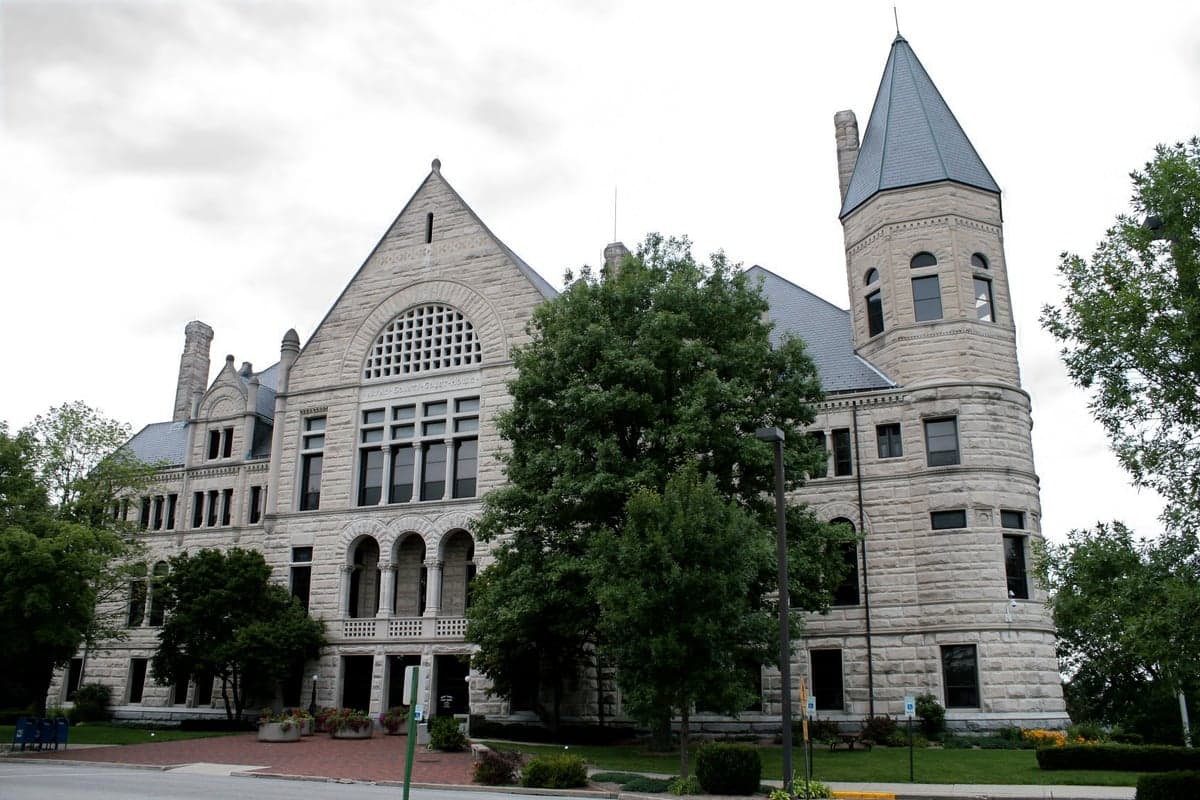
Long before European settlement, the region now known as Wayne County was home to the Miami and Delaware nations, who utilized the Whitewater River valley for hunting and seasonal camps. The first permanent Euro-American settlers were Quaker families from North Carolina and Pennsylvania, arriving in the early 1800s attracted by cheap federal land and the promise of religious freedom. They established the town of Richmond in 1806 and quickly spread to Centerville (founded 1811), which became the original county seat and a hub for the Underground Railroad – most famously through the Levi Coffin House in adjacent Fountain City. These early Quaker settlers brought a strong abolitionist and temperance tradition that shaped the county’s political culture for generations.
By the 1830s and 1840s, German and Swiss immigrants began arriving, many settling in Hagerstown and the rural townships around Milton and New Paris. They found work as farmers, millers, and craftsmen, and their cultural imprint remains in the brick architecture of Cambridge City’s historic canal district. The 1850s saw a wave of Irish immigrants drawn to railroad construction and the Whitewater Canal, though many moved on to larger cities. After the Civil War, freed Black families moved into Wayne County, concentrated in Richmond’s “Black neighborhood” around South 11th Street, working in domestic service, foundries, and later the auto parts industry.
The industrial boom of the early 20th century transformed Richmond into a manufacturing center for automobiles (Richmond Motor Company, early Duesenberg ventures) and farm equipment (Wayne Works, later part of American Hoist and Derrick). This drew additional European immigrants – Poles and Italians arrived around 1910–1920 – and also pulled in white domestic migrants from Appalachia and the rural South during the 1920s and 1930s. The county’s population peaked at roughly 74,000 in 1960, with Richmond alone accounting for over 40,000 residents.
Modern era (post-1965)
The 1965 Hart-Cellar Immigration Act had minimal demographic impact in Wayne County. Unlike booming suburban counties in the Sun Belt, Wayne County saw no notable new immigrant enclaves; the foreign-born share remains a very low 2.1%. Instead, the dominant population story after 1965 was industrial decline and domestic out-migration. As manufacturing plants closed or downsized through the 1970s and 1980s – including the massive Wayne Works facility in Richmond – the county lost roughly 10% of its population, with younger families leaving for Indianapolis, Columbus, or the South. This hollowing-out hit Richmond’s downtown and older industrial neighborhoods hardest.
Suburbanization within the county did occur, but modestly. Families moved from Richmond to surrounding communities like Centerville and Cambridge City, drawn by lower taxes and larger lots, while Hagerstown and Fountain City retained their small-town feel. The county’s Black population, which peaked around 6% in the 1980s, declined slightly as second- and third-generation families left for larger metros; it now stands at 4.0%. The Hispanic population began to grow in the 1990s and 2000s, reaching 3.8%, largely due to Mexican immigrants and their U.S.-born children working in agriculture (corn, soy, and hog operations) and light manufacturing in and around Richmond. The East/Southeast Asian population (0.8%) and Indian subcontinent population (0.2%) remain tiny, consisting mostly of professionals associated with Earlham College and Reid Health hospital in Richmond.
The future
Demographic projections suggest Wayne County will continue to age and shrink slowly, as it has since 1960, unless it attracts a new wave of in-migrants. The white majority (86.2%) is older on average, and natural decrease (more deaths than births) is offsetting any slight gains from Hispanic and Black families moving in. The county’s affordable housing stock – median home values well below state averages – could draw remote workers and early retirees from pricier areas, especially to historic towns like Centerville and Cambridge City. However, the low college-attainment rate (20.2%) and limited professional job growth constrain inbound migration.
Diversity will likely increase only gradually. The Hispanic share may approach 5–6% by 2040, and the Black share could stabilize around 4–5%, but the county will remain overwhelmingly white. New communities are forming not as ethnic enclaves but as exurban subdivisions dotted among cornfields – places like Boston and Dublin adding a few homes each year. Culturally, Wayne County is becoming slightly more suburban in outlook while retaining its Quaker-influenced respect for civic duty, hard work, and neighborly self-reliance.
For a family or individual moving in now, Wayne County offers a stable, affordable base where traditional values hold, the pace of life is unhurried, and the strongest identity markers are historical rather than trendy. It is not a place of rapid change or dense diversity, but one where a newcomer can quickly feel rooted in a community that knows its own story. The people here are cautious, self-sufficient, and welcoming to those who share their appreciation for quiet, slow-growing places.

* Values derived from national, state, county, city and local statistics and may differ in a specific area. Last updated: 2026-06-20T18:52:18.000Z
Narrative content on this page is AI-generated and may contain mistakes. Verify any details that matter before acting on them.
ReloMaps may earn a commission from affiliate links at no extra cost to you.

