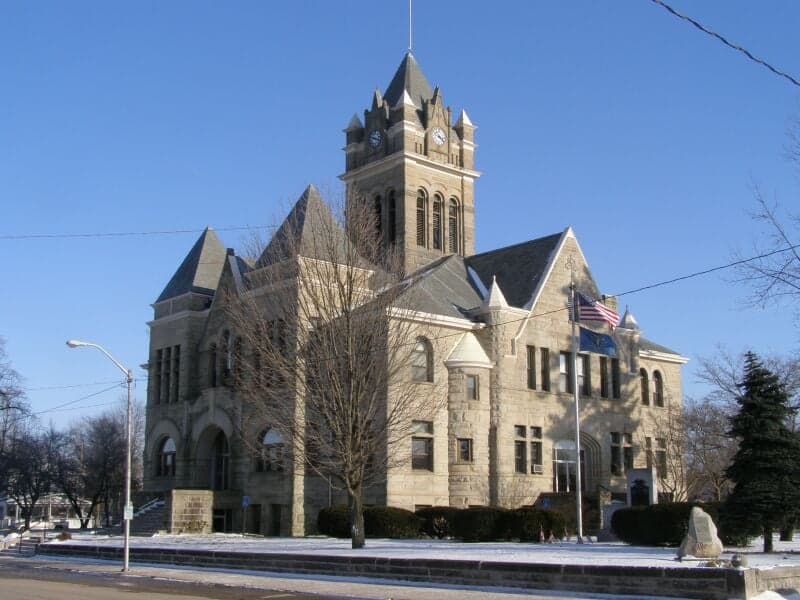
Photo: Wikipedia
Political ClimatePolitical Climate in Pulaski County
Showing county-level results — no local-only data available.
Lean and PVI are calculated from this county’s 2020 and 2024 presidential results, Cook-style.
Political rankings in Indiana
- Most Conservative Cities in Indiana
- Most Liberal Cities in Indiana
- Best Liberal-Leaning Towns in the Midwest
- Safest Liberal-Leaning Towns in the Midwest
- Safest Conservative-Leaning Towns in the Midwest
- Affordable Small Towns for Conservatives
- Most Affordable Liberal-Leaning Small Towns in the U.S.
- Safest Conservative-Leaning Cities in the U.S.
- Most Conservative Counties in Indiana
- Most Liberal Counties in Indiana
Local Political AnalysisPolitical Analysis of Pulaski County
Pulaski County, Indiana, is a reliably Republican stronghold with a Cook PVI of R+13, making it significantly more conservative than the state of Indiana as a whole, which sits at R+9. This isn't a recent shift; the county has voted for the GOP presidential candidate in every election since 2000, often by margins exceeding 30 points. The real story is the subtle internal variation—while the county is deeply red, the intensity of that red fades as you move from the rural farmlands into the small towns, and it's been slowly deepening over the past decade as national polarization has hardened local allegiances.
How it compares
Compared to Indiana's statewide R+9 rating, Pulaski County's R+13 is a meaningful jump, placing it among the more conservative rural counties in the northern part of the state. The difference isn't just in raw numbers; it's in the texture of political life. In the county seat of Winamac, you'll find a mix of small-business owners and county employees who lean Republican but are often pragmatic, especially on local issues like road funding and school budgets. Drive 10 miles north to Francesville, and the politics get noticeably more hardline—this is a town where the local grain elevator and the church parking lot are the main social hubs, and conversations about taxes or government overreach are common. The only real exception is Medaryville, a smaller, more transient community near the Jasper-Pulaski Fish and Wildlife Area, where a handful of precincts have shown slightly more competitive margins, often due to a mix of state employees and seasonal workers. But even there, no precinct has gone blue in a presidential race since 2008. The county's trajectory is clear: as the state has moved right, Pulaski County has moved with it, and the small pockets of Democratic-leaning voters—mostly in Winamac's older neighborhoods—are shrinking.
What this means for residents
For conservative residents, the political climate is comfortable and affirming. Local elected offices—county commissioner, sheriff, school board—are almost entirely held by Republicans, and policy debates tend to focus on keeping taxes low, supporting agriculture, and maintaining rural infrastructure. There's little friction in daily life for a conservative voter; the local newspaper, the Pulaski County Journal, reflects that lean, and community events like the Winamac Town-Wide Rummage Sales or the Pulaski County 4-H Fair are non-political spaces where shared values are assumed. For liberal residents, the reality is more isolating. There is no organized Democratic Party presence to speak of, and progressive viewpoints are rarely voiced in public forums. A liberal resident in Winamac might find like-minded friends through the county library or the local arts council, but they'll likely keep political opinions private to avoid awkwardness at the grocery store or church. The practical effect is that policy debates are narrow—issues like zoning reform, renewable energy siting, or public health mandates rarely get a full airing because the political spectrum is so compressed.
Culturally, Pulaski County stands apart from Indiana's urban and suburban centers. There's a strong sense of self-reliance and a wariness of outside influence, whether from Indianapolis or Washington. The county's large Amish and Mennonite populations in the northern townships add a distinctive layer—they vote at low rates but shape local politics through their emphasis on land use, school choice, and minimal government. The biggest policy distinction you'll notice is in how the county handles growth: there's little appetite for the kind of development seen in nearby counties like Jasper or Marshall. New housing subdivisions, solar farms, or wind turbines face steep skepticism, often framed as threats to the agricultural character of the place. For anyone moving here, understanding that this isn't just a red county—it's a county that actively resists change—is key to fitting in. The political climate isn't hostile; it's just deeply settled, and newcomers who respect that will find a welcoming, if politically uniform, community.

State Political ClimatePolitical Climate in Indiana
State Political AnalysisPolitical Environment in the State
Indiana has been reliably Republican for decades, with a Cook Partisan Voting Index of R+9, meaning it votes about nine points more Republican than the nation as a whole. The state hasn't backed a Democrat for president since 2008, when Barack Obama narrowly won it, and that was largely due to a massive turnout in the northwest corner and a weak Republican opponent. Since then, the GOP has solidified its grip, with Donald Trump winning the state by 16 points in 2020 and 19 points in 2024. The real story, though, is the slow but steady shift: the Indianapolis suburbs are getting bluer, while the rest of the state—especially the smaller industrial cities and rural areas—has moved sharply right.
Urban vs. rural divide
The political map of Indiana is a classic study in contrasts. The state's two major population centers, Indianapolis and Fort Wayne, are the anchors of the blue vote, but even they are far from monolithic. Marion County (Indianapolis) has trended Democratic for years, driven by a growing minority population and a liberal-leaning professional class. In 2024, Kamala Harris won Marion County by about 15 points. But drive ten miles north to Hamilton County—home to the affluent suburbs of Carmel, Fishers, and Noblesville—and you hit deep red territory. Hamilton County voted for Trump by 18 points in 2024, though that margin has been shrinking as more white-collar professionals move in from other states. The real Republican strongholds are the rural counties: places like Jasper County (northwest), Dubois County (south), and the entire Wabash Valley. These areas vote 70-80% Republican. The swing counties that decide statewide races are the old industrial towns like Kokomo, Anderson, and Muncie, which were once reliably blue but have flipped hard red over the past decade, driven by cultural and economic grievances. The northwest corner, around Gary and Hammond, remains a Democratic bastion, but its population is shrinking, diluting its influence.
Policy environment
Indiana's policy environment is consistently conservative, with a few notable exceptions. The state has a flat income tax rate of 3.05% (down from 3.15% in 2025, with a scheduled phase-down to 2.9% by 2029). Property taxes are relatively low, capped at 1% of assessed value for owner-occupied homes. There is no estate tax. The regulatory posture is business-friendly: Indiana is a right-to-work state (though that law was repealed in 2025, a major shift), and it has a low corporate tax rate of 4.9%. On education, the state has one of the most robust school choice programs in the country, with universal vouchers available to all families regardless of income. The state also has a near-total abortion ban, passed in 2022, with exceptions only for rape, incest, and lethal fetal anomalies. Election laws are moderately restrictive: voter ID is required, early voting is available but limited, and no-excuse absentee voting was eliminated in 2023. Gun laws are permissive: permitless carry was enacted in 2022, and there are no red-flag laws or waiting periods.
Recent policy direction
The last few years have seen Indiana's legislature push aggressively on cultural and liberty issues. In 2023, the state passed a law banning gender-affirming care for minors, which was later upheld by the Seventh Circuit. In 2024, the legislature passed a "Parents' Bill of Rights" that requires schools to notify parents of any curriculum related to sexuality or gender identity and to obtain parental consent before a student can change their name or pronouns. On gun rights, the 2022 permitless carry law was a major victory for Second Amendment advocates. On privacy, Indiana passed a consumer data privacy law in 2023, but it's relatively weak compared to California or Virginia. On property rights, the state has been active in limiting local control: in 2024, the legislature preempted local governments from banning natural gas hookups in new construction. On taxation, the trend is toward lower rates, with the flat income tax scheduled to drop further. On voting, the 2023 law eliminating no-excuse absentee voting was a clear tightening of ballot access. For a relocator weighing these factors: Indiana is a state where the government is actively expanding gun rights and parental control over education, while restricting abortion access and transgender medical care. It's a state where your tax burden is low and your property rights are strong, but your local government has limited ability to set its own rules on things like energy or housing.
Civil unrest & political movements
Indiana has seen its share of political flashpoints, but they tend to be localized rather than statewide. The most visible recent unrest was in 2020, when Indianapolis saw several nights of protests and some property damage following the murder of George Floyd. The city's police department has been under a federal consent decree since 2022 over patterns of excessive force. On the right, the most organized movement is the "Indiana Freedom Coalition," a network of conservative activists that has successfully pushed for school board takeovers and library board challenges in places like Hamilton County and Johnson County. Immigration politics are less heated than in border states, but there have been flashpoints: in 2024, the state sent National Guard troops to Texas as part of Operation Lone Star, and the legislature passed a bill requiring local law enforcement to cooperate with ICE. There is no sanctuary city movement of any significance; even Indianapolis, the most liberal city, has a "welcoming city" ordinance that limits but does not prohibit cooperation with federal immigration authorities. Election integrity controversies have been minimal; Indiana's voter ID law is long-standing and widely accepted. The most visible political movement a new resident would notice is the proliferation of "Don't Tread on Me" flags and "Let's Go Brandon" signs in rural areas, alongside "In This House, We Believe" signs in the liberal enclaves of Bloomington and the near-east side of Indianapolis.
Projection
Over the next 5-10 years, Indiana is likely to remain solidly Republican, but the margins will probably shrink slightly. The key demographic trend is the continued growth of the Indianapolis suburbs, particularly Carmel, Fishers, and Westfield, which are attracting young professionals from blue states. These voters tend to be fiscally conservative but socially moderate, and they are slowly pulling Hamilton County to the left. At the same time, the rural population is aging and shrinking, which could reduce the GOP's raw vote totals. The wild card is the industrial towns: if the economy in places like Elkhart and Columbus continues to struggle, those voters could become more volatile. The state's political trajectory is one of slow, grudging moderation on cultural issues, driven by business interests that want to attract talent, but the legislature is likely to remain conservative on guns, abortion, and education for the foreseeable future. A new resident moving in now should expect to find a state that is reliably red but not static, with a growing suburban middle that will eventually force the GOP to moderate on some issues, but not anytime soon.
For a new resident, the bottom line is this: Indiana is a state where your taxes are low, your gun rights are broad, and your local school board is likely to be a battleground over curriculum and parental rights. If you're conservative, you'll find a welcoming policy environment and a like-minded community in most places outside of Indianapolis and Bloomington. If you're liberal, you'll find a few blue islands—the near-east side of Indianapolis, the college towns of Bloomington and West Lafayette, and the lakefront communities of Michigan City and Chesterton—but you'll be living in a state where your vote is unlikely to matter in statewide elections. The practical takeaway: Indiana is a good fit for someone who values low taxes, strong property rights, and a conservative cultural environment, but it's not a place where you'll find much political diversity or local autonomy. It's a state that knows what it is and isn't trying to be anything else.
* Values derived from national, state, county, city and local statistics and may differ in a specific area. Last updated: 2026-11-08T12:39:31.000Z
Narrative content on this page is AI-generated and may contain mistakes. Verify any details that matter before acting on them.
ReloMaps may earn a commission from affiliate links at no extra cost to you.

