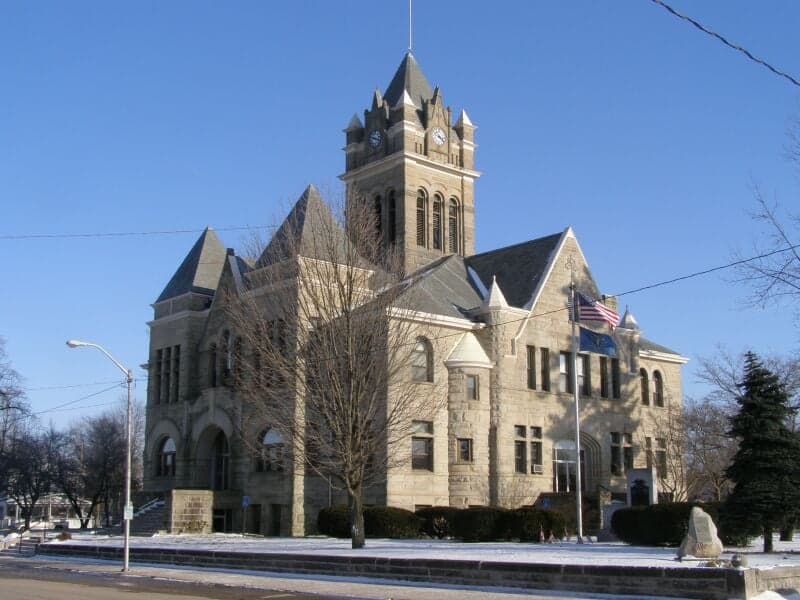
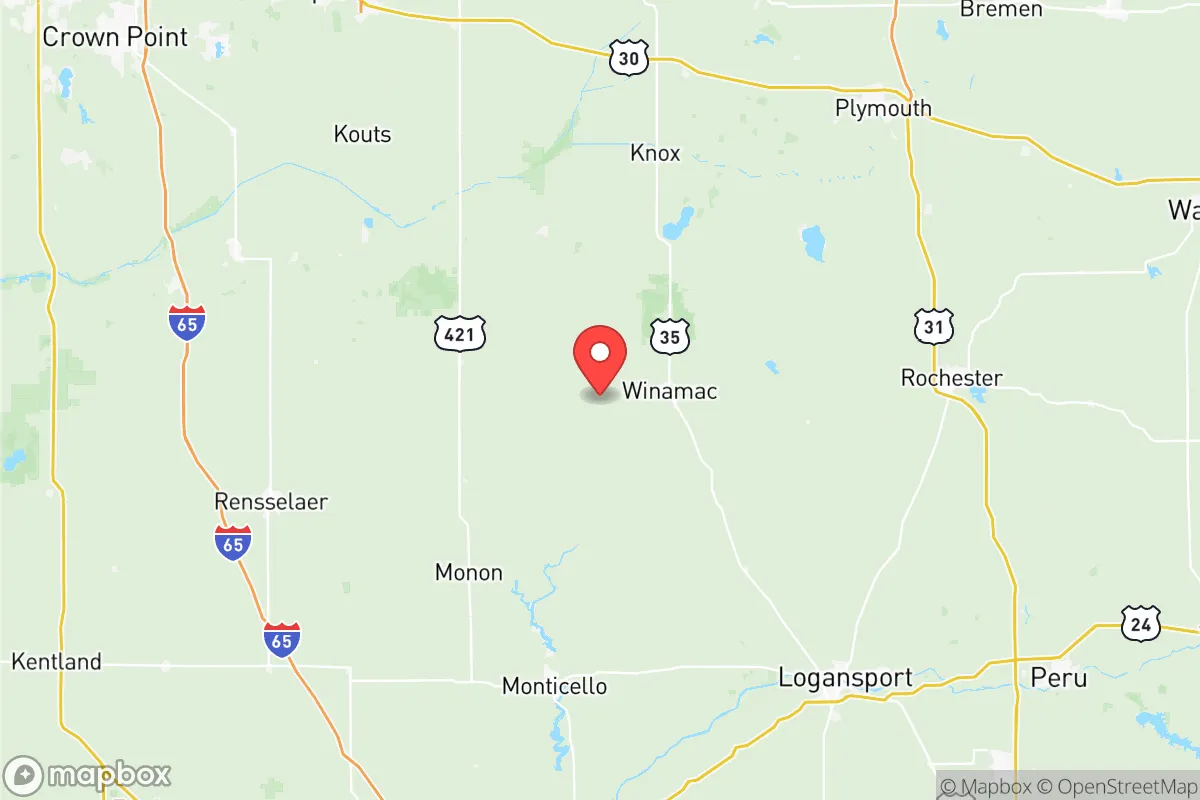
Photo: Wikipedia
Demographics of Pulaski County
Affluence Level in Pulaski County
A middle-class area roughly in line with national averages across income, home values, education, and employment.
People of Pulaski County
Pulaski County, Indiana, is a rural, predominantly white community of 12,441 residents where the population has remained remarkably stable over the past century, shaped by waves of European immigration and agricultural settlement. The county’s identity is rooted in its small towns—Winamac, Francesville, Medaryville, and Monterey—where family farms, local manufacturing, and a strong sense of self-reliance define daily life. With a foreign-born population of just 1.5% and a Hispanic share of 3.9%, Pulaski County is far less diverse than Indiana as a whole, and its character reflects the enduring legacy of its 19th-century settlers.
Settlement & growth (pre-1960)
Before American settlement, the area now known as Pulaski County was part of the traditional homeland of the Miami and Potawatomi nations, who used the Tippecanoe River and its tributaries for fishing, travel, and seasonal camps. The United States forcibly removed most of these Native peoples in the 1830s under the Indian Removal Act, opening the land to white settlers. Pulaski County was formally organized in 1839, carved from parts of Cass and St. Joseph counties, and named after the Polish-born Revolutionary War hero Casimir Pulaski.
The first major wave of settlers arrived in the 1840s and 1850s, primarily Yankee migrants from New England and New York—farmers and tradesmen seeking cheap, fertile land along the Tippecanoe River. They founded the county seat of Winamac (1840) and the smaller hamlets of Medaryville (1851) and Monterey (1850). These early settlers were overwhelmingly Protestant, English-speaking, and politically Whig-to-Republican, establishing a cultural template that persists today.
A second, distinct wave came in the 1860s through the 1880s: German Catholic immigrants, drawn by railroad construction jobs and the promise of affordable farmland. They established the town of Francesville (named after a local landowner’s wife) and the unincorporated community of Star City. German farmers brought a tradition of mixed livestock-and-crop agriculture—corn, soybeans, and hogs—that remains the backbone of the county’s economy. By 1900, Germans and their descendants made up roughly a third of the county’s population, and their Catholic churches (St. James in Francesville, St. Joseph in Winamac) became enduring community anchors.
A smaller but notable group of Polish immigrants arrived in the 1890s and early 1900s, settling primarily in Winamac and Medaryville to work in the county’s sawmills and on the expanding Monon Railroad line. They established St. Peter’s Catholic Church in Winamac, which still holds an annual Polish festival. The county’s population peaked at roughly 14,000 in 1910 and then plateaued, as the agricultural economy could not support rapid growth. The Dust Bowl and Great Depression had little direct impact here—the county’s diversified farming weathered the era better than the Great Plains—but outmigration to industrial cities like Gary and South Bend began in the 1940s and accelerated after World War II.
Modern era (post-1965)
The 1965 Hart-Cellar Act had almost no effect on Pulaski County’s demographics. Unlike urban Indiana counties that saw new immigration from Latin America and Asia, Pulaski County remained overwhelmingly white and native-born. The foreign-born share has hovered between 1% and 2% for decades, with the small immigrant population consisting mostly of Mexican-origin farmworkers who arrived seasonally from the 1970s onward, some of whom settled permanently in Francesville and Winamac to work in the county’s hog-processing plants and vegetable farms. Today, the Hispanic population stands at 3.9%—the county’s largest minority group—and is concentrated in these two towns, where a handful of Spanish-language services and a small Catholic Mass in Spanish are available.
Domestic migration has been the dominant demographic force since 1970, and it has been a story of slow, steady loss. The county’s population declined from 13,000 in 1970 to 12,441 in 2020, as young adults left for college and jobs in Lafayette, Indianapolis, and beyond, and few newcomers moved in to replace them. The county has seen a modest influx of retirees from the Chicago area since the 1990s, drawn by lower property taxes and the quiet of the Tippecanoe River valley, particularly around Lake Bruce and Lake Freeman (the latter shared with White County). These retirees are almost entirely white and tend to be politically conservative, reinforcing the county’s existing cultural lean.
Suburbanization has largely bypassed Pulaski County. There are no major subdivisions or exurban developments; the county’s towns have remained small, with Winamac (population ~2,300) as the largest. The county’s racial composition has barely shifted: White: 91.9%, Black: 0.3%, East/Southeast Asian: 0.4%, Indian subcontinent: 0.0%. The college-educated share is just 13.7%, well below the state average of 27%, reflecting the county’s agricultural and blue-collar employment base.
The future
Pulaski County’s population is projected to remain flat or decline slightly over the next 10–20 years, as the county’s older residents age and younger cohorts continue to leave for urban areas. The Hispanic share is likely to grow modestly—perhaps to 6–8% by 2040—driven by natural increase and continued recruitment of farm and food-processing labor, but the county will remain overwhelmingly white. No significant Asian, Indian, or Black population growth is expected, as the county lacks the job base or cultural infrastructure to attract these groups.
The county’s cultural identity is likely to stay rooted in its agricultural and small-town traditions, with a strong conservative political tilt. The main demographic change will be aging: the median age (43.5 in 2020) is already above the state median, and the share of residents over 65 will rise as the retiree-influx from Chicago continues. This will increase demand for healthcare and senior services but will not fundamentally alter the county’s character. New residents will continue to be overwhelmingly white, native-born, and drawn by low cost of living and rural quiet—not by diversity or urban amenities.
For someone moving in now, Pulaski County offers a stable, predictable community where neighbors know each other, schools are small, and the pace of life is slow. The trade-off is limited economic opportunity, minimal ethnic diversity, and a population that is slowly shrinking. It is a place for those who value continuity over change, and who are comfortable in a community where nearly everyone shares a similar background and worldview.

* Values derived from national, state, county, city and local statistics and may differ in a specific area. Last updated: 2026-11-08T12:39:31.000Z
Narrative content on this page is AI-generated and may contain mistakes. Verify any details that matter before acting on them.
ReloMaps may earn a commission from affiliate links at no extra cost to you.

