Photo: Wikipedia
Demographics of Marshall County
Affluence Level in Marshall County
A middle-class area roughly in line with national averages across income, home values, education, and employment.
People of Marshall County
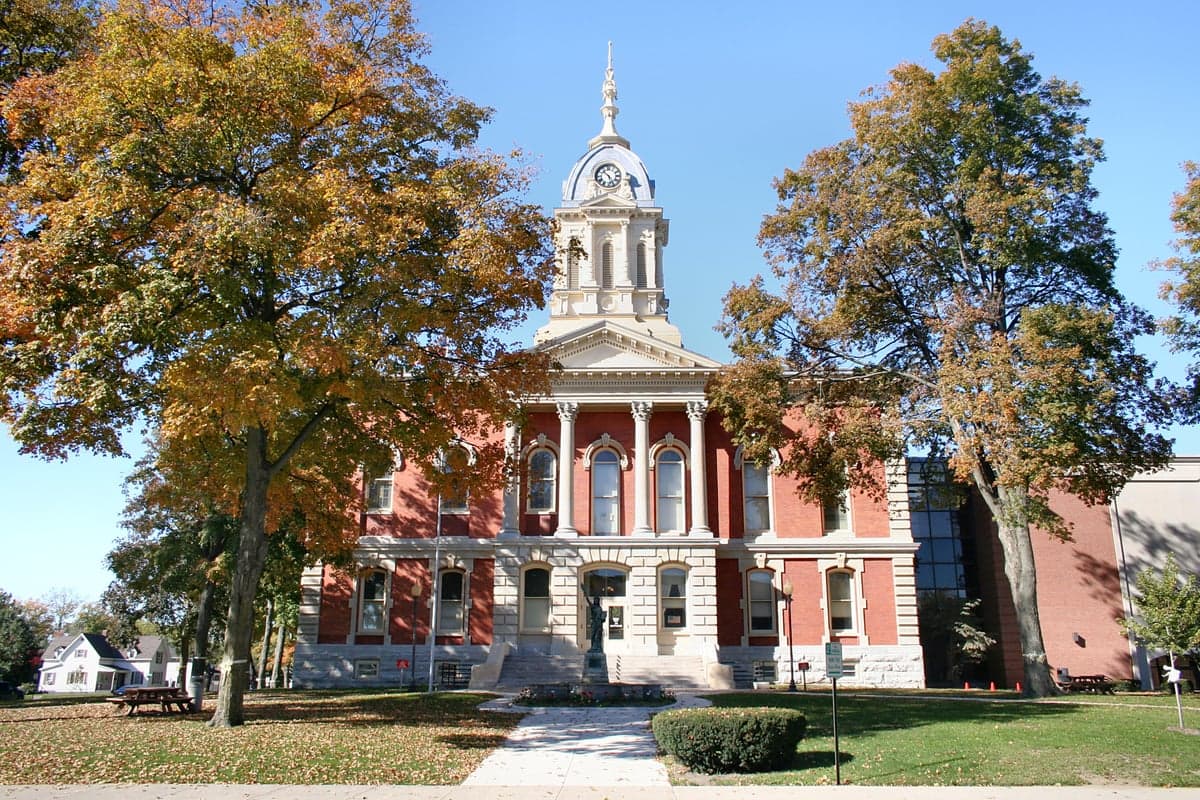
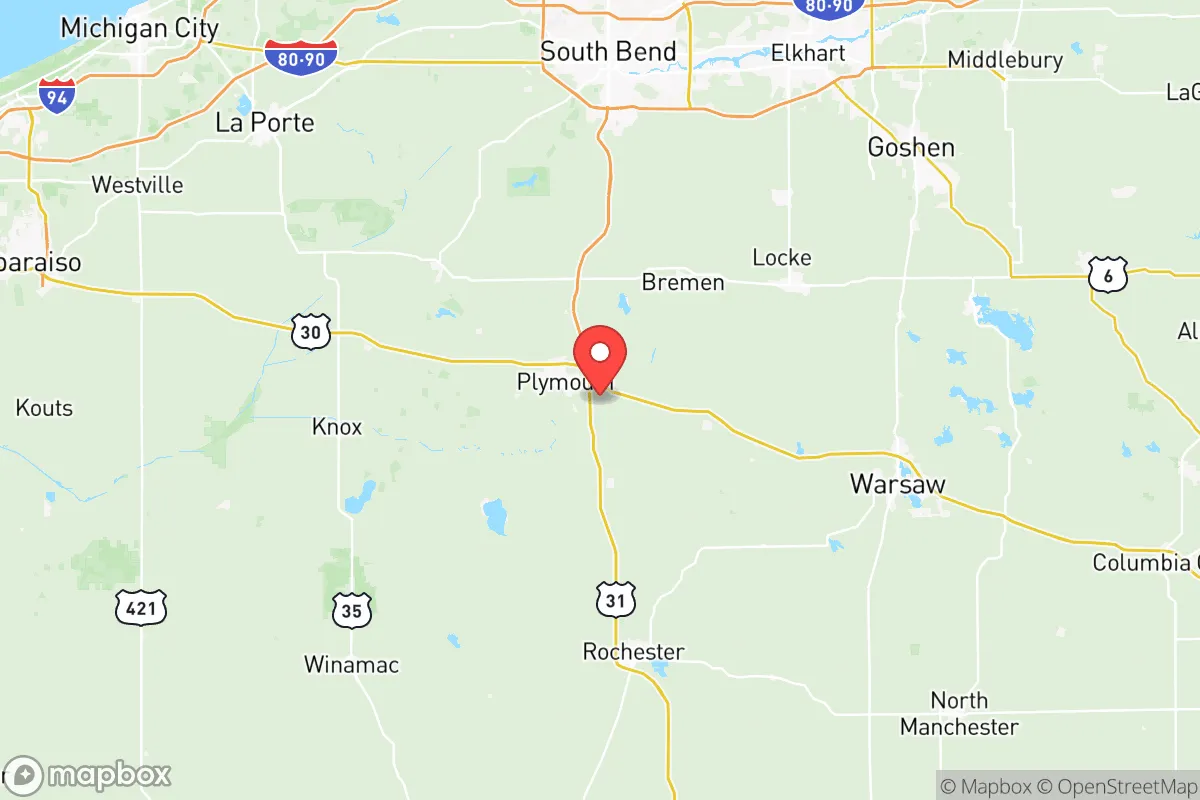
Marshall County, Indiana, is a predominantly white, rural county of 46,225 residents where the population is older and more rooted than the national average, with a distinct small-town, Midwestern character shaped by waves of European immigration. The county seat of Plymouth anchors the community, while the cities of Bremen, Bourbon, Culver, and Argos each retain distinct ethnic and economic identities from their founding eras. With a foreign-born population of just 3.4% and a white share of 85.4%, Marshall County remains one of Indiana’s more homogeneous counties, though a growing Hispanic community of 11.6% is gradually reshaping the cultural landscape of its towns and agricultural corridors.
Settlement & growth (pre-1960)
Before American settlement, the land that became Marshall County was home to the Potawatomi people, who maintained villages along the Yellow River and around the lakes that dot the region, including what is now Lake Maxinkuckee near Culver. The Potawatomi were forcibly removed in the 1830s under the federal Indian Removal Act, with most marched west on the Trail of Death in 1838, a route that passed directly through the county. Their departure opened the land to white settlement, and the county was formally organized in 1836, carved from St. Joseph County.
The first American settlers were primarily Yankees from New England and upstate New York, drawn by cheap land and the promise of fertile prairie soil. These early arrivals, arriving in the 1830s and 1840s, established the county’s first towns, including Plymouth, which was platted in 1834 and became the county seat. This initial wave was followed quickly by a significant influx of German immigrants, who began arriving in the 1840s and 1850s, fleeing political unrest and economic hardship in the German states. The Germans settled heavily in the northern and eastern parts of the county, founding and shaping the town of Bremen, which was platted in 1852 and became a distinctly German community with its own language, churches, and social clubs that persisted well into the 20th century.
The completion of the railroad through the county in the 1850s accelerated growth and brought a second wave of German settlers, as well as smaller numbers of Irish and Dutch immigrants who found work on the rail lines and in the emerging agricultural economy. The county’s fertile soil proved ideal for dairy farming, and by the late 19th century, Marshall County was one of Indiana’s leading dairy producers, with creameries and cheese factories in nearly every town. This agricultural prosperity attracted additional settlers through the 1870s and 1880s, including a notable influx of Polish immigrants who settled in the western part of the county around Bourbon and Argos, where they established Catholic parishes and maintained distinct cultural traditions.
The early 20th century brought a wave of Mexican laborers, who first arrived around 1910 to work on the railroad and in the sugar beet fields that had become a major crop in the county. This small but significant community established roots in Plymouth, where a Mexican Methodist church was founded in the 1920s, making Marshall County one of the earliest rural areas in Indiana to have a permanent Hispanic population. The Great Depression and World War II slowed immigration, but the county’s population continued to grow steadily through the 1950s, reaching a peak of over 40,000 residents by 1960, with the economy still dominated by agriculture and the growing manufacturing sector in nearby South Bend and Elkhart.
Modern era (post-1965)
The 1965 Hart-Cellar Act, which abolished national-origin quotas, had a relatively modest direct impact on Marshall County compared to urban areas, but it did set the stage for a gradual diversification of the county’s population. The most significant demographic shift since 1965 has been the steady growth of the Hispanic community, which has expanded from a small, long-established Mexican American population in Plymouth to a broader Latino community that now makes up 11.6% of the county’s residents. This growth has been driven primarily by domestic migration from Texas and the Southwest, as well as continued immigration from Mexico and Central America, with many newcomers drawn to work in the county’s poultry processing plants, particularly the Pilgrim’s Pride facility in Plymouth, and in the region’s growing recreational vehicle manufacturing industry.
The Hispanic community today is concentrated most heavily in Plymouth, where Hispanic residents make up roughly a quarter of the city’s population, and in the surrounding agricultural areas where many work in the fields and greenhouses that dot the county. The community has established its own churches, grocery stores, and restaurants along Plymouth’s Michigan Street corridor, and bilingual signage is increasingly common in the city’s commercial districts. In Bremen, a smaller but growing Hispanic population has developed around the town’s manufacturing base, while the more rural townships have seen Hispanic families settle in dispersed farmsteads and small rural subdivisions.
Domestic migration has also reshaped the county since 1965, though less dramatically than in Indiana’s suburban counties. The decline of manufacturing in nearby South Bend and Elkhart in the 1970s and 1980s pushed some workers to move to Marshall County for cheaper housing and a quieter lifestyle, while the growth of the RV industry in Elkhart County has pulled some workers in the opposite direction. The county has seen a modest influx of retirees drawn to the lake communities around Culver and Lake Maxinkuckee, where the Culver Academies and the lake’s recreational amenities have made it a desirable second-home destination for wealthy Chicagoans and Indianapolis residents. This has created a distinct socioeconomic divide within the county, with the lakefront properties around Culver commanding premium prices while the inland agricultural towns remain more modestly priced.
The county’s racial composition has remained remarkably stable outside of the Hispanic growth. The white population still accounts for 85.4% of residents, and the Black population is just 0.5%, reflecting the county’s lack of any significant African American migration history. East and Southeast Asian residents make up 0.6% of the population, a small community that includes a handful of families employed at the county’s manufacturing plants and a small number of professionals at the Culver Academies. The Indian subcontinent population is effectively zero, and there is no significant Arab community in the county.
The future
Marshall County is projected to continue its slow, steady demographic evolution, with the Hispanic share of the population expected to grow from its current 11.6% to perhaps 15-18% by 2040, driven by both continued immigration and higher birth rates among Hispanic families. This growth will likely remain concentrated in Plymouth and the agricultural townships, where the existing community infrastructure and employment base will continue to attract newcomers. The county’s overall population is projected to remain relatively flat, with modest growth in the lake communities around Culver offset by continued outmigration of young people who leave for college and do not return, a pattern that has persisted for decades.
The county’s cultural identity is likely to become more visibly multicultural, particularly in Plymouth, where the Hispanic community is already reshaping the city’s schools, churches, and commercial life. The public schools in Plymouth now serve a student body that is roughly one-third Hispanic, and the city has begun to embrace this diversity with bilingual programming and cultural events. However, the county’s rural townships and smaller towns like Bourbon and Argos are likely to remain overwhelmingly white for the foreseeable future, creating a patchwork of demographic change rather than a uniform transformation.
The aging of the county’s white population is a more pressing demographic challenge. The median age in Marshall County is several years above the national average, and the county has one of the higher shares of residents over 65 in northern Indiana. This aging population will increasingly strain local healthcare and social services, while the younger Hispanic population will become a growing share of the workforce, particularly in the county’s food processing and manufacturing sectors. The county’s low college attainment rate of 20.4% — well below the national average — suggests that the economy will continue to rely on blue-collar employment, and the county is unlikely to attract significant numbers of highly educated professionals unless the lake communities around Culver continue to draw remote workers and retirees.
For someone moving to Marshall County today, the county offers a stable, affordable, and safe rural lifestyle with a strong sense of community in its small towns, but it is not a place of rapid change or significant diversity. The growing Hispanic community in Plymouth is the county’s most dynamic demographic story, and newcomers will find a community that is gradually becoming more multicultural even as the broader county remains deeply rooted in its German, Polish, and Yankee heritage. The county’s future is one of slow evolution rather than transformation, with the lake communities around Culver providing the most economic vitality and the agricultural towns maintaining their traditional character.

* Values derived from national, state, county, city and local statistics and may differ in a specific area. Last updated: 2026-10-21T00:47:37.000Z
Narrative content on this page is AI-generated and may contain mistakes. Verify any details that matter before acting on them.
ReloMaps may earn a commission from affiliate links at no extra cost to you.

