Photo: Wikipedia
Political ClimatePolitical Climate in LaGrange County
Showing district-level results — no local-only data available.
Local Political AnalysisPolitical Analysis of LaGrange County
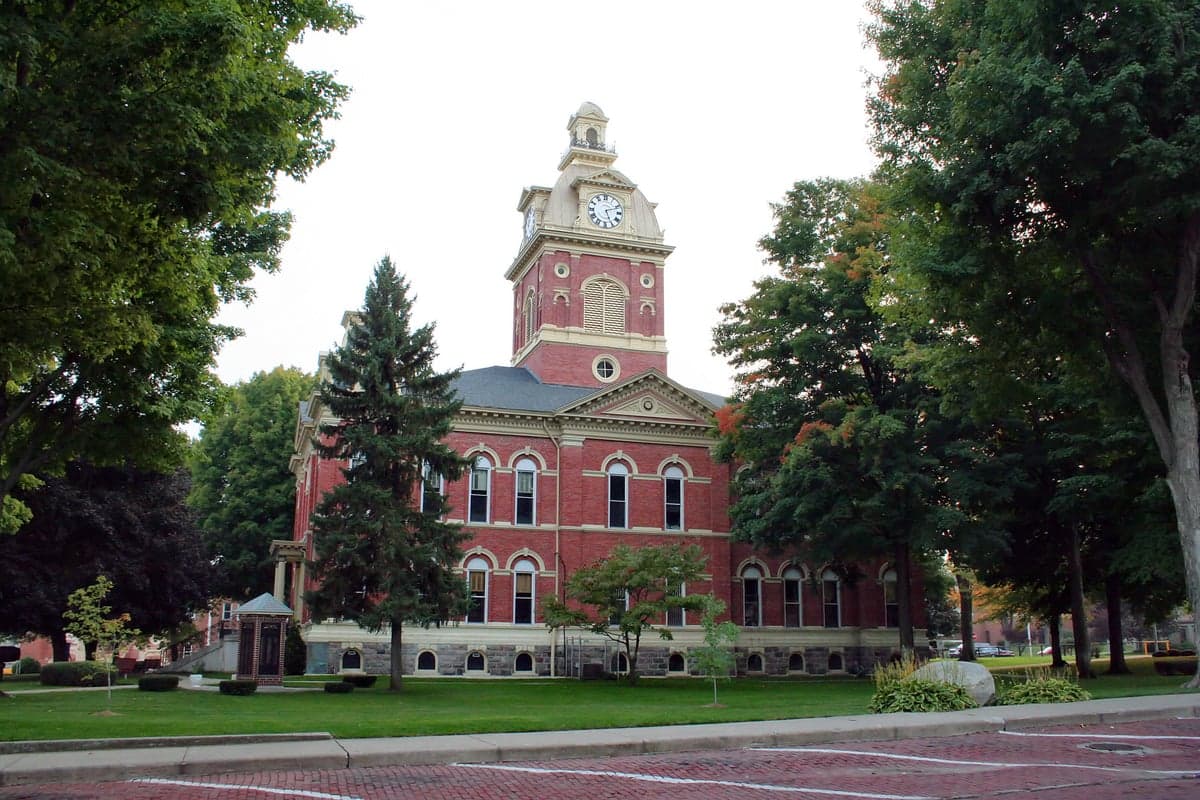
LaGrange County is one of the most reliably Republican counties in northern Indiana, carrying a Cook PVI of R+16—a full seven points more conservative than the state of Indiana as a whole, which sits at R+9. The county hasn't backed a Democrat for president in decades, and the margins have only widened in recent cycles, with the rural, agricultural character of the area reinforcing a deep-seated cultural conservatism. But if you spend any time here, you'll notice the politics aren't a monolith; the Amish and Mennonite communities, the small lake towns, and the bedroom-commuter villages each vote in their own distinct patterns.
How it compares
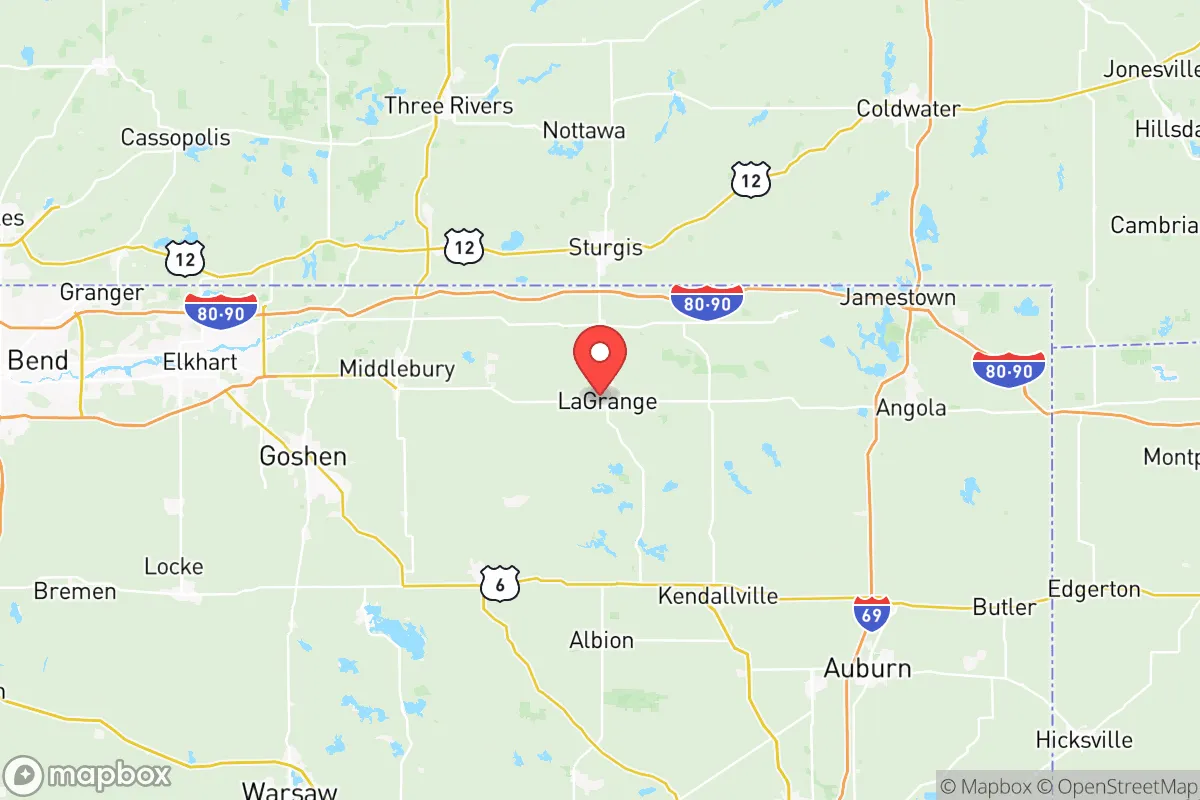
Indiana's R+9 rating already marks it as a solid red state, but LaGrange County's R+16 puts it in a different tier entirely—closer to the hardcore Republican strongholds of the Deep South than to the swingier suburbs of Indianapolis. The gap is driven by a few key factors. The county's large Amish and Old Order Mennonite population, concentrated around Topeka, Shipshewana, and the unincorporated areas of Eden and Van Buren townships, votes at extremely high rates for Republicans on issues of religious liberty, gun rights, and limited government. Meanwhile, the more diverse precincts in LaGrange town itself—the county seat—occasionally show a faint blue tint, especially in statehouse races, driven by a mix of Latino residents, service workers, and a small professional class. The swing precincts, such as those around Howe and Mongo, are where you see the closest margins; these are areas with more mobile populations, rental housing, and commuters who work in Elkhart or Goshen and bring back a slightly more moderate outlook. In the 2024 presidential race, the county delivered roughly 78% of its vote to the Republican ticket, while the state as a whole came in around 63%—a gap that mirrors the PVI spread almost exactly.
What this means for residents
For conservative residents, living in LaGrange County means their votes carry real weight in local primaries, which are effectively the general election in most races. The county commissioners, the sheriff, and the school board are all decided in the Republican primary, and the political culture is one where a candidate's stance on property taxes, road funding, and agricultural policy matters more than national talking points. For liberal residents, the reality is more about finding your niche than winning elections. The Democratic Party precinct organizations in LaGrange town and around the Howe Military School area are small but active, and there's a quiet but persistent progressive presence among the county's social service providers, teachers, and a handful of artists who've settled near the Shipshewana flea market district. In practice, this means a liberal resident can live comfortably—people here are neighborly and don't police your politics at the grocery store—but they should expect to be in the minority at town hall meetings and to see their preferred candidates lose by 40-point margins in most countywide races.
Cultural and policy distinctions
The most distinctive political feature of LaGrange County isn't the red-blue divide—it's the influence of the Anabaptist community on local policy. The Amish and Mennonite populations, who make up roughly a third of the county's residents, don't vote in large numbers, but their presence shapes the agenda in ways you won't see elsewhere in Indiana. Zoning ordinances are written to accommodate horse-and-buggy traffic, solar panel restrictions are debated with an eye toward traditional farming practices, and the county has been a flashpoint in state-level debates over religious freedom legislation. The county's school districts, particularly Westview and Prairie Heights, have navigated a delicate balance between state curriculum mandates and the preferences of conservative Anabaptist families, who often opt for private parochial schools. Looking ahead, the county's politics are likely to stay firmly Republican, but the internal dynamics are shifting—newer residents moving in from Elkhart County and the Goshen area are slightly less conservative than the old guard, and the growing Latino population in LaGrange town is beginning to register and vote in small but meaningful numbers. It's still a red county, but the shade of red is getting a little less uniform with each cycle.

State Political ClimatePolitical Climate in Indiana
State Political AnalysisPolitical Environment in the State
Indiana has been reliably Republican for decades, holding a Cook PVI of R+9, but the nature of that lean has shifted dramatically since the early 2000s. The state was once a genuine battleground — it went for Barack Obama in 2008 by a single point — but it has since settled into a solidly red posture, with Donald Trump winning by 11 points in 2016, 16 in 2020, and roughly 19 in 2024. The story isn't just about Republicans winning; it's about the suburbs of Indianapolis, Fort Wayne, and Evansville moving right while the urban cores of Marion County and Monroe County have become Democratic strongholds, creating a geographic and cultural chasm that defines Hoosier politics today.
Urban vs. rural divide
The political map of Indiana is a tale of three distinct regions. The Indianapolis metropolitan area — specifically Hamilton County to the north, with suburbs like Carmel, Fishers, and Noblesville — is the engine of the state's Republican majority. Hamilton County alone casts roughly 10% of the statewide vote and has become one of the most reliably conservative suburban counties in the Midwest, routinely delivering 60-65% margins for GOP candidates. Meanwhile, the city of Indianapolis proper (Marion County) is overwhelmingly Democratic, voting for Joe Biden by 40 points in 2020, but its influence is diluted by the sprawling, fast-growing suburbs that surround it.
To the south, the story is more nuanced. Bloomington, home to Indiana University, is a liberal island in a sea of red — Monroe County consistently votes 65-70% Democratic. But the rest of southern Indiana, including Evansville and the Ohio River counties, has trended hard right over the past decade, driven by cultural conservatism and a manufacturing base that has soured on Democratic trade policy. The northwest corner, anchored by Gary and the Lake County suburbs of Chicago, remains the state's most reliably Democratic region outside of Indianapolis, but its population has been stagnant or declining for years, shrinking its electoral footprint. The rural counties of the north and central parts of the state — places like Kosciusko, Wabash, and Huntington — are deep red, often voting 75-80% Republican, and they form the backbone of the state's legislative supermajorities.
Policy environment
Indiana's policy environment is defined by a few core commitments: low taxes, a right-to-work labor framework, and a hands-off regulatory posture. The state has a flat income tax rate of 3.05% as of 2025, down from 3.23% in 2023, with a legislatively mandated path toward eventual elimination. Property taxes are capped at 1% of assessed value for homesteads, 2% for rental properties, and 3% for businesses — a constitutional amendment that has been in place since 2010. The sales tax sits at 7%, which is on the higher end nationally, but the overall tax burden ranks in the bottom ten states.
Education policy has been a major focus, with Indiana being one of the earliest adopters of school choice. The state's Choice Scholarship program, launched in 2011, now serves over 70,000 students, and the 2023 expansion made it universal — any family, regardless of income, can apply for a voucher. The regulatory environment is business-friendly, with a one-stop permitting process and no state-level minimum wage above the federal $7.25. Healthcare is a mixed bag: Indiana expanded Medicaid under then-Governor Mike Pence in 2015, but the state has one of the highest uninsured rates in the Midwest, and rural hospital closures have been a persistent issue.
Recent policy direction
The last five years have seen Indiana's legislature push aggressively on cultural and liberty issues. In 2022, the state passed a permitless carry law (House Bill 1296), allowing any adult 18 or older to carry a handgun without a license. In 2023, the legislature passed a near-total abortion ban with limited exceptions, which was upheld by the state Supreme Court in 2024. On education, the 2023 session saw the passage of a Parents' Bill of Rights (Senate Bill 17), requiring schools to notify parents of any changes to a student's health or well-being, and a ban on instruction about human sexuality in grades K-3.
On the privacy and surveillance front, Indiana has been more moderate — it has not passed a comprehensive consumer data privacy law as strict as some states, but it did enact a limited one in 2024. Property rights are strongly protected, with the state having passed a law in 2021 restricting the use of eminent domain for private economic development. Voting access is a mixed bag: the state requires a government-issued photo ID to vote, which has been in place since 2005, but it also expanded early voting hours and allowed mail-in voting for all voters during the pandemic, though that expansion was not made permanent. The 2024 session saw the creation of an election integrity unit within the Secretary of State's office, tasked with auditing voter rolls and investigating irregularities.
Civil unrest & political movements
Indiana has seen its share of political flashpoints, but they tend to be localized rather than statewide. The most visible has been the ongoing debate over abortion — after the 2023 ban, protests have been a near-weekly occurrence in Indianapolis, Bloomington, and South Bend, with Planned Parenthood and other groups organizing large rallies at the Statehouse. On the right, the most organized movement has been around school boards and library content — conservative groups in Hamilton County and the Fort Wayne area have successfully pushed for book removals and stricter curriculum oversight, often citing the Parents' Bill of Rights.
Immigration politics have been relatively quiet compared to border states, but there is a notable undercurrent. In 2024, the legislature passed a law requiring local law enforcement to cooperate with federal immigration authorities, and several counties — including Elkhart and Allen — have voted to formally declare themselves "Second Amendment sanctuary" areas, though that designation is largely symbolic. There has been no serious secession or nullification movement, but the state did join a multi-state lawsuit challenging federal vaccine mandates in 2021, which was a popular position among rural voters.
Projection
Over the next decade, Indiana's Republican lean is likely to hold, but the margins may tighten slightly as the Indianapolis suburbs continue to diversify. The fastest-growing counties — Hamilton, Hendricks, and Boone — are still voting Republican, but by smaller margins than a decade ago; Hamilton County went from 68% Republican in 2012 to 61% in 2024. The state's population growth is concentrated in these suburban areas, while rural counties are losing residents, which could slowly shift the balance. However, the Democratic Party's strength is heavily concentrated in Marion and Monroe counties, and it has shown little ability to expand beyond those urban islands. The legislature's supermajority is unlikely to be seriously challenged before 2030, given the current district maps, which were drawn in 2021 and will remain in effect until the next census.
For a new resident, the practical reality is this: if you're conservative, you'll find a state that broadly shares your values on taxes, guns, and education, and you'll have little trouble fitting in politically in most communities. If you're liberal, you'll find welcoming enclaves in Indianapolis, Bloomington, and the college towns, but you'll be in the minority in most of the state, and you'll need to accept that state-level policy will frequently run against your preferences. The state is stable, predictable, and unlikely to undergo any dramatic political shifts in the near term — which is exactly what many relocators are looking for, regardless of which side they lean toward.
* Values derived from national, state, county, city and local statistics and may differ in a specific area. Last updated: 2026-10-31T19:20:04.000Z
Narrative content on this page is AI-generated and may contain mistakes. Verify any details that matter before acting on them.
ReloMaps may earn a commission from affiliate links at no extra cost to you.

