Photo: Wikipedia
Demographics of LaGrange County
Affluence Level in LaGrange County
A middle-class area roughly in line with national averages across income, home values, education, and employment.
People of LaGrange County
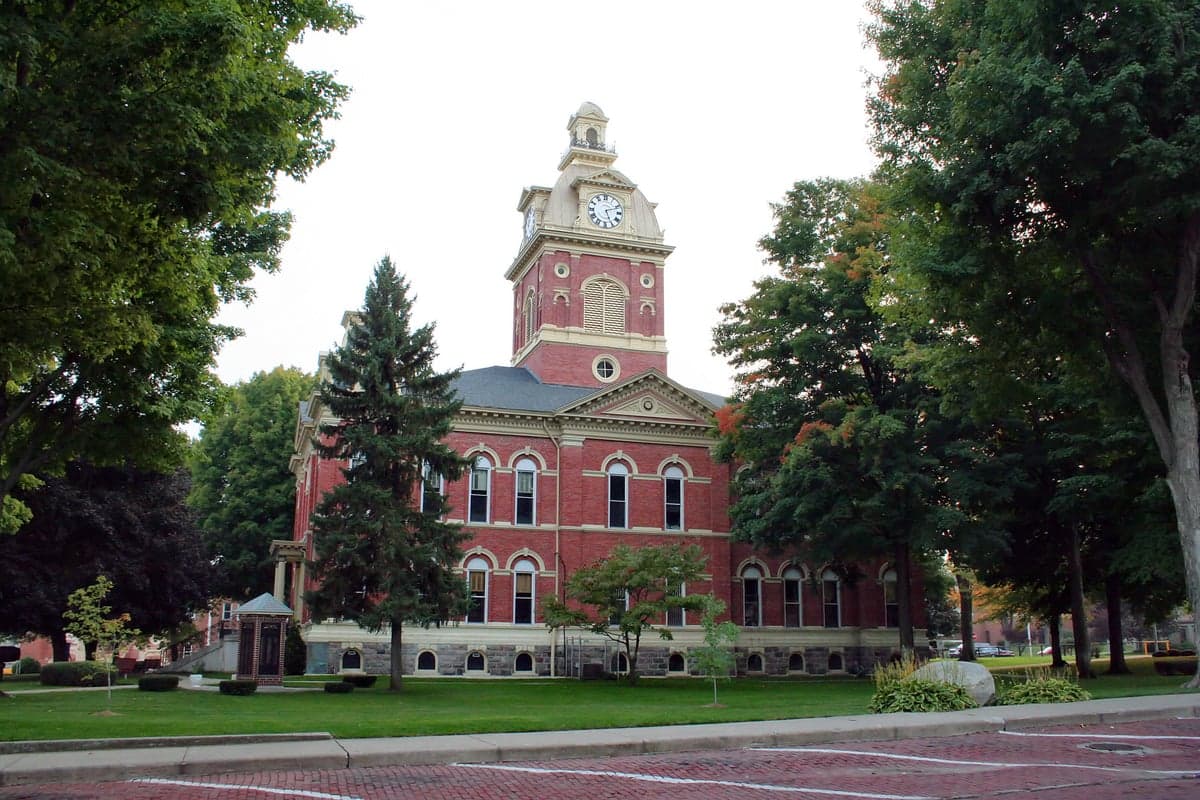
Today, LaGrange County, Indiana, is home to roughly 40,600 residents, making it one of the state’s smaller and more rural counties. Its population is overwhelmingly white (93.5%) and native-born, with a foreign-born share of just 1.0% — far below the national average. The county’s most distinctive identity marker is its large Amish and Mennonite population, concentrated in the northern and central townships, which gives the area a character shaped by horse-and-buggy traffic, family farms, and a deeply rooted sense of community. This is a place where the population is stable, culturally conservative, and tied to the land, with little of the ethnic diversity seen in Indiana’s urban centers.
Settlement & growth (pre-1960)
Before European settlement, the area that is now LaGrange County was part of the hunting and trading grounds of the Miami and Potawatomi nations. The Potawatomi in particular had established villages along the Elkhart River and its tributaries, using the region’s dense forests and fertile river valleys for seasonal agriculture and fur trading. The U.S. government forcibly removed most of these Native peoples in the 1830s and 1840s under the Indian Removal Act, opening the land to white settlement.
The first wave of Euro-American settlers arrived in the 1830s and 1840s, primarily from New England and upstate New York. These Yankees were drawn by the availability of cheap federal land — the government offered 80-acre parcels at $1.25 per acre — and the promise of rich, well-watered soil. They founded the county seat of LaGrange in 1832 and the town of Mongo in 1837, building sawmills, gristmills, and small churches. By 1850, the county’s population had reached about 5,000, almost entirely native-born whites of English and Scots-Irish descent.
A second, larger wave came from German-speaking regions of central Europe between 1845 and 1880. These immigrants — many from Bavaria, Hesse, and the Palatinate — were attracted by the same land availability and by the construction of the Lake Shore and Michigan Southern Railway through the county in the 1850s. They established farming communities in the townships around Topeka, Howe, and Stroh, where German remained the dominant language in churches and schools well into the early 1900s. The German influence is still visible in the Lutheran and Catholic parishes that dot the countryside.
The most transformative population movement, however, began in the 1880s and continued through the 1920s: the arrival of Amish and Mennonite families from Ohio, Pennsylvania, and directly from Europe. These groups were drawn by the availability of large, contiguous tracts of farmland — often 80 to 160 acres — that allowed them to maintain their traditional, horse-powered agricultural lifestyle. They concentrated in the northern half of the county, particularly around Shipshewana, Middlebury (which straddles the Elkhart County line), and the unincorporated settlement of Benton. By 1930, the Amish and Mennonite population in LaGrange County had grown to an estimated 3,000, and their numbers have only increased since, as large families and low out-migration are hallmarks of these communities.
Between 1900 and 1960, the county’s population grew slowly but steadily, from about 15,000 to 20,000. The economy remained overwhelmingly agricultural — dairy farming, corn, and soybeans — with small manufacturing in LaGrange and Shipshewana serving local needs. There was no significant in-migration from the Great Migration of African Americans from the South, nor from the Dust Bowl Okie migration; the county remained nearly all white, with a tiny Black population (0.3% today) and no Asian or Indian communities to speak of.
Modern era (post-1965)
The 1965 Hart-Cellar Act, which reshaped U.S. immigration by eliminating national-origin quotas, had virtually no impact on LaGrange County. The foreign-born population today is just 1.0%, and nearly all of those are European-born spouses or retirees, not immigrants from Asia, Africa, or Latin America. The county’s demographic story in the modern era is not about new immigrant groups, but about the internal growth of its existing populations — particularly the Amish and Mennonites.
Since 1970, the Amish and Mennonite population in LaGrange County has roughly tripled, driven by high birth rates (typically 5-7 children per family) and retention rates above 80%. They now make up an estimated 35-40% of the county’s total population, with the highest concentrations in the townships around Shipshewana, Mongo, and Ontario. This growth has reshaped the county’s economy: tourism centered on Shipshewana’s auction and flea market, Amish-built furniture, and buggy tours now accounts for a significant share of local employment. The non-Amish population, meanwhile, has grown more slowly, with some out-migration of young adults to Elkhart and Fort Wayne for jobs in manufacturing and services.
The Hispanic population, at 4.4%, is the only non-white group of any size, and it has grown from near zero in 1990. Most Hispanic residents are of Mexican descent and work in dairy farming, construction, and light manufacturing in and around LaGrange and Topeka. They are dispersed rather than concentrated in a single enclave, and the community remains small enough that it has not significantly altered the county’s cultural or political character. The Black and Asian populations remain negligible — 0.3% and 0.0%, respectively — and there is no Indian-subcontinent community.
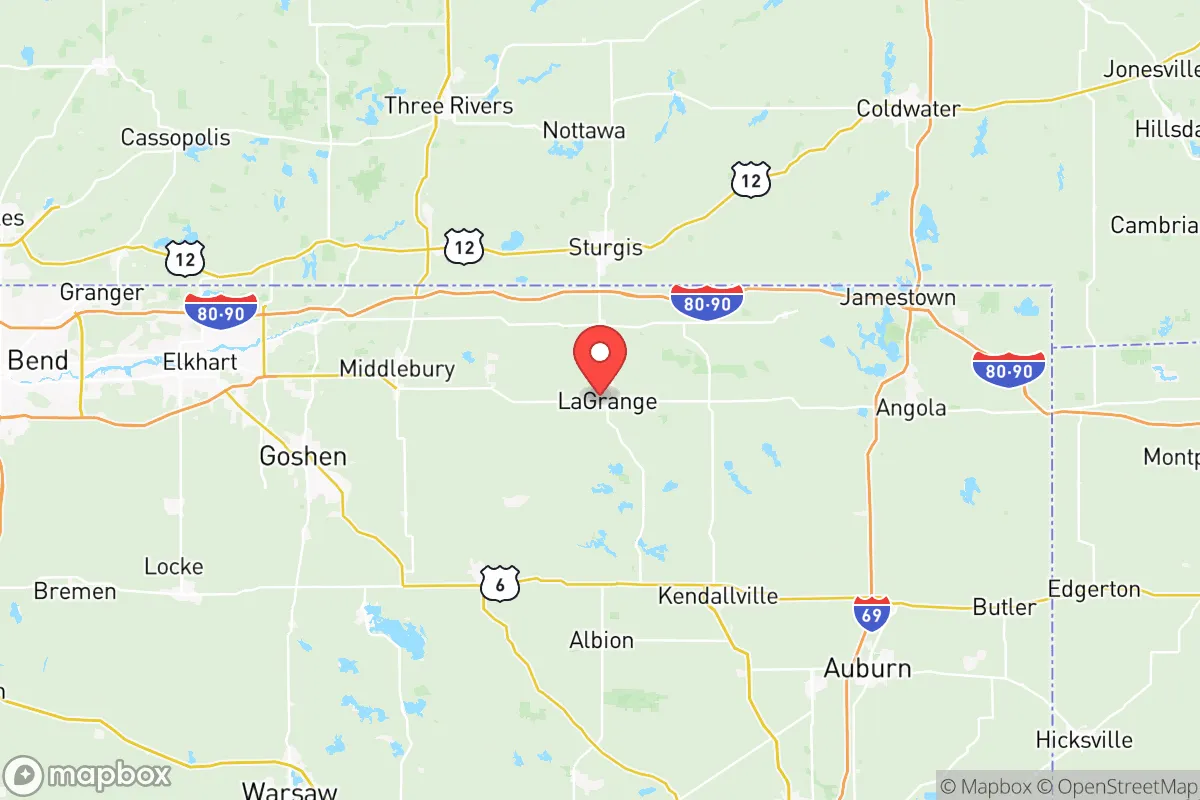
Suburbanization has been minimal. LaGrange County has no interstate highway and is a 45-minute drive from South Bend and an hour from Fort Wayne. New housing developments are rare; most growth occurs as individual homes on acreage or as additions to existing Amish farmsteads. The county’s population density is just 55 people per square mile, among the lowest in Indiana.
The future
LaGrange County’s population is projected to grow slowly — perhaps to 42,000-43,000 by 2040 — almost entirely driven by natural increase among the Amish and Mennonite communities. The non-Amish population is likely to remain flat or decline slightly, as young adults continue to leave for urban job markets and in-migration from outside the region remains very low. The county will become more culturally homogeneous in terms of values and lifestyle, even as the Amish and non-Amish populations remain socially separate.
Diversity is unlikely to increase significantly. The Hispanic share may rise to 6-7% by 2040, but the county will remain overwhelmingly white and native-born. There is no sign of significant Asian, Indian, or Black in-migration, and the county’s distance from major cities and lack of large employers make it unattractive to most immigrant groups. The Amish population will continue to expand geographically, pushing into townships that were previously majority non-Amish, such as Greenfield Township and Van Buren Township.
Culturally, the county will remain one of the most conservative in Indiana — politically, socially, and religiously. The Amish and conservative Mennonite influence keeps the area resistant to many national trends, including secularization and urbanization. For someone moving in now, LaGrange County offers a stable, quiet, rural life with strong community ties, but little ethnic diversity and limited economic opportunity outside of agriculture, tourism, and small-scale manufacturing.
This is a place where the past is still very much present — where horse-drawn buggies share the road with pickup trucks, and where the population’s growth comes not from newcomers but from the families who have been here for generations. For those seeking a deeply rooted, traditional community, LaGrange County is a rare find in 21st-century America.

* Values derived from national, state, county, city and local statistics and may differ in a specific area. Last updated: 2026-10-31T19:20:04.000Z
Narrative content on this page is AI-generated and may contain mistakes. Verify any details that matter before acting on them.
ReloMaps may earn a commission from affiliate links at no extra cost to you.

