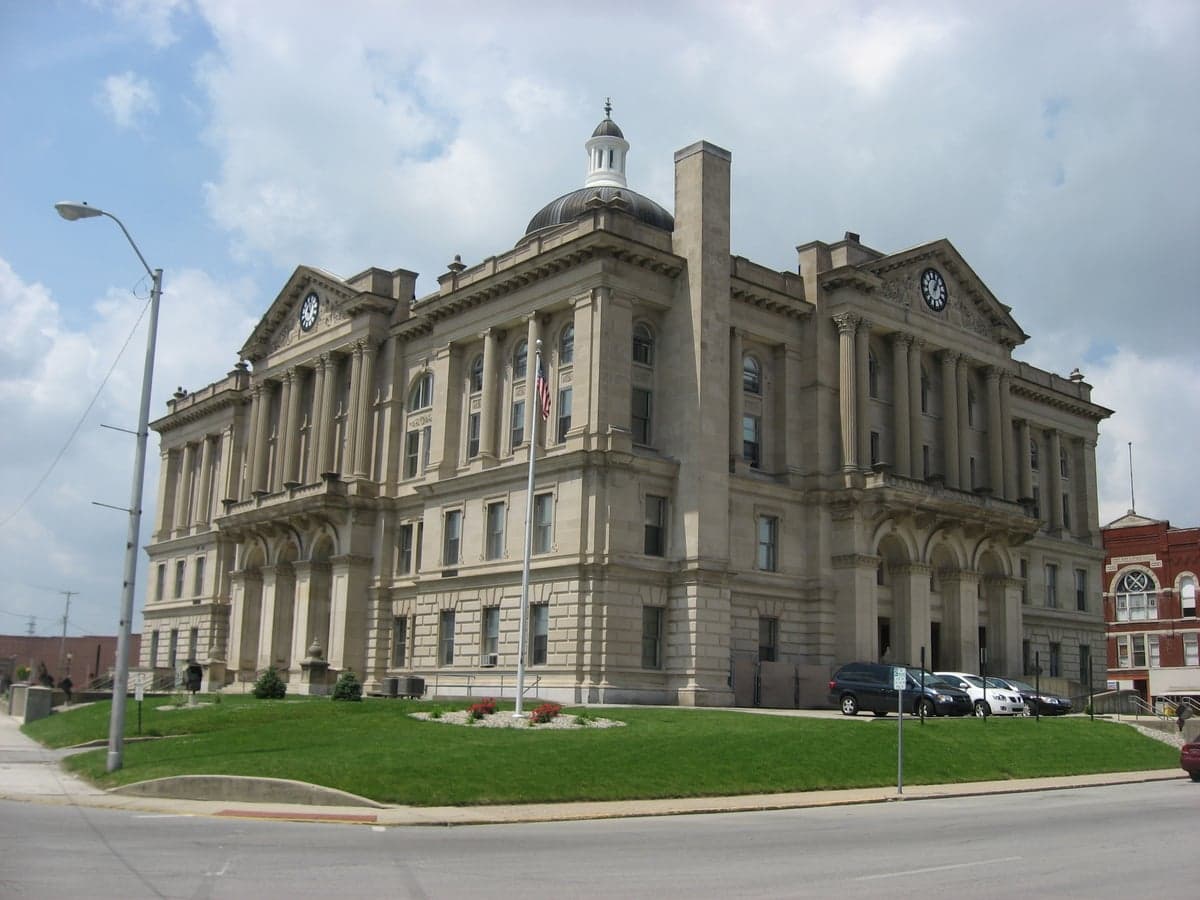
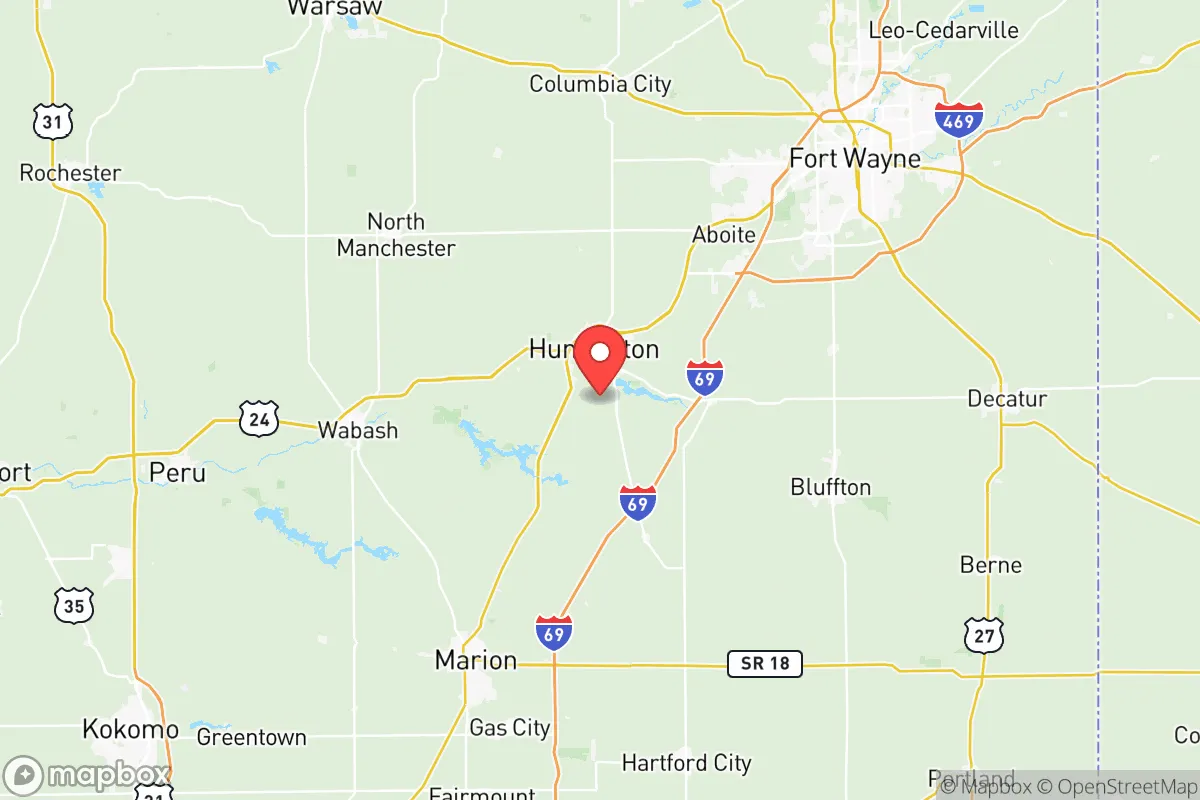
Photo: Wikipedia
Political ClimatePolitical Climate in Huntington County
Showing county-level results — no local-only data available.
Lean and PVI are calculated from this county’s 2020 and 2024 presidential results, Cook-style.
Political rankings in Indiana
- Most Conservative Cities in Indiana
- Most Liberal Cities in Indiana
- Best Liberal-Leaning Towns in the Midwest
- Safest Liberal-Leaning Towns in the Midwest
- Safest Conservative-Leaning Towns in the Midwest
- Affordable Small Towns for Conservatives
- Most Affordable Liberal-Leaning Small Towns in the U.S.
- Safest Conservative-Leaning Cities in the U.S.
- Most Conservative Counties in Indiana
- Most Liberal Counties in Indiana
Local Political AnalysisPolitical Analysis of Huntington County
Huntington County, Indiana, is a reliably conservative area with a Cook Partisan Voting Index (PVI) of R+16, meaning it votes about 16 percentage points more Republican than the national average. This is a deeper shade of red than the state of Indiana as a whole, which sits at R+9. The county has been trending rightward for decades, and while it’s not a swing county by any stretch, there are subtle shifts and local variations worth noting if you’re thinking about moving here.
How it compares
Huntington County’s R+16 PVI places it among the more Republican-leaning counties in northeast Indiana, though it’s not as deep red as neighboring counties like Wells (R+22) or Allen (R+14, but with a large Fort Wayne blue pocket). The county seat, Huntington, is the political anchor—it’s where most of the county’s registered Republicans live, and it consistently delivers 65-70% of its vote to GOP candidates in presidential races. However, there’s a noticeable split within the city limits. The older, more established neighborhoods near the courthouse and along the Wabash River tend to vote slightly more moderate, while the newer subdivisions on the east side (near the Huntington University campus) are solidly red. The small towns outside Huntington—like Markle, Roanoke, and Warren—are even more conservative, often hitting 75-80% Republican. The only real blue dot in the county is the tiny village of Andrews, which has a small but persistent Democratic lean, likely tied to its historic union ties from the old railroad days. Swing precincts are rare, but the area around Lancaster Township (south of Huntington) can shift a few points depending on the candidate, usually breaking for the GOP but with a higher independent vote share.
What this means for residents
For conservative residents, this is a comfortable environment. Local government, school boards, and county commissions are dominated by Republicans, and policy debates tend to center on tax cuts, Second Amendment rights, and rural infrastructure. The county’s GOP machine is well-organized, but it’s not monolithic—there’s a quiet faction of fiscal conservatives who clash with social conservatives over spending on roads and broadband. For liberal residents, life is more about finding your niche. There’s no active Democratic Party infrastructure to speak of, but the Huntington County Democratic Party does hold monthly meetings at the library, and they’ve had some success in local races (like school board) by focusing on nonpartisan issues like teacher pay and library funding. Most liberals here are used to being outvoted, but they report that day-to-day interactions are civil—politics rarely comes up at the grocery store or at the Huntington County Fair. The biggest practical difference is that if you’re progressive, you’ll likely need to drive to Fort Wayne (about 25 minutes east) for more diverse social or political events.
Culturally, Huntington County is more traditional than the state average. The influence of Huntington University (a private Christian college) gives the county a slightly more religiously conservative flavor than neighboring counties. You’ll see more “In God We Trust” signs in public buildings, and the county’s alcohol laws were among the last in Indiana to go wet (it’s fully wet now, but some townships still have dry precincts). Policy-wise, the county has been a leader in the state’s right-to-work movement and has a strong anti-tax sentiment—property tax rates are among the lowest in the region. For newcomers, the political climate is stable and predictable, which is a draw for many families and retirees. Just know that if you lean left, you’ll be in a clear minority, but the community is small enough that people tend to judge you by your character, not your bumper sticker.

State Political ClimatePolitical Climate in Indiana
State Political AnalysisPolitical Environment in the State
Indiana has been a reliably Republican state for decades, carrying a Cook PVI of R+9, meaning it votes about nine points more Republican than the national average. The dominant coalition is a mix of socially conservative rural voters, fiscally conservative suburbanites, and a shrinking but still influential blue-collar Democratic base in the industrial northwest. Over the last 10-20 years, the state has shifted rightward, with the GOP gaining a supermajority in the legislature and winning every statewide office, though the margins in presidential races have tightened slightly as the Indianapolis suburbs have become more competitive.
Urban vs. rural divide
The political map of Indiana is a classic urban-rural split, but with a few wrinkles. Indianapolis (Marion County) is the state's Democratic stronghold, consistently voting blue by double digits, driven by a diverse population and a growing professional class. Lake County (Gary, Hammond) in the northwest is another Democratic bastion, anchored by union-heavy industrial towns and a large Black population. On the flip side, the vast rural expanse—counties like Kosciusko (Warsaw), Elkhart, and Dubois (Jasper)—vote Republican by 70-80% margins. The real battlegrounds are the suburban rings around Indianapolis: Hamilton County (Carmel, Fishers, Noblesville) was once a GOP fortress but has shifted from +30 R to about +15 R in recent cycles, as educated professionals move in and moderate on social issues. Allen County (Fort Wayne) and Vanderburgh County (Evansville) are more mixed, often tipping the state in close races. The Bloomington area (Monroe County) stands out as a liberal island in the south, home to Indiana University and a progressive voting record.
Policy environment
Indiana's policy environment is broadly conservative, with a low-tax, low-regulation posture. The state has a flat income tax rate of 3.05% (scheduled to drop to 2.9% by 2027), and property taxes are capped at 1% of assessed value for owner-occupied homes. There is no inheritance or estate tax. The regulatory climate is business-friendly, with a right-to-work law (passed in 2012) and a "business court" system for commercial disputes. Education policy leans toward school choice: Indiana has one of the nation's largest voucher programs, allowing public funds to follow students to private and religious schools. Healthcare is a mixed bag—the state expanded Medicaid under the Affordable Care Act (HIP 2.0) but has not pursued a state-based exchange. Election laws are moderately restrictive: voter ID is required, early voting is available for 28 days, and no-excuse absentee voting was allowed during the pandemic but has since been tightened. The state has a Republican supermajority in both chambers, meaning policy direction is largely set by the GOP caucus.
Recent policy direction
Recent legislation in Indiana has pushed the state further to the right on several fronts. On gun and self-defense law, Indiana became a permitless carry state in 2022 (Senate Enrolled Act 1), allowing any adult who can legally possess a firearm to carry it concealed or openly without a license. Parental and education rights saw a major shift with House Enrolled Act 1134 (2022), which requires schools to notify parents of any curriculum involving "human sexuality" and gives parents the right to opt their children out. The state also banned instruction on "human sexuality" in grades K-3 (2023). On speech and privacy, Indiana passed a law in 2023 restricting the use of "captive audience" meetings by employers to discuss political or religious topics, though it's narrow in scope. Medical and bodily autonomy is a flashpoint: Indiana passed one of the nation's strictest abortion bans in 2023 (Senate Enrolled Act 1), prohibiting the procedure at all stages except in cases of rape, incest, or lethal fetal anomaly, with a 10-week limit for rape/incest. The law also requires that fetal remains be cremated or buried. Property rights are generally strong, with no statewide rent control and a "takings" law that requires compensation for regulatory actions that reduce property value by more than 20%. Voting and ballot access saw a tightening in 2021 with Senate Enrolled Act 334, which shortened the window for mail-in ballot requests and added stricter signature verification. Overall, the direction is toward more individual liberty on guns and education, but less on reproductive choice and voting access.
Civil unrest & political movements
Indiana has seen its share of political flashpoints, though not at the scale of coastal states. The 2020 George Floyd protests in Indianapolis led to several nights of unrest, including property damage and a police shooting, but the city has since invested in community policing reforms. Abortion rights have been a major mobilizing force: after the 2023 ban, thousands protested at the Statehouse, and groups like Indiana Right to Life and All-Options have been active. On the right, the Indiana Firearms Coalition is a powerful lobbying force, and the state has seen a rise in "constitutional sheriff" movements in rural counties like Porter and Jackson, where sheriffs have publicly refused to enforce certain gun laws. Immigration politics are less heated than in border states, but there have been localized tensions in Logansport and Goshen, where meatpacking plants employ large immigrant populations. No sanctuary cities exist in Indiana; state law (2011) prohibits them. Election integrity controversies have been minimal, though the 2020 audit of Allen County found no significant irregularities. The most visible flashpoint for a new resident might be the annual Indy Pride parade, which draws both large crowds and counter-protesters, or the Tea Party rallies that still occur in smaller towns like Franklin and Greensburg.
Projection
Over the next 5-10 years, Indiana is likely to remain solidly Republican but with a slowly purpling suburban corridor. The Indianapolis metro is growing faster than the rest of the state, driven by tech and life sciences jobs (Eli Lilly, Salesforce, IU Health), and these newcomers tend to be more moderate on social issues while still fiscally conservative. This could make the 5th and 6th Congressional districts more competitive, but the GOP's supermajority in the legislature is safe due to gerrymandering. Rural counties are aging and losing population, which will reduce their political weight over time. In-migration from blue states (Illinois, California) is modest but noticeable in Carmel and Zionsville, and these transplants often bring more liberal views on education and healthcare. However, the state's low taxes and business climate will continue to attract conservative-leaning families. Expect the abortion debate to remain heated, with potential ballot initiatives or further restrictions. A new resident moving in now should expect a state that is reliably red but with a growing blue undercurrent in the cities, and a political culture that values stability over upheaval.
For a new resident, the bottom line is that Indiana offers a predictable, low-tax environment with a conservative tilt that is unlikely to change dramatically. If you lean right, you'll find a state that generally aligns with your values on guns, taxes, and education. If you lean left, you'll find strong communities in Indianapolis, Bloomington, and the college towns, but state-level policy will often frustrate you. The practical takeaway: your day-to-day life will be shaped more by your local county than by the statehouse, so choose your town carefully. The suburbs of Indianapolis offer a blend of conservative governance and moderate social attitudes, while rural areas are deeply traditional. Either way, the state's political trajectory is stable, not volatile, making it a safe bet for those seeking consistency.
* Values derived from national, state, county, city and local statistics and may differ in a specific area. Last updated: 2026-11-10T01:16:36.000Z
Narrative content on this page is AI-generated and may contain mistakes. Verify any details that matter before acting on them.
ReloMaps may earn a commission from affiliate links at no extra cost to you.

