
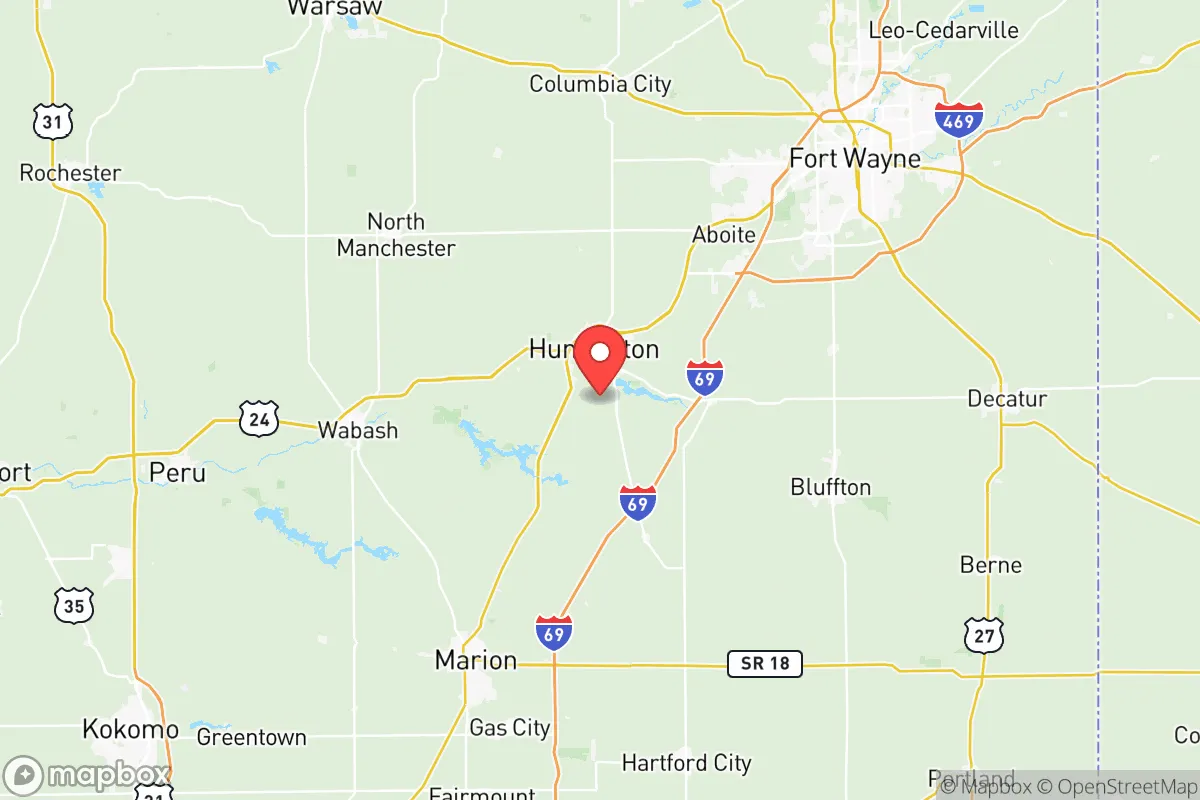
Photo: Wikipedia
Personal Sovereignty in Huntington County
Viable for self-reliance. Generally workable, though some barriers may limit total independence.
What does Personal Sovereignty tell us?
Personal Sovereignty measures your capacity for self-reliance and independence with minimal government friction. Higher scores mean fewer barriers between you and the way you want to live... but it assumes you have the space you need and good neighbors.
What does this tell us?
Personal Sovereignty measures your capacity for self-reliance and independence with minimal government friction. Higher scores mean fewer barriers between you and the way you want to live... but it assumes you have the space you need and good neighbors.
State Policy
Energy independence: Importer (29% of energy produced in-state)
Personal Liberty
Homesteading

Personal Liberty Analysis
Huntington County, Indiana, offers a notably high degree of personal sovereignty, grounded in Indiana’s consistently conservative state-level governance and a local culture that prizes self-reliance. The county’s regulatory environment is light-touch, its tax burden is among the lowest in the Midwest, and its legal framework strongly supports gun rights, parental authority, and property freedom. For individuals and families seeking to minimize government interference in daily life—whether through lower taxes, the ability to defend oneself, or the option to live more independently on a piece of land—Huntington County presents a compelling option, particularly when compared to more regulated urban centers in states like Illinois or California.
Tax burden and regulatory posture: how Huntington County compares to surrounding areas
Huntington County’s tax environment is a clear draw for sovereignty-minded residents. Indiana’s state income tax is a flat 3.05%, and the state’s property tax caps—1% of assessed value for owner-occupied homes, 2% for rental properties, and 3% for commercial—are enshrined in the state constitution. Within Huntington County, the combined property tax rate typically falls between 1.0% and 1.3% of assessed value, depending on the specific township. For example, Huntington city proper has a slightly higher rate due to city services, while rural townships like Dallas, Jackson, and Wayne often see rates closer to the 1.0% floor. There is no county-level sales tax beyond the state’s 7% rate, and no local income tax beyond the state levy. The regulatory posture is similarly light: there is no county-wide zoning in unincorporated areas, meaning that in places like Andrews, Roanoke, and Markle, a property owner can generally build a shed, park an RV, or keep livestock without seeking a variance—a stark contrast to the restrictive codes found in nearby Fort Wayne or Indianapolis. The county’s building permit process is straightforward, with fees based on project value and no onerous environmental review for standard residential construction. This combination of low taxes and minimal red tape makes Huntington County a practical choice for those who want to keep more of their earnings and avoid bureaucratic hurdles.
Self-defense and gun law specifics: what Indiana’s permitless carry means for residents
Indiana is a strong Second Amendment state, and Huntington County reflects that culture. Since July 2022, Indiana has been a permitless carry (constitutional carry) state, meaning any law-abiding adult 18 or older can carry a handgun openly or concealed without a license. This is a significant sovereignty advantage: no government permission slip is required to exercise a fundamental right. For those who still want a license for reciprocity when traveling, the Indiana License to Carry a Handgun is issued on a shall-issue basis with no discretionary denial by local sheriffs. In Huntington County, the sheriff’s office processes applications efficiently, typically within 30 days. The county also has no local ordinances restricting firearm possession in parks or public buildings beyond state law, which prohibits carry in schools and government meetings. Huntington city itself has a gun-friendly culture, with multiple gun shops and a local shooting range. Roanoke and Andrews are similarly permissive, with no local restrictions. Stand-your-ground and castle doctrine laws are fully in effect, meaning there is no duty to retreat before using deadly force in self-defense in one’s home, vehicle, or any place where one has a legal right to be. For a reader prioritizing personal safety and autonomy, Huntington County offers a legal environment where self-defense is a private matter, not a bureaucratic one.
Self-reliance and homesteading viability: lot sizes, zoning, and off-grid feasibility
Huntington County is a strong candidate for homesteading and off-grid living, especially in its unincorporated areas. The county’s zoning code is minimal outside town limits: there is no minimum lot size for agricultural or residential use in most townships, though a typical rural parcel for a homestead runs 1 to 10 acres. In Dallas Township and Jackson Township, for example, you can find 5-acre parcels with no HOA restrictions, allowing for gardens, chicken coops, and even small livestock like goats or pigs. Off-grid feasibility is high: Indiana has no state law prohibiting rainwater collection, and many rural residents use private wells and septic systems. Solar panels are permitted without special county approval, and net metering is available through local utilities like Huntington Power & Light and REMC. There are no county-level restrictions on composting toilets or alternative energy sources, though a septic permit is required for any dwelling. Markle and Andrews are particularly attractive for those seeking a balance of rural independence and access to basic services like a grocery store and hardware store. The county’s agricultural extension office offers workshops on canning, livestock care, and soil management, supporting a self-reliant lifestyle. For those who want to live entirely off-grid—no grid electricity, no municipal water—the county’s building code does not mandate connection to utilities, though a health department-approved septic system is mandatory. Overall, Huntington County’s regulatory posture is one of permission rather than prohibition, making it a viable location for a modern homestead.
Personal liberties: parental rights, medical autonomy, speech, and property
Indiana’s legal framework strongly supports parental rights and medical autonomy, and Huntington County’s local governance aligns with that. Parental rights in education are protected by state law: parents have the right to review curriculum, opt their children out of specific lessons, and homeschool without excessive state oversight. The county has a robust homeschooling community, with support groups in Huntington city and Roanoke. Medical autonomy is similarly broad: Indiana does not have a state-level vaccine mandate for adults, and there is no county health order requiring masks or proof of vaccination for public access. The county’s health department takes a hands-off approach to personal medical choices, focusing on communicable disease reporting rather than lifestyle regulation. Free speech is protected under the First Amendment, and Huntington County has no local ordinances restricting political signage, leafleting, or public assembly beyond standard time-place-manner rules. Property rights are strong: there is no county-wide rent control, no short-term rental bans (though Huntington city requires a permit for Airbnb-style rentals), and no restrictions on the number of vehicles or boats you can park on your own land in unincorporated areas. The county’s assessor’s office is transparent about property valuations, and appeals are straightforward. For a reader who values the freedom to make personal decisions about health, education, and property without government overreach, Huntington County’s legal environment is permissive and predictable.
Overall, Huntington County ranks among the more sovereignty-friendly areas in the Midwest, particularly for those who prioritize low taxes, strong gun rights, and the ability to live independently on rural land. While it lacks the extreme libertarian ethos of some western counties (e.g., in Idaho or Montana), its combination of constitutional carry, minimal zoning, low property taxes, and strong parental rights places it well above the national average for personal freedom. For a family or individual moving from a high-regulation state like New York or California, the shift in autonomy will be immediately tangible—from the absence of a state income tax on retirement income to the ability to carry a firearm without a permit. The county’s small towns—Huntington, Roanoke, Andrews, Markle, and Warren—each offer slightly different flavors of independence, but the common thread is a government that stays out of the way. For the reader whose relocation criteria center on personal sovereignty, Huntington County deserves serious consideration.

* Values derived from national, state, county, city and local statistics and may differ in a specific area. Last updated: 2026-11-10T01:16:36.000Z
Narrative content on this page is AI-generated and may contain mistakes. Verify any details that matter before acting on them.
ReloMaps may earn a commission from affiliate links at no extra cost to you.

