Photo: Wikipedia
Demographics of Huntington County
Affluence Level in Huntington County
A middle-class area roughly in line with national averages across income, home values, education, and employment.
People of Huntington County
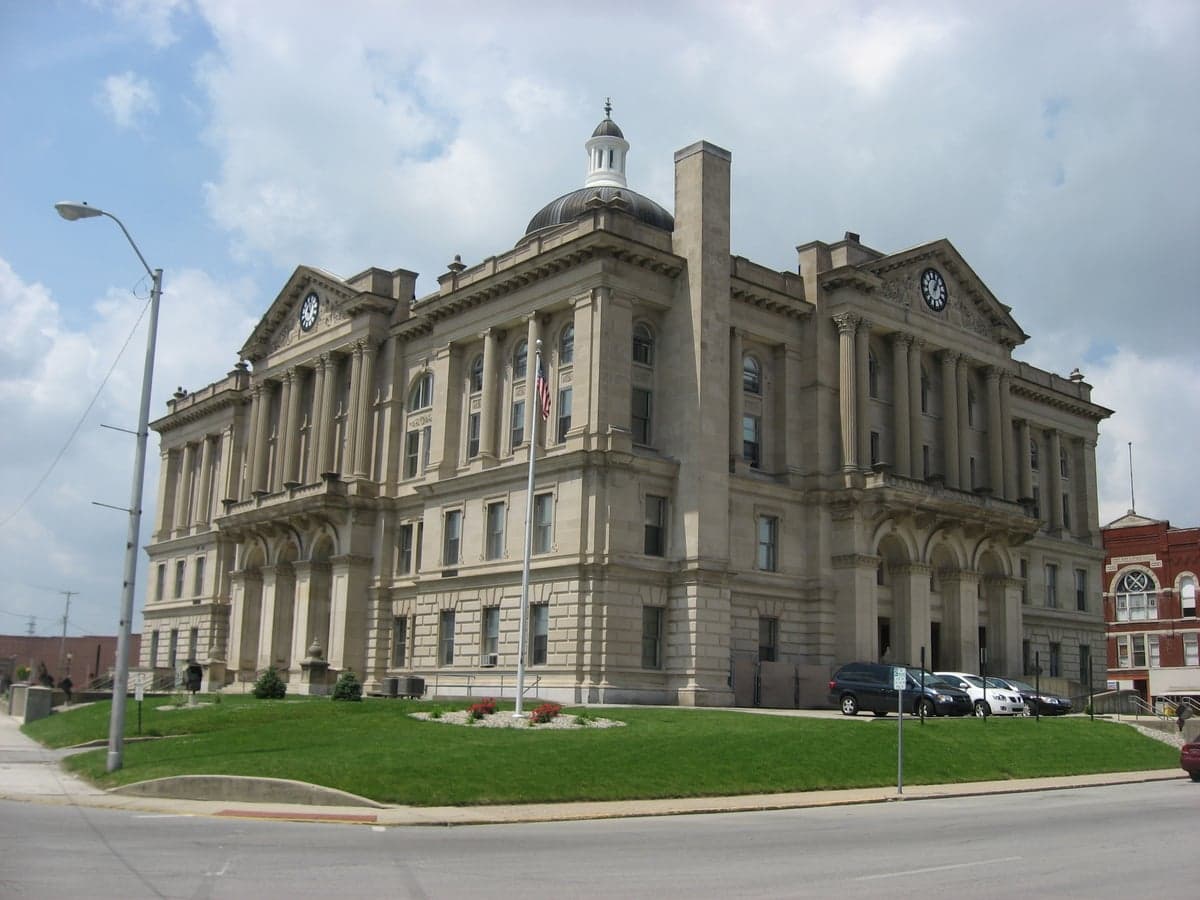
Huntington County, Indiana, is home to 36,757 residents who overwhelmingly identify as white (93.3%), with a foreign-born population of just 1.0% — one of the lowest in the state. The county’s character is shaped by its deep German and Swiss heritage, a legacy of 19th-century immigration that still defines its small towns and rural landscape. Today, the population is older than the state average, with a median age of 42.3, and the county remains a predominantly agricultural and manufacturing hub where family ties and church communities anchor daily life. For those considering a move, Huntington County offers a stable, culturally homogeneous environment where change comes slowly and tradition holds firm.
Settlement & growth (pre-1960)
Before European settlement, the area now known as Huntington County was part of the traditional homeland of the Miami and Potawatomi nations. The Wabash River and its tributaries, including the Little River, provided rich hunting and fishing grounds, and the Miami maintained several villages along these waterways. The 1795 Treaty of Greenville and subsequent land cessions opened the region to American settlers, though Native presence persisted until the forced removals of the 1830s and 1840s under the Indian Removal Act.
The first wave of Euro-American settlers arrived in the 1820s and 1830s, primarily from Kentucky, Ohio, and Pennsylvania. These were largely of Scots-Irish and English stock, drawn by cheap federal land offered at $1.25 per acre under the Land Act of 1820. They established the county seat of Huntington in 1834, strategically located at the forks of the Wabash River, which soon became a milling and trading center. The construction of the Wabash and Erie Canal in the 1840s transformed the county, linking it to the Great Lakes and the Ohio River. Towns like Roanoke (platted 1846) and Markle (platted 1847) grew as canal ports, attracting merchants and laborers.
The defining demographic wave came between 1840 and 1880, when thousands of German and Swiss immigrants arrived. They were drawn by the canal’s promise of commerce and by the availability of fertile farmland in the county’s interior. These immigrants were predominantly Lutheran and Catholic, and they established tight-knit rural communities that persist today. Bippus (founded 1854) and Lancaster (settled 1840s) became German strongholds, while Swiss families concentrated around Zanesville (platted 1852). The Germans brought with them a tradition of family farming, craftsmanship, and a strong work ethic that shaped the county’s economy for generations. By 1870, over a third of Huntington County’s population was German-born or of German parentage.
The railroad era, beginning with the arrival of the Pittsburgh, Fort Wayne and Chicago Railway in 1854, spurred further growth. Warren (platted 1837) and Andrews (platted 1854) became rail hubs, attracting a smaller wave of Irish laborers who built the tracks and later settled in the county’s towns. The discovery of natural gas in the 1880s briefly fueled an industrial boom in Huntington, with glass factories and foundries drawing additional workers, but the gas fields were largely depleted by 1910. Throughout the early 20th century, the county’s population remained stable, with agriculture — particularly corn, soybeans, and livestock — and light manufacturing as the economic mainstays. The post-World War II era saw modest suburbanization around Huntington city, but the county never experienced the explosive growth seen in Indiana’s larger metropolitan areas.
Modern era (post-1965)
The 1965 Hart-Cellar Act, which dramatically expanded non-European immigration, had almost no effect on Huntington County. The foreign-born population today stands at just 1.0%, and the county’s racial composition has remained remarkably static: 93.3% white, 3.0% Hispanic, 0.8% Black, 0.6% East/Southeast Asian, and no measurable Indian-subcontinent population. This homogeneity reflects the county’s limited economic pull for new immigrants. Unlike the booming suburbs of Indianapolis or the industrial cities of northern Indiana, Huntington County offers few entry-level jobs in sectors like meatpacking or hospitality that typically attract immigrant labor.
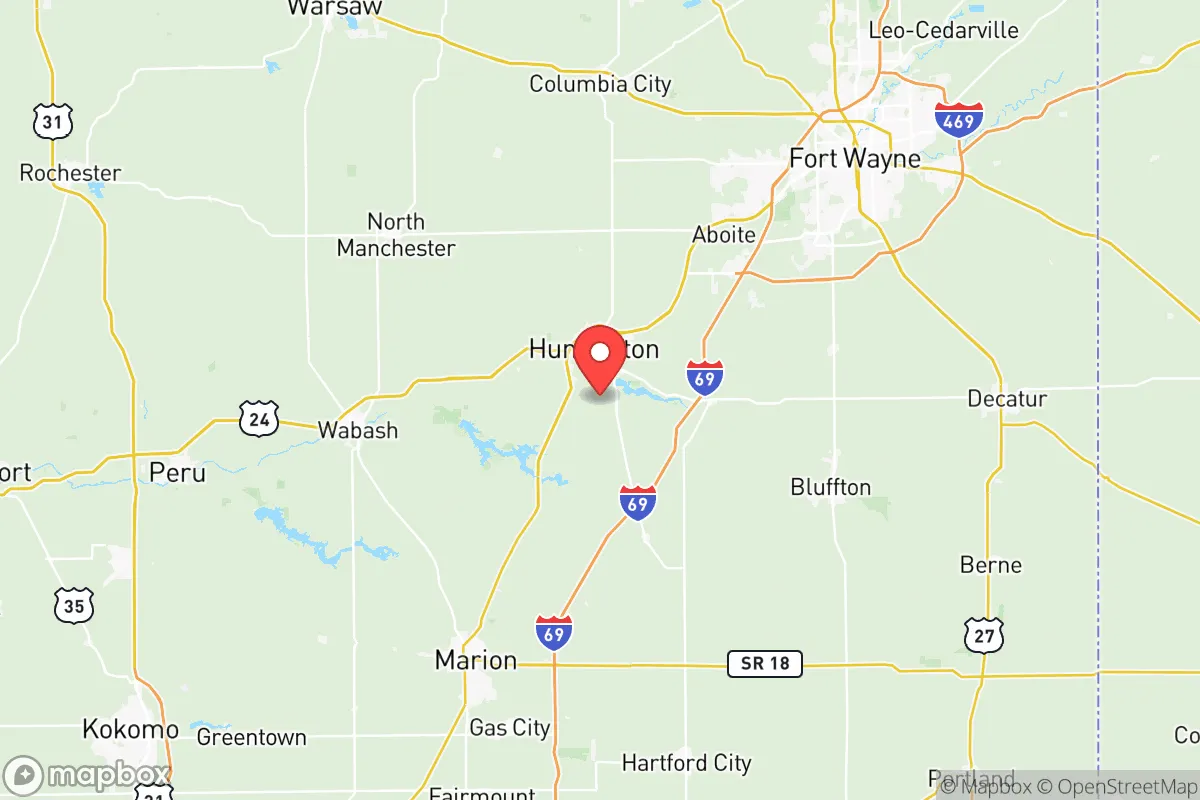
Domestic migration patterns have been more consequential. Since the 1980s, the county has experienced a slow but steady out-migration of younger adults seeking opportunities in larger cities like Fort Wayne (25 miles east) and Indianapolis. This “brain drain” has been partially offset by an influx of retirees and families from more expensive parts of the Midwest, drawn by the county’s low cost of living and rural character. The Hispanic population, while small, has grown from negligible levels in 1990 to 3.0% today, concentrated primarily in Huntington city, where a handful of Mexican-origin families work in manufacturing and agriculture. The Black population remains tiny (0.8%), largely descendants of families who moved to the county during the Great Migration but never formed a substantial community.
Suburbanization has been modest. The city of Huntington itself has seen some new subdivisions on its outskirts, particularly along the US-24 corridor, but the county’s smaller towns — Roanoke, Markle, Warren, and Andrews — have lost population since their mid-20th-century peaks. The county’s cultural identity remains firmly rooted in its German-American heritage, with events like the Huntington County Fair and the Roanoke Heritage Days celebrating that legacy. The college-educated share of the population is 23.1%, below the state average of 27.5%, reflecting the county’s blue-collar economic base.
The future
Huntington County’s population is projected to decline slightly over the next decade, mirroring trends across rural Indiana. The county’s birth rate has fallen below replacement level, and out-migration of young adults continues. The Hispanic share may grow to 5-6% by 2035, driven by natural increase and some new arrivals in the manufacturing sector, but the county is unlikely to see significant diversification. The white population will remain dominant, though it will age further: the share of residents over 65, currently 19.5%, is expected to exceed 25% by 2040.
New residential development will likely concentrate in the Huntington city area and along the US-24 corridor toward Fort Wayne, where commuters can access better-paying jobs while enjoying lower housing costs. The smaller towns — Bippus, Lancaster, Zanesville — will continue to lose population as their remaining residents age and younger generations leave. The county’s cultural identity will remain conservative and community-oriented, with churches and agricultural organizations serving as the primary social anchors. There is no indication that the county will attract significant immigrant or refugee resettlement, given its limited public transportation and lack of ethnic enclaves.
For someone moving in now, Huntington County offers a stable, predictable environment where the population is homogeneous, aging, and slowly shrinking. The trade-off is clear: low crime, affordable housing, and strong community ties, but limited economic opportunity, cultural diversity, and amenities. The county is becoming a quieter, older version of itself — a place where the past is preserved rather than transformed.

* Values derived from national, state, county, city and local statistics and may differ in a specific area. Last updated: 2026-11-10T01:16:36.000Z
Narrative content on this page is AI-generated and may contain mistakes. Verify any details that matter before acting on them.
ReloMaps may earn a commission from affiliate links at no extra cost to you.

