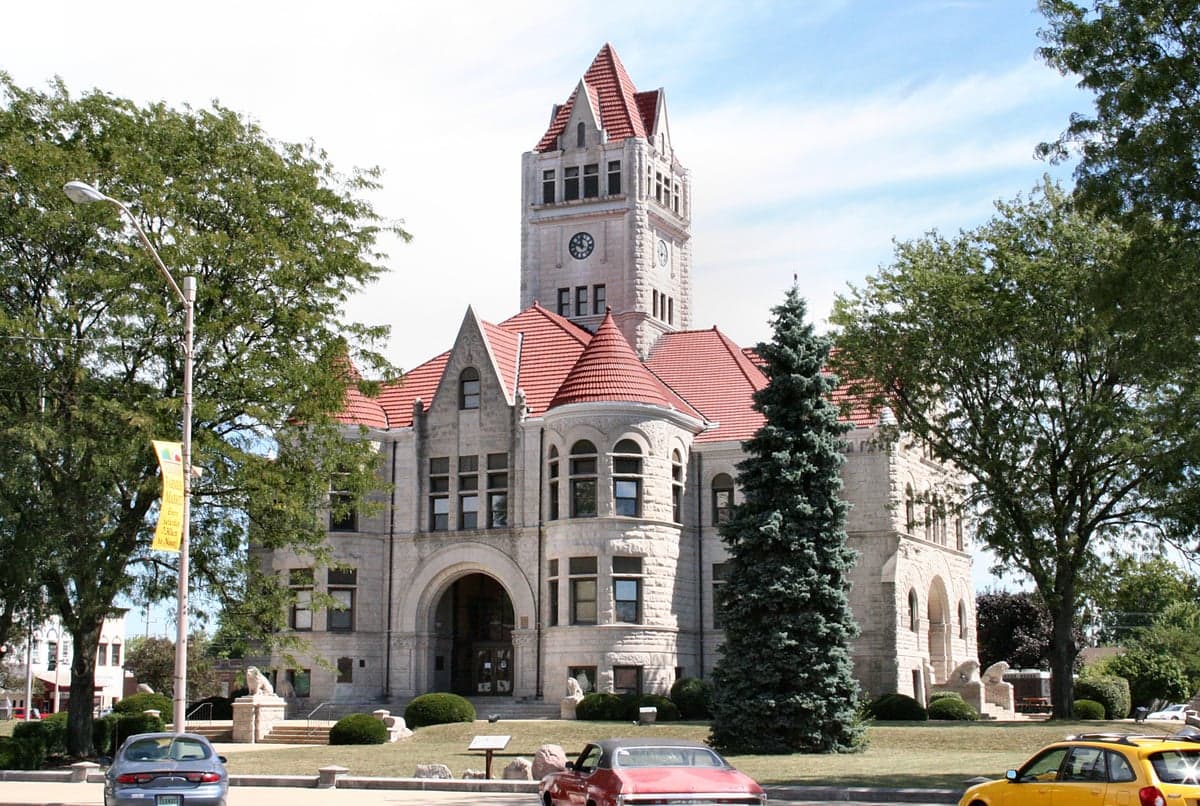
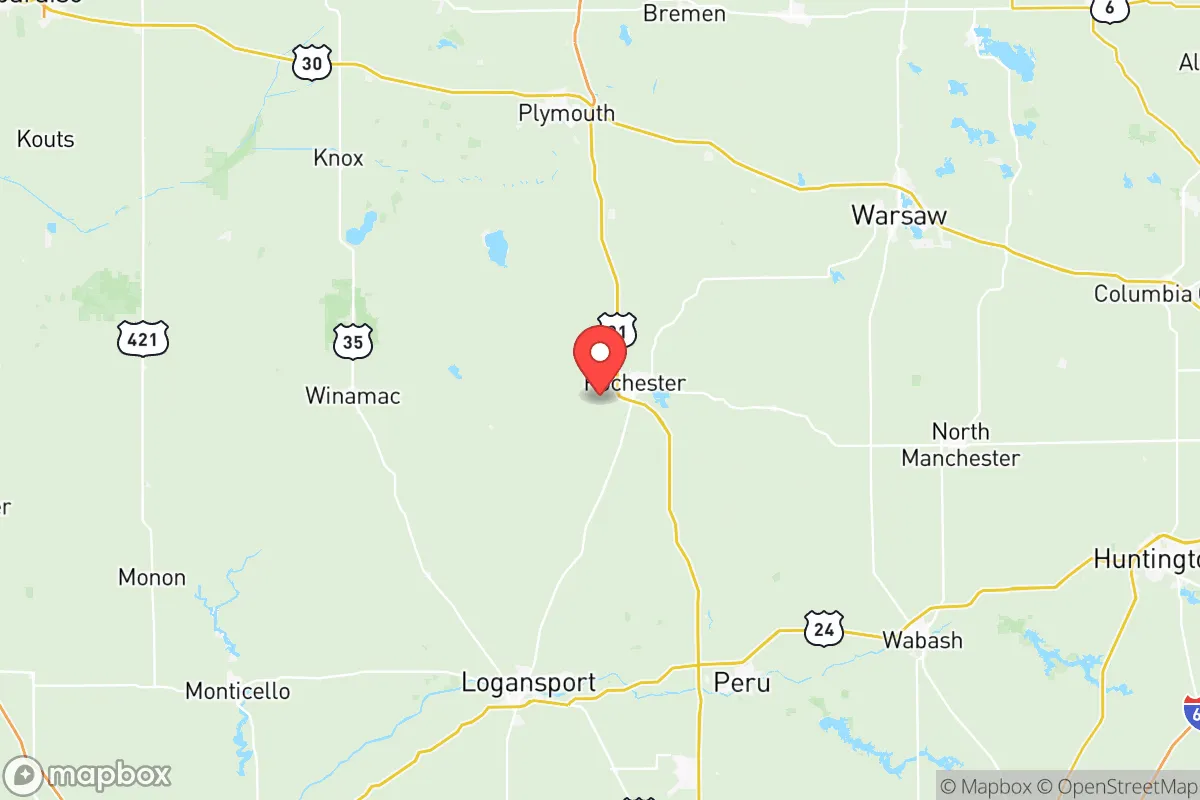
Photo: Wikipedia
Political ClimatePolitical Climate in Fulton County
Showing county-level results — no local-only data available.
Lean and PVI are calculated from this county’s 2020 and 2024 presidential results, Cook-style.
Political rankings in Indiana
- Most Conservative Cities in Indiana
- Most Liberal Cities in Indiana
- Best Liberal-Leaning Towns in the Midwest
- Safest Liberal-Leaning Towns in the Midwest
- Safest Conservative-Leaning Towns in the Midwest
- Affordable Small Towns for Conservatives
- Most Affordable Liberal-Leaning Small Towns in the U.S.
- Safest Conservative-Leaning Cities in the U.S.
- Most Conservative Counties in Indiana
- Most Liberal Counties in Indiana
Local Political AnalysisPolitical Analysis of Fulton County
Fulton County, Indiana, is a reliably Republican area with a Cook PVI of R+13, making it significantly more conservative than the state of Indiana as a whole, which sits at R+9. This isn't a recent shift; the county has been a GOP stronghold for decades, though the margin has widened in the last two presidential cycles. The real story here isn't a political revolution but a steady, quiet consolidation of red votes, especially in the rural townships, while a few small pockets of blue hold on in the county seat.
How it compares
The four-point gap between Fulton County (R+13) and Indiana (R+9) is meaningful in practical terms. In the 2024 presidential election, Fulton County voted roughly 72% Republican, while the state as a whole came in around 58%. That extra 14-point spread isn't evenly distributed across the county. Rochester, the county seat and largest town, is the most politically mixed area — its precincts around the courthouse and the older neighborhoods near Lake Manitou can swing within 5-8 points of the county average, often producing the only Democratic votes on the county commission ballot. In contrast, the small towns of Kewanna, Fulton, and Akron are deep red, routinely delivering 80%+ Republican margins. The rural townships — especially Richland, Union, and Newcastle — are where the R+13 rating really comes from; they're as conservative as any place in north-central Indiana. The county's trajectory is toward the right, driven by an aging population and out-migration of younger, more moderate voters to Kokomo or South Bend for work.
What this means for residents
For conservative residents, this political climate means their values are reflected in local governance without much friction. The county commission and council have been Republican-controlled for as long as anyone can remember, which translates to low property tax levies, minimal zoning restrictions, and a strong law-and-order approach from the sheriff's office. Gun rights are widely respected, and Second Amendment sanctuary resolutions passed easily in recent years. For liberal residents, the reality is more about finding community than changing policy. There's a small but active Democratic club in Rochester that meets monthly, and the local library and arts council tend to be more progressive-leaning spaces. Socially, most people get along fine regardless of party — the divide is less about hostility and more about a quiet assumption that conservative views are the default. A liberal resident won't face open hostility, but they'll rarely hear their perspective represented in local news or public meetings.
Cultural and policy distinctions
The most visible policy distinction between Fulton County and the state is on land use and development. Fulton County has no county-wide zoning ordinance, a stance that's popular with farmers and rural property owners but frustrates those who want more planned growth around Rochester's lake areas. This is a classic rural Indiana libertarian streak — the same impulse that keeps the county's tax rate among the lowest in the region. Another distinction: the county's strong opposition to wind and solar energy projects. While the state has pushed for renewable energy development, Fulton County has passed restrictive ordinances that effectively ban large-scale wind turbines, citing noise and property value concerns. This puts the county at odds with the state's energy goals but aligns perfectly with local sentiment. The bottom line: Fulton County is a place where the politics are predictable, the pace is slow, and the biggest fights are over how much to let outsiders — whether developers or state government — change the landscape.

State Political ClimatePolitical Climate in Indiana
State Political AnalysisPolitical Environment in the State
Indiana has been a reliably Republican state for decades, with a Cook Partisan Voting Index of R+9, meaning it votes about nine points more Republican than the nation as a whole. The state hasn't backed a Democrat for president since 2008, when Barack Obama narrowly won it, and that now looks like a fluke driven by the financial crisis and a strong ground game. Over the last 10-20 years, the GOP has solidified its grip on the legislature and statewide offices, though the margin has tightened slightly in presidential years as the Indianapolis suburbs have drifted left while the rest of the state has stayed deep red.
Urban vs. rural divide
The political map of Indiana is a classic study in contrast. Marion County (Indianapolis) is the Democratic stronghold, delivering about 60% of its vote to Democratic candidates in recent cycles. The city itself is a blue island in a red sea, driven by a diverse population, a growing tech and life sciences sector, and a strong union presence. Surrounding it, the "donut counties" like Hamilton County (home to Carmel and Fishers) were once reliably Republican but have shifted noticeably toward the center, with Biden winning Hamilton by a narrow margin in 2020 after Trump carried it in 2016. This is the biggest demographic shift in the state: affluent, educated suburbanites moving left on social issues while still favoring fiscal conservatism. Meanwhile, Lake County in the northwest corner (part of the Chicago metro area) is another blue anchor, with strong union and minority populations. The rest of the state — places like Fort Wayne, Evansville, Terre Haute, and the vast rural stretches — votes overwhelmingly Republican. The I-69 corridor from Indianapolis to Evansville is a GOP stronghold, and the southern part of the state, including Bloomington (home to Indiana University), is a rare blue dot in an otherwise red region. The divide isn't just urban vs. rural; it's also suburban vs. exurban, with places like Noblesville and Greenwood still reliably red but less so than a decade ago.
Policy environment
Indiana's policy environment is broadly conservative, with a low-tax, low-regulation posture. The state has a flat income tax rate of 3.05% (down from 3.23% in 2023, with a scheduled phase-down to 2.9% by 2027), and no inheritance or estate tax. Sales tax is 7%, among the highest in the region, but it applies broadly. Property taxes are relatively low, capped at 1% of assessed value for owner-occupied homes. The state is a right-to-work state (since 2012), which has weakened union influence, particularly in manufacturing. Education policy is a mix: Indiana has a robust school voucher program (the Choice Scholarship Program), one of the largest in the country, and charter schools are widely available. However, public school funding has been a perennial issue, with rural districts struggling. Healthcare policy is limited; the state did expand Medicaid under the Affordable Care Act (the Healthy Indiana Plan), but it's a conservative expansion with work requirements and premiums. Election laws are moderately restrictive: voter ID is required, early voting is available but not as expansive as in some states, and there's no same-day registration. The state has also passed laws limiting local control, such as preempting local ordinances on minimum wage and paid leave.
Recent policy direction
The last few years have seen a clear conservative shift on several fronts. On gun rights, Indiana became a constitutional carry state in 2022, meaning no permit is needed to carry a handgun in public. This was a major priority for the GOP supermajority. On education and parental rights, the state passed a law requiring schools to notify parents of any changes to a student's "services or monitoring" related to gender identity, effectively a "parental bill of rights." The state also banned nearly all abortions in 2022 (with narrow exceptions for rape, incest, and life of the mother), making it one of the most restrictive states in the Midwest. On taxation, the trend is toward lower rates, with the flat income tax scheduled to drop further. On voting and ballot access, the state has tightened rules on absentee voting and purged voter rolls more aggressively, though it hasn't gone as far as some Southern states. On property rights, Indiana is generally friendly to landowners, with limited eminent domain abuse and a strong "right to farm" law. On privacy and surveillance, the state has not passed a comprehensive data privacy law, but it has restricted local police from using facial recognition without a warrant in some contexts. On medical and bodily autonomy, the abortion ban is the headline, but the state has also restricted gender-affirming care for minors. The overall direction is toward more conservative social policy, lower taxes, and less regulation, with a strong emphasis on local control being preempted by the state.
Civil unrest & political movements
Indiana is not a hotbed of civil unrest, but there have been notable flashpoints. The 2020 protests in Indianapolis over George Floyd's murder were large and occasionally violent, leading to property damage and a heavy police response. The state has seen organized pro-life activism around the Statehouse, particularly during the abortion ban debate, and gun rights rallies when constitutional carry was being considered. Immigration politics are less intense than in border states, but there have been local controversies over sanctuary city policies, with the state legislature passing a law in 2011 banning such policies. There's a small but vocal secessionist movement in some rural counties, mostly symbolic, expressing frustration with Indianapolis and federal overreach. Election integrity has been a topic of debate, with the GOP-controlled legislature passing stricter voter ID laws and purging inactive voters, which Democrats argue suppresses turnout. The most visible political movement in recent years has been the Moms for Liberty chapter in Hamilton County, which has been active in school board meetings over curriculum and library books. Overall, the political climate is less volatile than in swing states, but the cultural divides are real and can be felt in local elections and community debates.
Projection
Over the next 5-10 years, Indiana is likely to remain solidly Republican, but the margins could narrow in presidential years as the Indianapolis suburbs continue to moderate. The state's population growth is slow, and it's not a major destination for out-of-state migration compared to Texas or Florida, so the demographic shifts are more about internal movement — people leaving rural areas for the suburbs and exurbs. The I-69 corridor and the Indianapolis metro will continue to grow, while rural counties will shrink. This will likely make the state's politics more suburban and less rural, which could lead to a slightly more moderate GOP on some issues (like infrastructure and education funding) while staying conservative on social and fiscal policy. The flat tax phase-down will continue, and the abortion ban is unlikely to be rolled back unless there's a major shift in the legislature. The biggest wildcard is the 2028 redistricting cycle, which could either entrench or loosen the GOP supermajority depending on population shifts. For a new resident, the state will likely feel politically stable and predictable, with a conservative tilt that's more pragmatic than ideological in many areas.
For a new resident, the bottom line is that Indiana offers a stable, low-tax environment with a conservative social and fiscal bent. If you're a conservative, you'll find a state that generally aligns with your values, with strong gun rights, school choice, and a business-friendly climate. If you're a liberal, you'll find a state where your vote carries less weight in statewide races, but you can still find like-minded communities in Indianapolis, Bloomington, and parts of the Chicago suburbs. The political climate is not as intense as in swing states, but the cultural divides are real, especially around education and social issues. The state's trajectory is toward continued Republican dominance, with a slow suburban shift that could make things more competitive over time. Practical takeaways: expect low taxes, a strong school choice system, and a government that generally stays out of your business, but also expect limited abortion access and a conservative approach to social policy. If you're moving for work or family, the political climate is unlikely to be a major disruption, but it's worth understanding the local dynamics of your specific county and city.
* Values derived from national, state, county, city and local statistics and may differ in a specific area. Last updated: 2026-11-08T12:33:52.000Z
Narrative content on this page is AI-generated and may contain mistakes. Verify any details that matter before acting on them.
ReloMaps may earn a commission from affiliate links at no extra cost to you.

