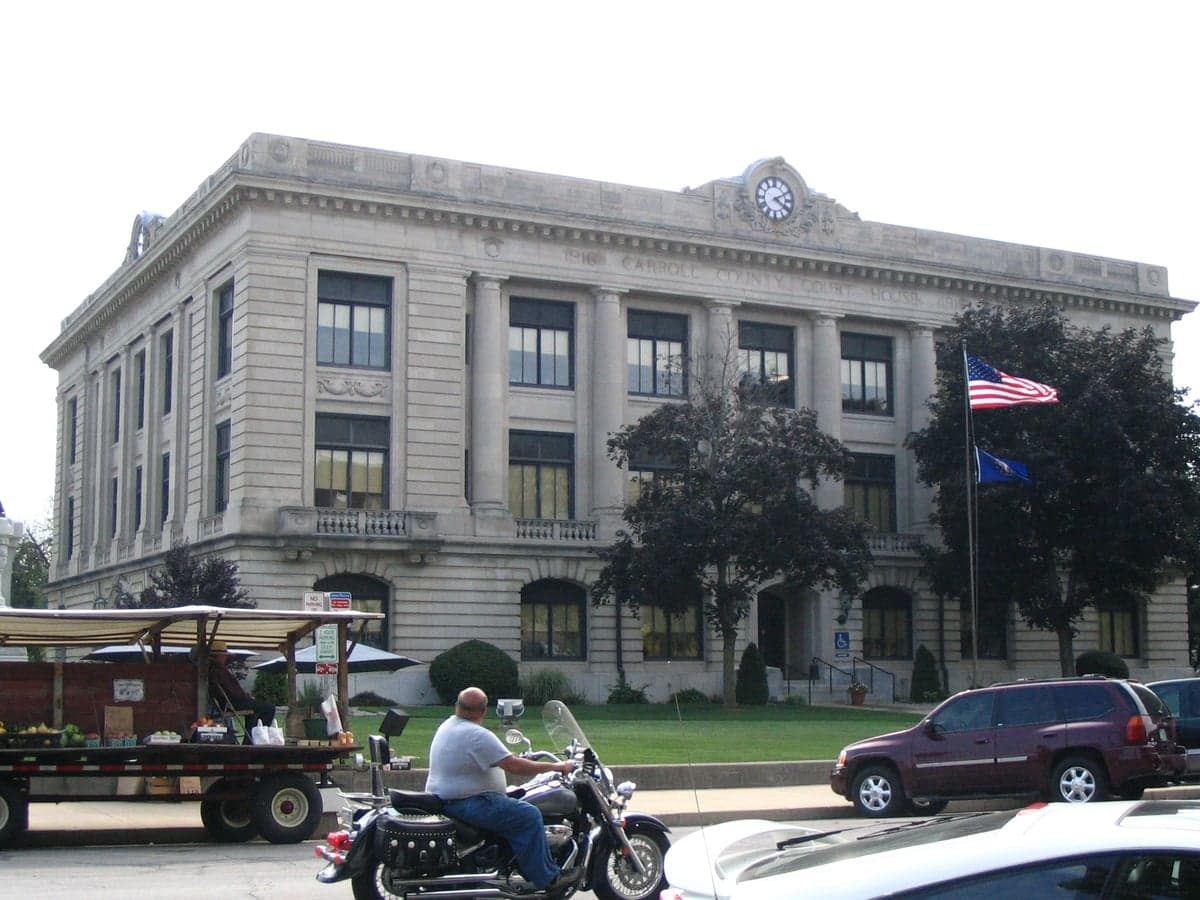
Photo: Wikipedia
Political ClimatePolitical Climate in Carroll County
Showing county-level results — no local-only data available.
Lean and PVI are calculated from this county’s 2020 and 2024 presidential results, Cook-style.
Political rankings in Indiana
- Most Conservative Cities in Indiana
- Most Liberal Cities in Indiana
- Best Liberal-Leaning Towns in the Midwest
- Safest Liberal-Leaning Towns in the Midwest
- Safest Conservative-Leaning Towns in the Midwest
- Affordable Small Towns for Conservatives
- Most Affordable Liberal-Leaning Small Towns in the U.S.
- Safest Conservative-Leaning Cities in the U.S.
- Most Conservative Counties in Indiana
- Most Liberal Counties in Indiana
Local Political AnalysisPolitical Analysis of Carroll County
Carroll County, Indiana, is a deeply conservative stronghold, carrying a Cook PVI of R+27 — a full 18 points more Republican than the state of Indiana as a whole, which sits at R+9. This isn't a recent shift; the county has been reliably red for decades, with the last Democratic presidential candidate to carry it being Lyndon B. Johnson in 1964. The political center of gravity is firmly rural and traditional, but there are subtle variations across the county's towns that give the landscape some texture.
How it compares
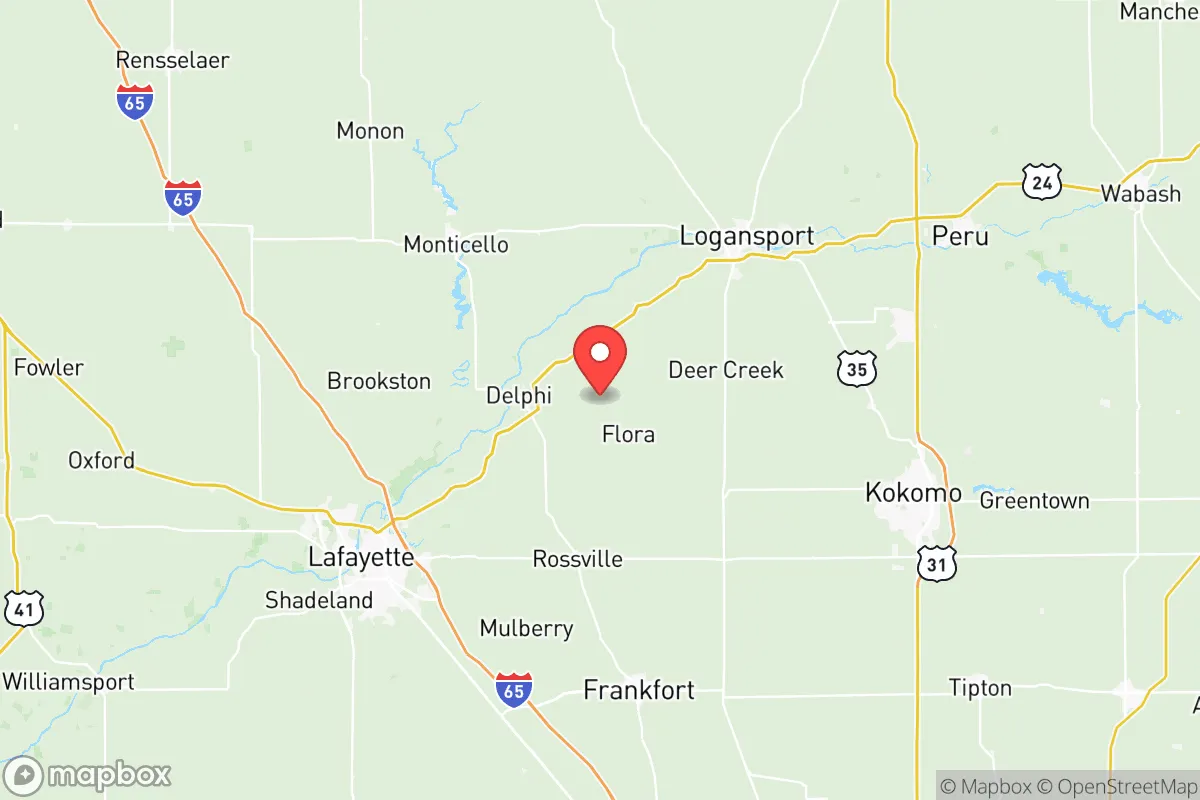
When you stack Carroll County against the rest of Indiana, the difference is stark. While the state has become more competitive in recent cycles — with Democrats winning statewide races for Senate and Governor as recently as 2012 — Carroll County has only hardened its Republican lean. In 2020, Donald Trump won the county with over 75% of the vote, compared to his 57% statewide. The county's R+27 PVI places it among the top 10% most Republican counties in the entire country. The contrast is especially visible when you compare it to neighboring Tippecanoe County (home to Purdue University and the city of Lafayette), which is a swing county with a PVI of D+4. That 31-point gap between Carroll and Tippecanoe is one of the sharpest political divides between any two adjacent counties in Indiana.
Within Carroll County itself, the political geography is not monolithic. Delphi, the county seat and largest town, is the most reliably Republican, often delivering 80% or more of its vote to GOP candidates. Flora and Burlington are similarly deep red. The only real deviation is in Camden, a small town of about 600 people, where Democratic candidates occasionally crack 40% of the vote — still a losing effort, but notably less lopsided than the rest of the county. There are no true swing precincts; even the most competitive areas are still R+15 or higher.
What this means for residents
For conservative residents, Carroll County offers a political environment where their values are the default. Local government, school boards, and law enforcement all reflect a conservative worldview. Tax policy is consistently low — the county's property tax rate is among the lowest in Indiana — and there is little appetite for new spending or regulations. For liberal residents, the reality is more isolating. There are no active Democratic Party organizations in the county, and progressive candidates rarely bother to campaign here. Socially, it can be difficult to find like-minded neighbors, especially in the smaller towns. That said, most residents report that political disagreements are handled with civility in day-to-day life; the county's small population (about 20,000) means people interact across political lines regularly at church, school events, and local businesses.
Looking ahead, the trajectory is toward even deeper conservatism. The county's population is aging and shrinking slightly, with younger residents moving to Lafayette or Indianapolis for jobs. Those who stay tend to be even more conservative than the generation they're replacing. The 2024 election saw Trump's margin in the county increase by another 2 points over 2020, suggesting the R+27 PVI may actually understate the current reality.
Culturally, Carroll County is distinct from much of Indiana in its strong agricultural identity — it's one of the top pork-producing counties in the state — and its relative lack of suburbanization. Unlike fast-growing counties like Hamilton or Hendricks to the south, Carroll has seen almost no development pressure from Indianapolis. This insulates it from the political moderation that often comes with suburban growth. Policy-wise, the county has been a leader in the state's push for local control over COVID-era health mandates and has one of the most restrictive zoning codes in the region, aimed at preserving farmland. For residents, this means a predictable, slow-changing environment where the political and cultural norms have been stable for generations — for better or worse, depending on one's perspective.

State Political ClimatePolitical Climate in Indiana
State Political AnalysisPolitical Environment in the State
Indiana has been a reliably Republican state for decades, with a Cook Partisan Voting Index of R+9, meaning it votes about nine points more Republican than the nation as a whole. The state hasn't backed a Democrat for president since 2008, when Barack Obama narrowly won it, and that now looks like a fluke driven by a perfect storm of economic anxiety and a strong ground game in the industrial north. Over the last 10-20 years, the GOP has tightened its grip on the legislature and statewide offices, while the Democratic base has shrunk to a few urban strongholds and college towns. For a relocator, this means a state government that consistently pushes conservative policy, but with enough internal diversity that you'll find pockets of blue in a sea of red.
Urban vs. rural divide
The political map of Indiana is a textbook case of the urban-rural split. Indianapolis (Marion County) is the Democratic anchor, regularly delivering 60-65% of its vote to Democratic candidates, but it's surrounded by a ring of deep-red suburban and exurban counties like Hamilton, Hendricks, and Johnson that more than cancel it out. Lake County, in the northwest corner near Chicago, is another Democratic stronghold, powered by union-heavy industrial towns like Gary and Hammond. On the other side, Fort Wayne (Allen County) and Evansville (Vanderburgh County) have trended reliably Republican for years, though Fort Wayne's growing Hispanic and immigrant population is slowly nudging the county toward purple. The real engine of the GOP majority, though, is the vast rural expanse: counties like Kosciusko (home to Warsaw, the orthopedic capital), Dubois (Jasper), and Elkhart (the RV manufacturing hub) routinely vote 70-80% Republican. The divide isn't just cultural—it's economic. Urban and suburban voters tend to be more diverse and college-educated, while rural voters are whiter, older, and more reliant on manufacturing and agriculture.
Policy environment
Indiana's policy environment is broadly conservative, with a few notable exceptions. The state has a flat income tax rate of 3.05% (down from 3.23% in 2023), and the legislature is actively discussing further cuts toward elimination. Property taxes are relatively low, with a statewide cap of 1% of assessed value for owner-occupied homes. There is no inheritance or estate tax. On education, Indiana has one of the most robust school choice programs in the nation, with universal vouchers available to any family, regardless of income, starting in 2025. The state also has a "right-to-work" law (passed in 2012) and is a "shall-issue" state for concealed carry permits—though permitless carry was enacted in 2022. Election laws are moderately restrictive: voter ID is required, early voting is available for 28 days, and absentee voting requires an excuse (though the excuse requirement was temporarily waived during COVID and has since been reinstated). Indiana is not a "sanctuary state" and has actively resisted any form of sanctuary city policies.
Recent policy direction
The last five years have seen a clear acceleration of conservative priorities. In 2022, the legislature passed a near-total abortion ban (Senate Enrolled Act 1), with exceptions only for rape, incest, and lethal fetal anomalies up to 10 weeks, and to save the mother's life. The ban was briefly blocked by a court challenge but was upheld by the Indiana Supreme Court in 2023. On gun rights, permitless carry (House Enrolled Act 1296) became law in 2022, and the state has preempted local gun ordinances, meaning cities like Indianapolis cannot pass their own restrictions. Parental rights in education have been a major focus: the state passed a "Parents' Bill of Rights" (House Enrolled Act 1608) in 2022, requiring schools to notify parents of any changes to a student's health or well-being, and banning instruction on human sexuality in grades K-3. On privacy and surveillance, Indiana has no comprehensive data privacy law yet, but a bill (Senate Enrolled Act 5) was passed in 2023 to restrict the use of facial recognition by law enforcement. Property rights are strong, with no statewide rent control and a relatively straightforward eminent domain process. Voting access has tightened: the legislature passed a law in 2021 requiring absentee ballots to be returned by Election Day (no postmark grace period), and in 2023, it banned private funding of election administration (a response to the "Zuckerbucks" controversy).
Civil unrest & political movements
Indiana has seen its share of political flashpoints, but nothing approaching the scale of states like Oregon or Minnesota. The 2020 George Floyd protests in Indianapolis were large and occasionally violent, leading to property damage downtown and a heavy police response. The state's response was to pass a law in 2021 increasing penalties for rioting and blocking highway access during protests. On the right, the "Moms for Liberty" movement has been active in school board races, particularly in Hamilton County (Carmel, Fishers) and Johnson County (Greenwood). Immigration politics are relatively quiet, though there was a brief controversy in 2019 when the city of South Bend (home to Notre Dame) considered a "welcoming city" ordinance, which was ultimately defeated. There is no serious secession or nullification movement in Indiana, though some rural counties have passed symbolic "Second Amendment sanctuary" resolutions. Election integrity remains a live issue: the 2020 election in Indiana was not seriously contested, but the 2022 law tightening absentee ballot deadlines was framed as a response to "concerns about fraud." A new resident would notice that political signs are common in yards, but political conversations in public are generally civil—Hoosiers tend to avoid confrontation.
Projection
Over the next 5-10 years, Indiana is likely to remain solidly Republican, but the margins may narrow slightly. The key demographic shift is the growth of the Indianapolis suburbs, particularly Hamilton County (Carmel, Fishers, Noblesville), which is becoming more diverse and more educated. These voters are still Republican, but they are trending toward a more moderate, business-friendly conservatism rather than the culture-warrior style. Meanwhile, the rural population is aging and shrinking, which could slowly erode the GOP's base. In-migration is modest—Indiana is not a boom state like Texas or Florida—but it is attracting some retirees and remote workers from Illinois and Michigan, drawn by lower taxes and housing costs. The state's political trajectory will likely be defined by internal Republican fights between the establishment (pro-business, pro-economic development) and the populist wing (anti-vaccine, anti-CRT, anti-ESG). The Democratic Party will remain competitive only in Indianapolis, Lake County, and a few college towns like Bloomington and West Lafayette. For a relocator, this means the state will continue to pass conservative legislation, but the intensity of that legislation may moderate as the suburbs become more influential.
Bottom line for a new resident: If you're a conservative, you'll find a state government that largely aligns with your values on taxes, guns, education, and abortion. If you're a liberal, you'll find a state where your vote matters most in local elections in Indianapolis or Lake County, but where state-level policy will consistently run against your preferences. Either way, the political climate is stable, predictable, and unlikely to surprise you. The practical takeaway: your tax bill will be low, your school choice options are excellent, and your ability to carry a firearm is broad. Just don't expect to see a Democratic governor anytime soon.
* Values derived from national, state, county, city and local statistics and may differ in a specific area. Last updated: 2026-11-15T20:51:06.000Z
Narrative content on this page is AI-generated and may contain mistakes. Verify any details that matter before acting on them.
ReloMaps may earn a commission from affiliate links at no extra cost to you.

