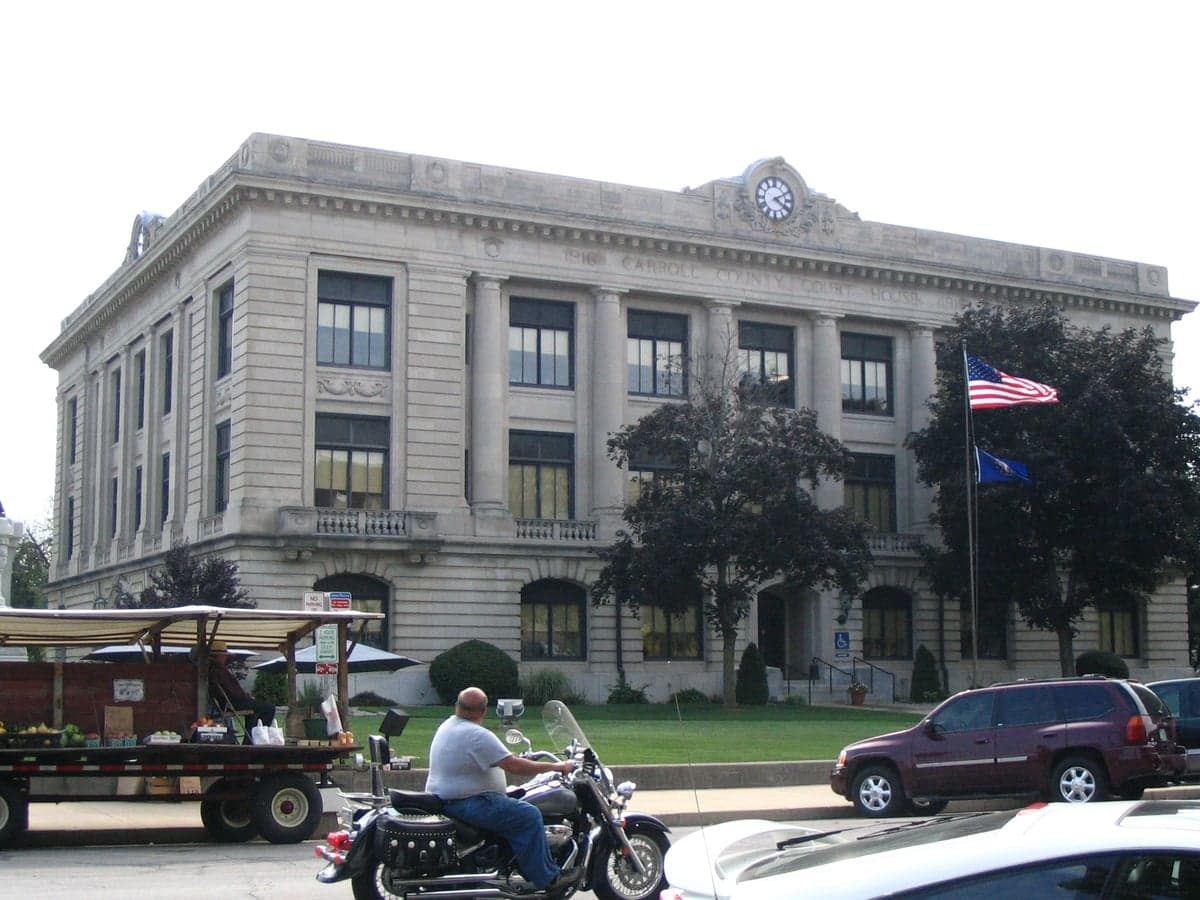
Photo: Wikipedia
Personal Sovereignty in Carroll County
Viable for self-reliance. Generally workable, though some barriers may limit total independence.
What does Personal Sovereignty tell us?
Personal Sovereignty measures your capacity for self-reliance and independence with minimal government friction. Higher scores mean fewer barriers between you and the way you want to live... but it assumes you have the space you need and good neighbors.
What does this tell us?
Personal Sovereignty measures your capacity for self-reliance and independence with minimal government friction. Higher scores mean fewer barriers between you and the way you want to live... but it assumes you have the space you need and good neighbors.
State Policy
Energy independence: Importer (29% of energy produced in-state)
Personal Liberty
Homesteading

Personal Liberty Analysis
Carroll County, Indiana, offers a notably high degree of personal sovereignty, rooted in a low-tax, low-regulation state environment and a deeply ingrained culture of self-reliance. For individuals and families prioritizing autonomy, the county presents a landscape where state preemption laws limit local government overreach on issues like firearms and property use, while the rural character of towns such as Delphi, Flora, and Camden fosters a hands-off approach to daily life. This analysis examines the specific pillars of personal freedom—tax burden, self-defense law, homesteading viability, and personal liberties—to provide a clear picture of what sovereignty looks like on the ground in this west-central Indiana region.
Tax burden and regulatory posture: How Carroll County compares to surrounding areas
Indiana’s state-level tax structure is among the most favorable in the Midwest for those seeking to keep more of their earnings. The state imposes a flat income tax rate of 3.05% (as of 2026), and Carroll County’s property tax rates are consistently below the state average. The effective property tax rate in Carroll County hovers around 0.8% of assessed home value, compared to the Indiana average of roughly 0.9% and significantly lower than neighboring Tippecanoe County (home to Lafayette), where rates can exceed 1.1%. This difference is meaningful for a family purchasing a $200,000 home: annual property taxes in Carroll County would be approximately $1,600, versus $2,200 in Tippecanoe County. The regulatory posture at the county level is light-touch. Zoning in unincorporated areas is minimal, with no county-wide building codes for agricultural structures, and the permit process for residential additions is straightforward. Towns like Delphi (the county seat) and Flora have their own planning departments, but they generally follow state model codes without adding local layers of red tape. For example, Delphi does not impose rent control, inclusionary zoning, or business license fees beyond a nominal registration. The county’s approach to business regulation is similarly permissive: no local minimum wage ordinances, no paid leave mandates, and no plastic bag bans—all areas where Indiana state law preempts local action. This creates a predictable environment where a resident opening a small engine repair shop in Camden or a home-based bakery in Yeoman faces minimal bureaucratic friction.
Self-defense and gun law specifics: What Indiana’s permitless carry means for Carroll County residents
Indiana is a constitutional carry state, meaning that as of July 1, 2022, any law-abiding adult 18 or older may carry a handgun openly or concealed without a permit. Carroll County fully aligns with this framework. The county sheriff’s office in Delphi does not impose additional local restrictions, and there are no county-level waiting periods, magazine capacity limits, or firearm registration requirements. For those who still wish to obtain a License to Carry a Handgun (LCH) for reciprocity purposes when traveling, the process is straightforward: a $75 fee, a background check, and a wait time of typically 30-60 days. The county’s gun culture is robust. Shooting ranges are accessible, including the Delphi Conservation Club (a private range with annual memberships around $50) and the Carroll County Wildlife Club near Burlington. Self-defense law in Indiana is governed by the "Castle Doctrine" and a "Stand Your Ground" statute. There is no duty to retreat in any place where a person has a legal right to be, including public spaces. This provides strong legal protection for defensive firearm use. Notably, Carroll County has no local ordinances restricting firearm possession in parks or government buildings beyond what state law already prohibits (e.g., courthouses, schools). For a resident in Flora or Camden, carrying a sidearm while walking down Main Street or while working on a farm is legally unremarkable and culturally accepted.
Self-reliance and homesteading viability: Lot sizes, zoning, and off-grid feasibility in Carroll County towns
Carroll County is one of the most homestead-friendly areas in Indiana, particularly outside its incorporated towns. In unincorporated areas, there are no minimum lot size requirements for agricultural use, and a family can purchase a 5- to 10-acre parcel for $8,000–$15,000 per acre—far cheaper than the $25,000+ per acre seen in suburban Hamilton County to the south. Zoning in these areas is classified as "Agricultural" (A-1), which permits livestock, crop farming, and accessory structures like barns and greenhouses by right, with no special use permit required. Off-grid living is legally feasible. Indiana has no state law requiring a connection to the electrical grid, and Carroll County does not mandate grid tie-ins for new homes. Solar panels, rainwater collection (for non-potable uses), and composting toilets are all permissible, provided the home meets basic septic system requirements (a $3,000–$6,000 cost for a standard system). Towns like Yeoman and Burlington are particularly attractive for off-grid setups, as they have no municipal water or sewer systems, meaning residents rely entirely on wells and septic. Delphi and Flora do have municipal utilities, but they do not penalize residents who choose to disconnect from the grid. The county’s building department does not inspect owner-built homes for code compliance unless the owner is financing through a bank; cash-built homes are exempt from most inspections. This makes Carroll County a strong candidate for those building a self-sufficient homestead with their own hands.
Personal liberties: Parental rights, medical autonomy, speech, and property rights in practice
Indiana law provides robust protections for parental rights. The state’s "Parental Bill of Rights" (IC 1-1-27) affirms that parents have the fundamental right to direct the upbringing, education, and healthcare of their children. In Carroll County, this translates into school districts—such as the Delphi Community School Corporation and the Carroll Consolidated School Corporation—that generally defer to parental decisions on curriculum opt-outs, library materials, and medical consent. There is no local mandate for mask mandates or vaccine requirements for school attendance beyond state law. Medical autonomy is similarly protected. Indiana does not have a state-level vaccine passport system, and Carroll County has not enacted any local health orders that restrict medical choice. The county’s health department in Delphi focuses on sanitation and disease reporting, not on mandating treatments. Speech and assembly rights are fully respected; the county has no ordinances restricting political signage, leafleting, or public gatherings on sidewalks or in parks. Property rights are strong, with Indiana’s "Right to Farm" law (IC 32-30-6) protecting agricultural operations from nuisance lawsuits, even as residential development encroaches. This is particularly relevant in areas like Camden and Flora, where farms and homes sit side by side. Eminent domain is rarely exercised for private development, and the county’s comprehensive plan explicitly prioritizes voluntary land transactions over condemnation.
Overall, Carroll County ranks among the top 20% of Indiana counties for personal sovereignty, offering a regulatory environment that is permissive by design and restrictive only where state law requires. Compared to more urbanized areas like Tippecanoe County or Hamilton County, the difference is stark: lower taxes, fewer zoning hurdles, stronger gun rights, and a culture that expects residents to solve their own problems. For a family or individual who values independence—whether that means carrying a firearm, building a solar-powered home on five acres near Yeoman, or simply not being told what to do with their property—Carroll County provides a legal and social framework that supports that choice without unnecessary friction.

* Values derived from national, state, county, city and local statistics and may differ in a specific area. Last updated: 2026-11-15T20:51:06.000Z
Narrative content on this page is AI-generated and may contain mistakes. Verify any details that matter before acting on them.
ReloMaps may earn a commission from affiliate links at no extra cost to you.

