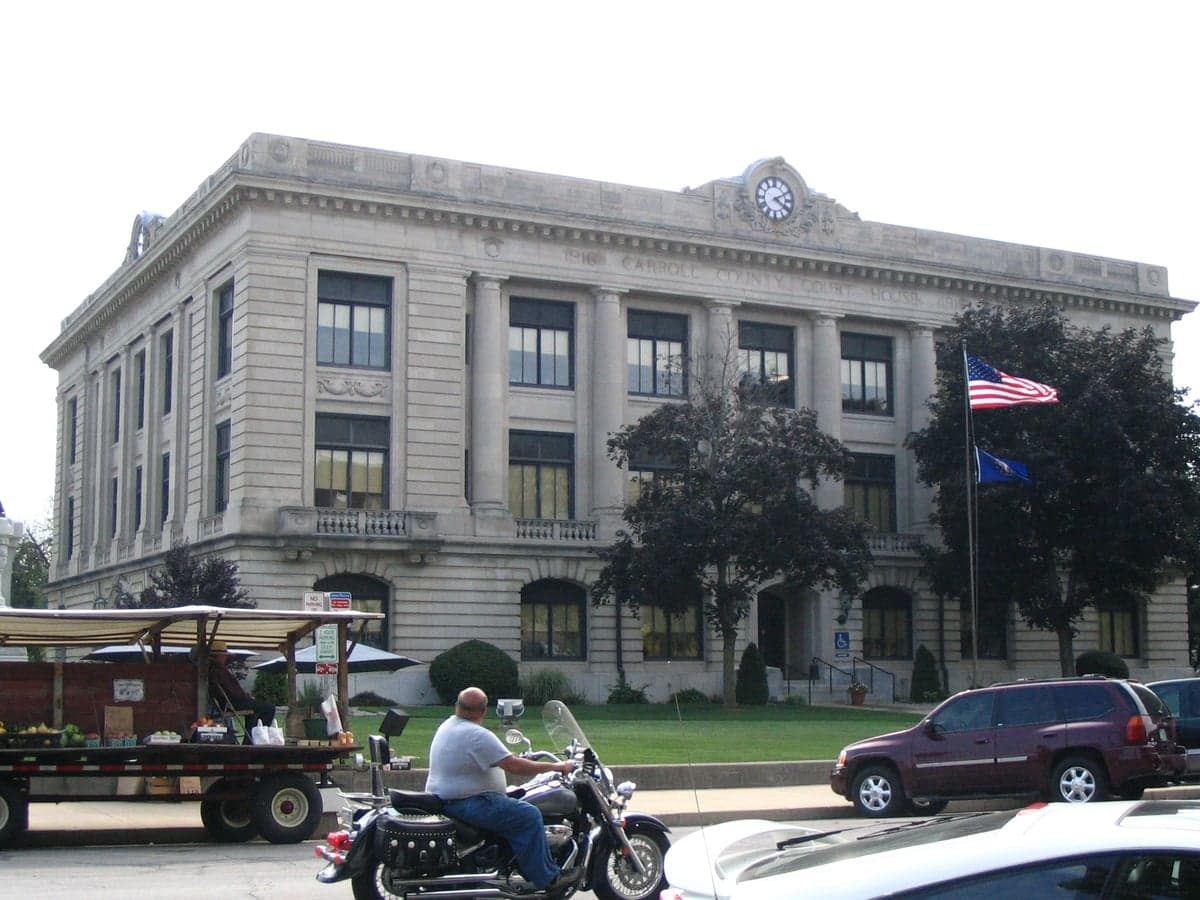
Photo: Wikipedia
Demographics of Carroll County
Affluence Level in Carroll County
A middle-class area roughly in line with national averages across income, home values, education, and employment.
People of Carroll County
Carroll County, Indiana, is a predominantly rural and agricultural community of 20,443 residents, characterized by its strong white majority (92.6%) and a very small foreign-born population (0.9%). The county’s identity is rooted in its 19th-century settlement by European immigrants and its enduring role as a center for grain and livestock farming along the Wabash River. With a notably low college attainment rate of 15.5%, the population is stable, aging, and culturally homogeneous, reflecting a deep continuity with its pioneer past rather than the rapid diversification seen in Indiana’s urban counties.
Settlement & growth (pre-1960)
Before American settlement, the area now known as Carroll County was part of the traditional homelands of the Miami and Potawatomi nations, who used the Wabash River as a transportation and trade corridor. The first permanent American settlers arrived in the 1820s, following the end of the War of 1812 and the subsequent treaties that opened the region to white settlement. These initial pioneers were primarily of Scots-Irish and English descent, migrating from Kentucky, Ohio, and the Upland South. They established the first county seat, Delphi, in 1828, drawn by the fertile bottomlands along the Wabash and Deer Creek.
The major wave of settlement came between the 1830s and 1860s, driven by the construction of the Wabash and Erie Canal. The canal, completed through Carroll County in the 1840s, transformed the local economy and attracted a distinct group of immigrants: German Catholics and German Lutherans. These families, fleeing economic hardship and political unrest in the German states, settled in agricultural townships and founded communities like Burlington and Flora. The canal also spurred the growth of Camden and Yeoman as shipping points for grain and pork. By 1860, Germans made up a significant minority of the county’s population, and their influence remains visible in the Catholic and Lutheran churches that dot the countryside.
After the canal era ended in the 1870s, the railroad—specifically the Lake Erie and Western and the Toledo, St. Louis and Kansas City lines—reinforced the county’s agricultural focus. The late 19th and early 20th centuries saw a small influx of Polish and Czech immigrants, who worked as farm laborers and in the canning factories that processed the county’s tomato and corn harvests. These families concentrated in Delphi and Flora, where they established ethnic parishes and social clubs. The Dust Bowl and Great Depression had a muted effect here, as the county’s diversified crop base (corn, soybeans, wheat, and livestock) provided relative stability. From 1900 to 1960, the population hovered around 20,000, with growth limited by the shift from family farms to larger mechanized operations, which reduced the need for farm labor.
Modern era (post-1965)
The 1965 Hart-Cellar Act had almost no impact on Carroll County. Unlike Indiana’s urban centers—Indianapolis, Lafayette, or Fort Wayne—the county did not attract post-1965 immigrants from Asia, Latin America, or Africa. The foreign-born population remains negligible at 0.9%, and the county’s racial composition has changed only marginally. The Hispanic population, at 4.4%, is the largest minority group, but it is not the result of a concentrated immigration wave. Instead, it reflects a slow, organic growth from seasonal agricultural workers—many from Texas and Mexico—who settled permanently in Delphi and Flora to work in hog processing plants and grain elevators. These families are largely integrated into the existing community, with no distinct ethnic enclave.
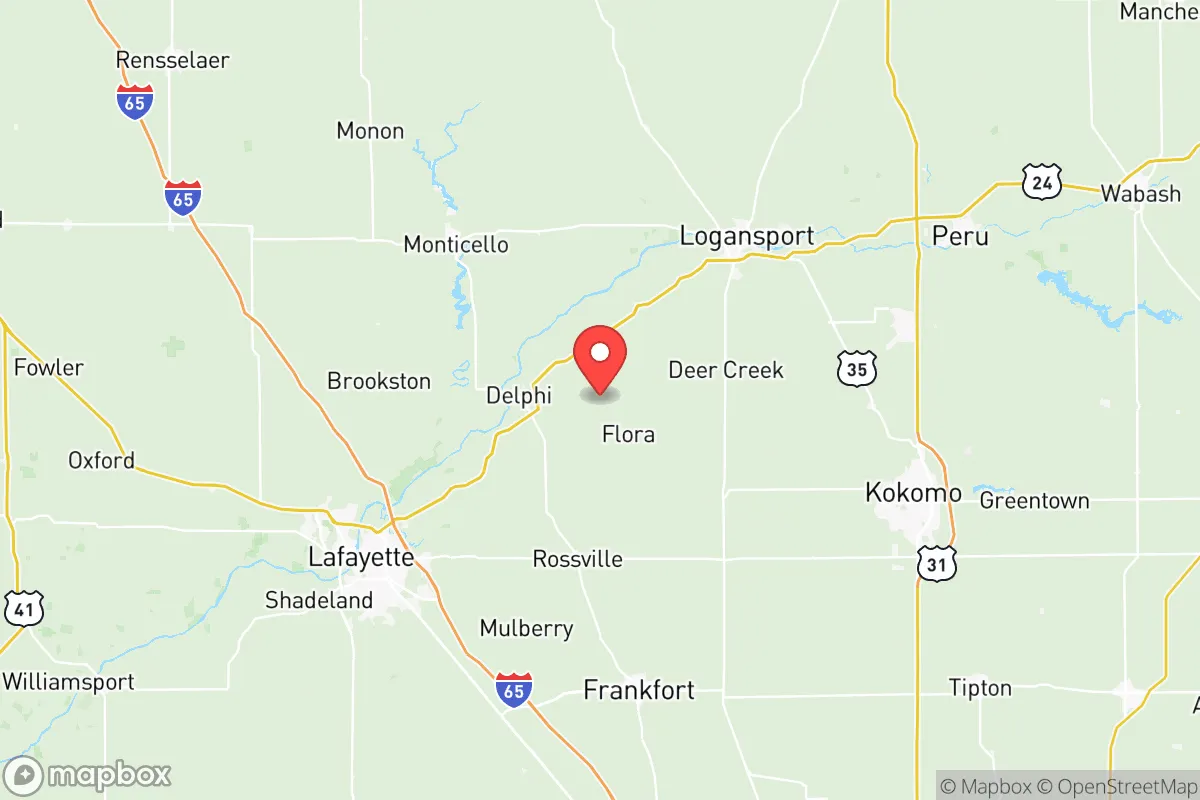
The most significant demographic shift since 1965 has been domestic: the outmigration of young adults to larger cities for education and employment. Carroll County’s college attainment rate of 15.5% is well below the state average of 27%, reflecting a pattern where high school graduates either leave for college and do not return, or stay and work in agriculture, manufacturing, or local services. The county’s population peaked at 20,594 in 2000 and has since declined slightly, as deaths outnumber births and net migration is negative. Suburbanization has been minimal; the county lacks a major interstate highway (I-65 runs just east of the border), and the nearest large city, Lafayette, is 20 miles away. New housing developments are rare, and the county’s housing stock is dominated by older single-family homes and mobile homes.
The future
Carroll County is projected to continue its slow population decline over the next 10–20 years, as the remaining farm population ages and young people continue to leave. The county’s demographic profile will likely become slightly more Hispanic, as the existing 4.4% share grows through natural increase and continued settlement of agricultural workers, but it will remain overwhelmingly white. The Black population (0.7%) and East/Southeast Asian population (0.1%) are too small to drive any measurable diversification. No new immigrant communities are expected to form, given the lack of urban amenities, employment diversity, or housing stock to attract newcomers.
Culturally, the county will retain its conservative, rural character. The dominant identity will remain tied to farming, hunting, and local churches, with little pressure to change. The county’s small towns—Delphi, Flora, Burlington, Camden, and Yeoman—will continue to serve as service centers for the surrounding agricultural area, but their populations will likely shrink. The county government may face challenges maintaining infrastructure and schools with a declining tax base.
For someone moving in now, Carroll County offers a quiet, affordable, and safe rural lifestyle, but it is not a place of demographic dynamism or growth. The population is stable, aging, and culturally homogeneous, and the county’s future is one of gradual contraction rather than expansion. New residents should expect a community where change comes slowly, and where the social fabric is built on longstanding family and church ties rather than diversity or new arrivals.

* Values derived from national, state, county, city and local statistics and may differ in a specific area. Last updated: 2026-11-15T20:51:06.000Z
Narrative content on this page is AI-generated and may contain mistakes. Verify any details that matter before acting on them.
ReloMaps may earn a commission from affiliate links at no extra cost to you.

