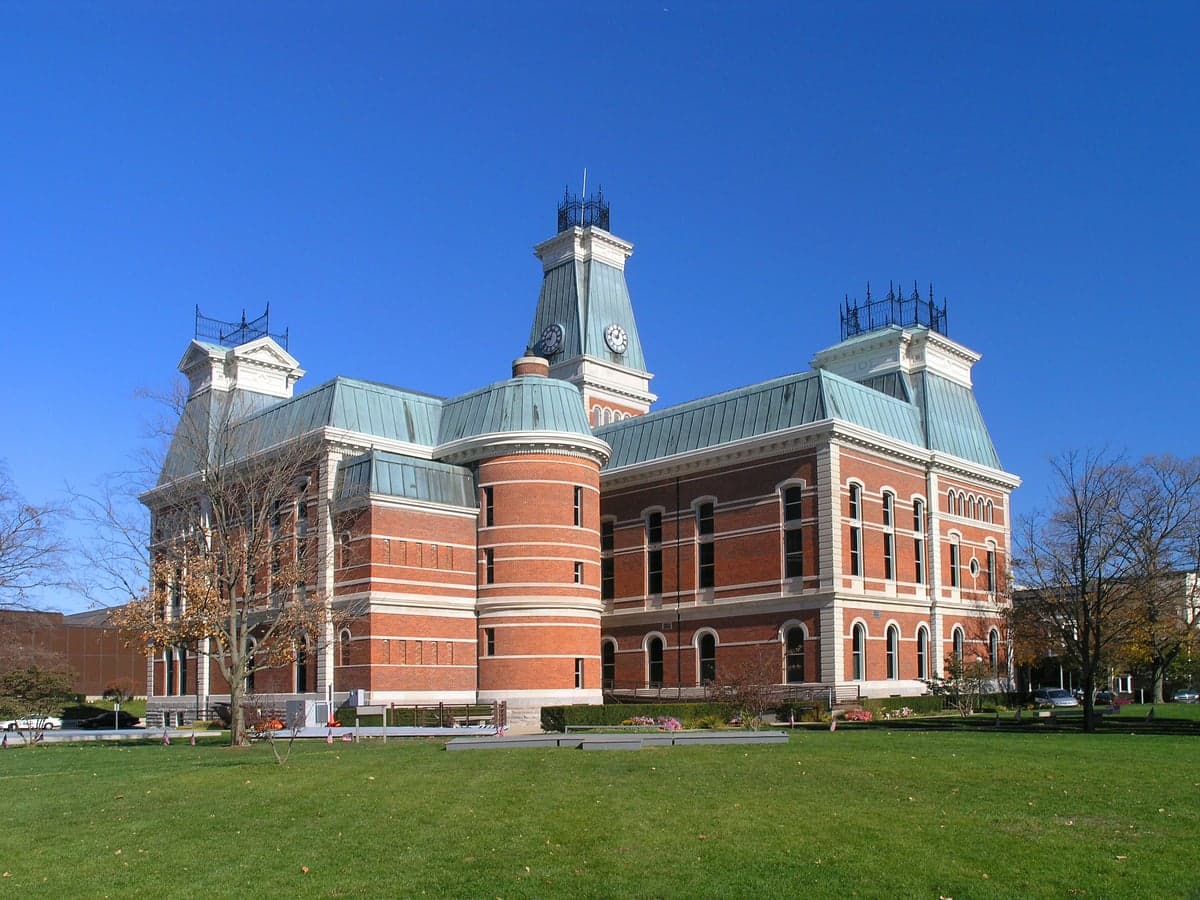
Photo: Wikipedia
Political ClimatePolitical Climate in Bartholomew County
Showing county-level results — no local-only data available.
Lean and PVI are calculated from this county’s 2020 and 2024 presidential results, Cook-style.
Political rankings in Indiana
- Most Conservative Cities in Indiana
- Most Liberal Cities in Indiana
- Best Liberal-Leaning Towns in the Midwest
- Safest Liberal-Leaning Towns in the Midwest
- Safest Conservative-Leaning Towns in the Midwest
- Affordable Small Towns for Conservatives
- Most Affordable Liberal-Leaning Small Towns in the U.S.
- Safest Conservative-Leaning Cities in the U.S.
- Most Conservative Counties in Indiana
- Most Liberal Counties in Indiana
Local Political AnalysisPolitical Analysis of Bartholomew County
Bartholomew County is a reliably Republican stronghold, with a Cook Partisan Voting Index (PVI) of R+14, making it significantly more conservative than the state of Indiana as a whole, which sits at R+9. This isn't a recent shift; the county has been steadily red for decades, though the margin has widened in the last two presidential cycles. The real story, though, is the variation within the county—Columbus, the county seat and economic hub, is a fascinating mix of moderate and liberal-leaning precincts, while the surrounding towns and rural areas are deeply conservative.
How it compares
Indiana's R+9 PVI already marks it as a solidly red state, but Bartholomew County's R+14 rating places it in the top tier of conservative counties in the state. To put it in perspective, the county voted for Donald Trump by roughly 62% in 2020, compared to about 57% statewide. The key difference isn't just the margin, but the consistency of the vote. While Indiana has pockets of deep blue (Marion County, Lake County) and swing areas (Hamilton County trending left, parts of the Rust Belt trending right), Bartholomew County's rural and exurban precincts—places like Hope, Hartsville, and Clifford—routinely deliver 75-80% Republican votes. The swing precincts are almost entirely within Columbus itself. For example, precincts around the downtown core and near Ivy Tech Community College can be competitive, sometimes breaking 50-55% Democratic in local races, while the newer subdivisions on the city's north side, near FairOaks Mall, are reliably red but by narrower margins (55-60% Republican).
What this means for residents
For conservative residents, this political climate means their values are broadly reflected in local governance. The county commission and council are overwhelmingly Republican, and school board races tend to be decided in GOP primaries. Tax policy is generally low, and Second Amendment rights are strongly supported. For liberal residents, it means being in a clear minority, but not an isolated one. Columbus's status as a global center for architecture and manufacturing (home to Cummins Inc.) attracts a more educated, diverse workforce, creating a visible progressive community. You'll find active Democratic clubs, a thriving arts scene that leans left, and local elections where a well-organized candidate can win a city council seat or a school board position, even if the countywide vote is lopsided. The practical reality is that most residents, regardless of party, find common ground on bread-and-butter issues like infrastructure, economic development, and quality of life, which keeps the political temperature lower than in many other parts of the country.
Culturally, Bartholomew County is distinct from the rest of Indiana in a few key ways. The most obvious is the Columbus architectural legacy, which draws international visitors and fosters a more cosmopolitan, design-conscious atmosphere than you'd expect in a county of this size. This creates a subtle cultural tension: the county is socially conservative in its rural areas, but the city of Columbus itself is more tolerant and diverse, with a visible immigrant population (many working at Cummins or in healthcare) and a strong public art program. Policy-wise, the county has been slower than some Indiana counties to embrace cannabis decriminalization or needle-exchange programs, but it has also avoided the most extreme culture-war battles seen elsewhere. The long-term trajectory suggests the county will remain red, but the urban-rural divide within it will likely deepen, making Columbus an increasingly interesting blue dot in a very red sea.

State Political ClimatePolitical Climate in Indiana
State Political AnalysisPolitical Environment in the State
Indiana has been a reliably Republican state for decades, with a Cook PVI of R+9, meaning it votes about nine points more Republican than the nation as a whole. The dominant coalition is a mix of rural conservatives, suburban moderates, and a growing number of working-class voters who have shifted rightward on cultural and economic issues. Over the last 20 years, the state has moved from a competitive lean-red state to a solidly red one, driven largely by the collapse of Democratic support in rural areas and the slow but steady rightward drift of the Indianapolis suburbs.
Urban vs. rural divide
The political map of Indiana is a classic study in contrast. The state's two major urban centers, Indianapolis (Marion County) and Fort Wayne (Allen County), are the primary Democratic strongholds, though neither is as deep blue as Chicago or Detroit. Marion County has voted Democratic in every presidential election since 2008, but its margins have shrunk from +26 in 2008 to about +15 in 2024. Lake County, in the northwest corner near Chicago, is the most reliably Democratic county in the state, often voting +30 or more for Democrats. Meanwhile, the rest of the state is overwhelmingly red. Hamilton County, just north of Indianapolis, is the wealthiest and fastest-growing county in the state and has become a Republican powerhouse, voting +25 or more in recent cycles. Allen County (Fort Wayne) is a bellwether—it voted for Obama in 2008 but has since swung hard right, going +18 for Trump in 2024. The rural counties in the southern part of the state, like Dubois County and Knox County, are deeply conservative, often voting +40 or more Republican. The Bloomington area (Monroe County) is a notable outlier—a liberal college town surrounded by deep-red countryside, voting +20 Democratic in 2024.
Policy environment
Indiana's policy environment is consistently conservative, with a focus on low taxes, limited regulation, and cultural conservatism. The state has a flat income tax rate of 3.15% (down from 3.23% in 2023), with a scheduled phase-down to 2.9% by 2027. Property taxes are relatively low, with an average effective rate of about 0.85% of home value. The state is a "right-to-work" state, meaning workers cannot be required to join a union as a condition of employment. Education policy has been a major focus: Indiana has a robust school voucher program (the Choice Scholarship Program) that is among the most expansive in the country, allowing public funds to follow students to private and religious schools. The state also has a "Parents' Bill of Rights" (HB 1134, passed in 2022) that requires schools to notify parents about curriculum changes and allows them to opt their children out of certain materials. Healthcare policy is limited; Indiana did not expand Medicaid under the Affordable Care Act until 2015, and then only under a conservative waiver program (HIP 2.0) that requires small monthly premiums for some enrollees. Election laws are moderately restrictive: voters must show a government-issued photo ID at the polls, and early voting is available but not as expansive as in some states. There is no no-excuse absentee voting; a valid reason is required.
Recent policy direction
Indiana's recent legislative sessions have been marked by a sharp turn toward cultural and social conservatism. In 2023, the state passed a near-total abortion ban (SEA 1), with exceptions only for rape, incest, and to save the mother's life. This law has been challenged in court but remains in effect. On gun rights, Indiana became a "constitutional carry" state in 2022 (HB 1296), allowing permitless carry of handguns for adults 18 and older. The state also passed a "stand your ground" law in 2023 (HB 1184), removing the duty to retreat before using deadly force in self-defense. On education, the state passed a law in 2023 (HB 1447) that requires schools to adopt policies on the use of restrooms and locker rooms based on biological sex at birth, effectively barring transgender students from using facilities that align with their gender identity. On privacy and surveillance, Indiana has no comprehensive data privacy law, though a bill (SB 5) was introduced in 2024 to create a consumer data privacy framework. On voting, the state passed a law in 2023 (SB 109) that requires counties to use paper ballots and bans private funding of election administration. On property rights, Indiana has a relatively strong eminent domain framework, but there have been no major recent changes. On taxation, the state has been steadily cutting income taxes, with the goal of reaching a 2.9% flat rate by 2027.
Civil unrest & political movements
Indiana has seen its share of political activism, though it has been less intense than in some neighboring states. The most visible flashpoint in recent years was the 2023 abortion ban protests, which drew thousands to the Statehouse in Indianapolis and to rallies in Bloomington and South Bend. These protests were largely peaceful but sustained, with demonstrators packing the Statehouse rotunda for weeks. On the right, the "Parents' Rights" movement has been very active, particularly in suburban school board meetings in Hamilton County and Johnson County, where activists have pushed for curriculum transparency and restrictions on LGBTQ+ content. Immigration politics have been less heated than in border states, but there have been localized tensions in Logansport and Goshen, which have seen significant Hispanic population growth. There is no sanctuary city policy anywhere in the state; in fact, a 2011 law (SEA 590) requires local law enforcement to cooperate with federal immigration authorities. Election integrity controversies have been minimal compared to states like Arizona or Georgia, though there was a brief controversy in 2020 over the handling of absentee ballots in Lake County. There is no serious secession or nullification movement in Indiana.
Projection
Over the next 5-10 years, Indiana is likely to remain solidly Republican, but the margins may narrow slightly as the Indianapolis suburbs continue to diversify and as younger, more educated voters move into Hamilton County and Boone County. The state's population growth is modest (about 0.5% annually), and most of that growth is concentrated in the Indianapolis metro area, which is becoming more moderate. However, the rural areas are not losing population as fast as in some Midwestern states, so the overall partisan balance is unlikely to shift dramatically. The biggest wildcard is the state's cultural policy direction: if the abortion ban and transgender restrictions continue to drive suburban women away from the GOP, the state could become more competitive in presidential elections. But for now, the Republican supermajority in the legislature is secure, and the state's policy trajectory will remain conservative. Someone moving in now should expect a state that is politically stable, with a low-tax, low-regulation environment, but with a cultural climate that is increasingly polarized between the urban centers and the rest of the state.
For a new resident, the bottom line is this: Indiana is a safe, affordable, and politically predictable state. If you're a conservative, you'll find a government that largely aligns with your values on taxes, guns, education, and abortion. If you're a liberal, you'll find that your vote is unlikely to change the outcome of statewide elections, but you'll have strong local communities in Bloomington, Indianapolis, and South Bend where you can live comfortably. The state's political climate is not particularly volatile or confrontational—it's more of a steady, slow-moving conservative consensus. Just be aware that the cultural divide between the cities and the countryside is real, and it shapes everything from school board politics to the availability of certain services.
* Values derived from national, state, county, city and local statistics and may differ in a specific area. Last updated: 2026-11-14T07:02:44.000Z
Narrative content on this page is AI-generated and may contain mistakes. Verify any details that matter before acting on them.
ReloMaps may earn a commission from affiliate links at no extra cost to you.

