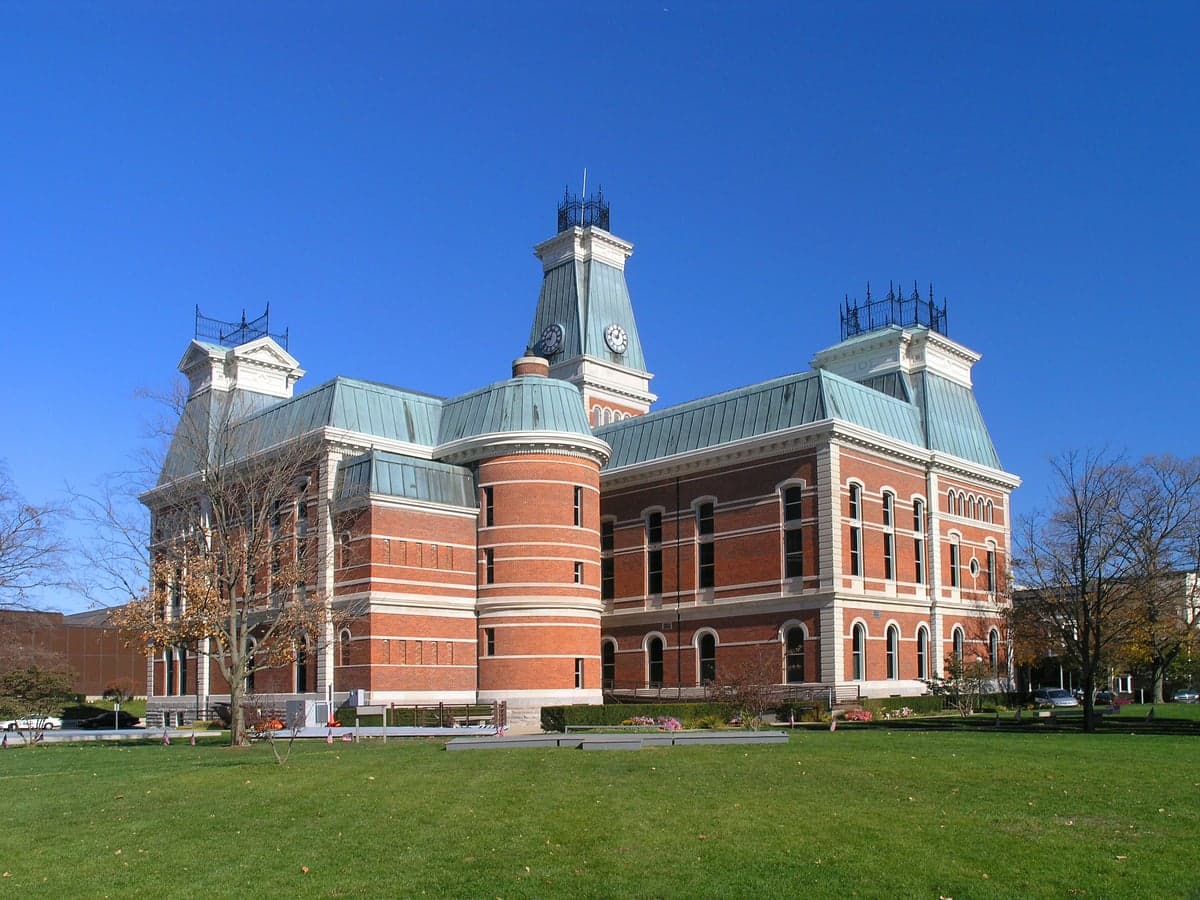
Photo: Wikipedia
Demographics of Bartholomew County
Affluence Level in Bartholomew County
A middle-class area roughly in line with national averages across income, home values, education, and employment.
People of Bartholomew County
Bartholomew County, Indiana, is home to 82,881 residents, a population shaped by a distinctive blend of German Lutheran and Catholic settlement, a strong manufacturing base anchored by Cummins Inc., and a growing diversity driven by immigration from India and Latin America. The county's character is one of Midwestern pragmatism and industrial stability, with a foreign-born population of 7.8% that is notably higher than the state average, concentrated in the county seat of Columbus and the surrounding townships. This is a community where a historic, largely white, working-to-middle-class base is being gradually reshaped by new arrivals, creating a demographic landscape that is more diverse than much of rural Indiana but still retains a conservative-leaning, family-oriented identity.
Settlement & growth (pre-1960)
Before European settlement, the land that is now Bartholomew County was part of the hunting grounds of the Miami and Shawnee nations, with the Driftwood and Flatrock Rivers serving as key travel corridors. The area saw no permanent French or British colonial settlements; it remained a contested frontier zone until the post-Revolutionary War period. The county was formally organized in 1821, named after General Joseph Bartholomew, a hero of the Battle of Tippecanoe, and the first wave of settlers were primarily Scots-Irish and English pioneers from Kentucky, Tennessee, and the Ohio River Valley. They arrived in the 1820s and 1830s, drawn by cheap federal land at $1.25 per acre, and established the earliest communities along the rivers: Columbus (the county seat, platted in 1821), Hope (founded 1830), and Elizabethtown (1830). These early settlers were subsistence farmers and small-scale traders, and their cultural imprint—a strong sense of local governance and Protestant individualism—remains a subtle undercurrent in the county's politics.
The defining demographic wave, however, began in the 1840s and 1850s with the arrival of German immigrants. These were not the urban, intellectual Germans of the 1848 revolutions, but largely farmers and craftsmen from Bavaria, Hesse, and the Rhineland, fleeing land fragmentation and political instability. They were drawn to Bartholomew County by the availability of rich, rolling farmland and the promise of religious freedom for both Lutherans and Catholics. The German settlement was dense and enduring. They established St. Louis Crossing (a rural Catholic enclave), Waymansville, and Rock Creek Township, and they heavily populated the northern half of the county around Hartsville and Jonesville. By 1860, roughly one-third of the county's population was German-born or of German descent. They built churches, parochial schools, and mutual-aid societies, and their influence is still visible in the county's many Lutheran and Catholic congregations, as well as in family names like Keller, Meyer, and Schmidt. A smaller wave of Irish immigrants arrived in the same period, working on the railroad and in early industry, but they never formed the same concentrated enclaves as the Germans.
The late 19th and early 20th centuries saw the county's economy shift from agriculture to manufacturing, a transition that shaped its modern population. The key event was the founding of the Cummins Engine Company in Columbus in 1919 by Clessie Cummins, a local mechanic and entrepreneur. Cummins grew into a global diesel-engine powerhouse, and its presence transformed Bartholomew County into a magnet for skilled labor. From the 1920s through the 1960s, the company attracted a steady stream of domestic migrants: white Appalachian families from Kentucky, Tennessee, and southern Indiana, as well as a smaller number of African American workers from the South during the Great Migration. The Black population, however, remained small (under 2% through most of the 20th century), concentrated in a few neighborhoods in Columbus. The county's population grew steadily, reaching 48,000 by 1950, and remained overwhelmingly white and native-born, with German and Scots-Irish ancestry dominating.
Modern era (post-1965)
The 1965 Hart-Cellar Act, which eliminated national-origin quotas, had a delayed but significant impact on Bartholomew County. The most transformative change began in the 1990s and accelerated after 2000: the arrival of a substantial Indian (subcontinent) population. This wave was almost entirely driven by Cummins Inc. The company, which employs over 10,000 people in the county, aggressively recruited highly skilled engineers and IT professionals from India, particularly from the states of Tamil Nadu, Andhra Pradesh, and Karnataka. These workers and their families settled almost exclusively in Columbus, particularly in newer subdivisions on the city's north and west sides. Today, the Indian population stands at 5.4% of the county's total—a remarkably high share for a Midwestern county of this size. This community is well-educated, English-proficient, and economically integrated, with many holding professional and managerial roles at Cummins and its supplier network. They have established cultural institutions, including the Indiana Hindu Temple (serving the broader region) and several Indian grocery stores and restaurants in Columbus.
Simultaneously, the Hispanic population has grown to 9.0%, a trend that began in the 1990s and accelerated after 2000. This wave is primarily composed of immigrants from Mexico and Central America, drawn by jobs in manufacturing (Cummins and its suppliers), construction, and agriculture (particularly in the county's remaining dairy and crop farms). Unlike the Indian population, the Hispanic community is more geographically dispersed. A significant concentration exists in Columbus, especially in the central and east-side neighborhoods near the industrial parks, but there are also growing clusters in Hope and Elizabethtown, where workers have found employment in smaller factories and food-processing facilities. The East/Southeast Asian population (2.1%) is smaller and more diffuse, with a mix of Chinese, Korean, and Vietnamese families, many also connected to Cummins or to the academic and medical sectors in nearby Bloomington and Indianapolis.
The white population has declined from over 95% in 1980 to 77.6% today, a shift driven both by the arrival of new immigrant groups and by domestic out-migration of younger, college-educated whites to larger metropolitan areas. The county's overall population has grown modestly (from 71,000 in 2000 to 82,881 today), but the growth is almost entirely attributable to the Indian and Hispanic influx. The Black population remains small at 1.8%, with no significant recent migration. Suburbanization has been limited; the county's rural character persists, with most new housing development occurring in the Columbus township and along the State Road 46 corridor.
The future
Bartholomew County is on a trajectory toward greater diversity, but the pace will likely remain moderate. The Indian population is expected to continue growing, as Cummins remains a dominant employer and the company's global recruitment pipeline remains strong. This community is likely to become more established, with second-generation Indian-Americans entering the local workforce and schools. The Hispanic population is also projected to grow, driven by both immigration and higher birth rates, and will likely become more geographically dispersed into smaller towns like Hartsville and Clifford as housing costs in Columbus rise. The white population will continue its slow numerical decline, but will remain the majority for the foreseeable future.
Culturally, the county is becoming a place where a traditional Midwestern, German-rooted identity coexists with a newer, globally connected professional class. The public schools in Columbus are already adapting to a more multilingual student body, and local civic organizations are increasingly inclusive. However, the county's political leanings remain conservative—it voted Republican in every presidential election since 2000—and the cultural integration of new groups is proceeding without major conflict, but also without rapid assimilation. The next 10-20 years will likely see Bartholomew County become a more pronounced example of a "two-track" Midwestern community: a stable, older white population in the rural townships, and a younger, more diverse, and more educated population in Columbus and its immediate suburbs.
For someone moving in now, Bartholomew County offers a place where the economic anchor of Cummins provides stability and opportunity, and where the demographic changes are gradual enough to feel manageable. It is not a melting pot in the classic sense, but a community where distinct groups—German-American, Indian-American, Hispanic, and native-born white—coexist in a landscape of manufacturing, farmland, and small-town life. The county is becoming more diverse, more educated, and more globally connected, while retaining the conservative, family-oriented values that have defined it for nearly two centuries.

* Values derived from national, state, county, city and local statistics and may differ in a specific area. Last updated: 2026-11-14T07:02:44.000Z
Narrative content on this page is AI-generated and may contain mistakes. Verify any details that matter before acting on them.
ReloMaps may earn a commission from affiliate links at no extra cost to you.

