Photo: Wikipedia
Demographics of Sangamon County
Affluence Level in Sangamon County
A middle-class area roughly in line with national averages across income, home values, education, and employment.
People of Sangamon County
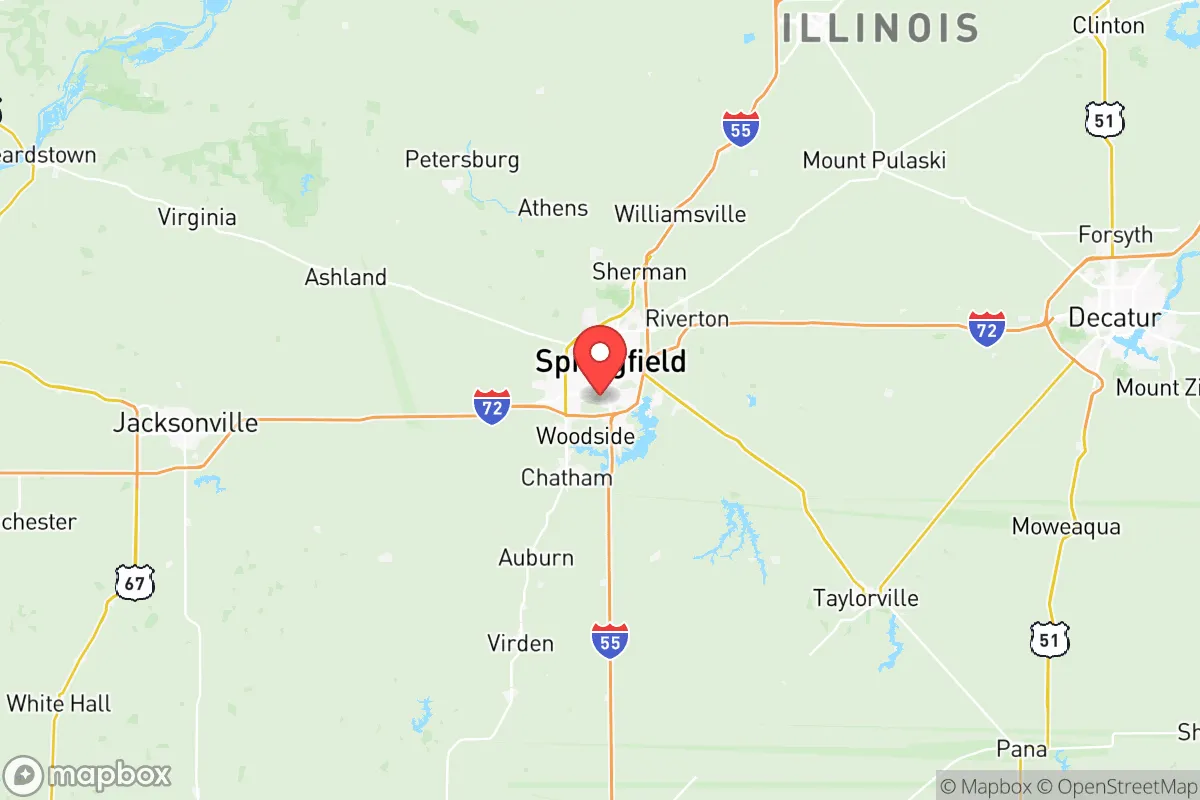
Sangamon County, Illinois, is home to roughly 195,000 residents, anchored by the state capital of Springfield. The county’s population is notably less diverse than the nation as a whole, with a 78.1% white majority and a 12.5% Black population, while Hispanic (2.8%), East/Southeast Asian (1.2%), and Indian subcontinent (0.9%) communities remain small but growing. The foreign-born share is a low 1.6%, and 35.1% of adults hold a college degree, reflecting a workforce shaped by government, healthcare, and education. The county’s identity is rooted in a steady, Midwestern character—politically moderate, historically significant as Abraham Lincoln’s home, and demographically stable compared to fast-growing Sun Belt regions.
Settlement & growth (pre-1960)
Before European settlement, the area now known as Sangamon County was inhabited by the Kickapoo and Potawatomi peoples, who used the Sangamon River as a travel and trade corridor. French explorers and traders passed through in the 17th and 18th centuries, but no permanent European settlement occurred until after the War of 1812. The 1818 Treaty of Edwardsville forced the Kickapoo to cede most of central Illinois, opening the land to American settlers.
The first major wave of American settlers arrived in the 1820s and 1830s, primarily from Kentucky, Tennessee, and the Ohio River Valley. These were largely of Scots-Irish and English stock, drawn by the promise of cheap, fertile prairie land under the 1820 Land Act. They founded the county’s earliest towns: Springfield (chosen as the county seat in 1821), Rochester (settled 1823), and Petersburg (1832). Abraham Lincoln himself arrived in 1837, practicing law in Springfield and later launching his political career from the county. By 1850, the county’s population had reached 19,000, overwhelmingly native-born and Protestant.
A second wave came with German and Irish immigration between 1840 and 1880. Germans, many fleeing political unrest and economic hardship, settled in Springfield’s north side and in the farming communities of Chatham and Pleasant Plains. They established Lutheran churches, breweries, and German-language newspapers. Irish immigrants, arriving during and after the Great Famine, concentrated in Springfield’s “Irish Patch” near the railroad yards and worked on the construction of the Alton & Sangamon Railroad. By 1880, foreign-born residents made up about 15% of the county’s population.
The post-Civil War era saw the arrival of African Americans, initially as freedmen moving from the Upper South. By 1900, Springfield’s Black population had grown to about 2,000, concentrated in the city’s east side. The Great Migration (1910–1940) brought a much larger wave of Black families from Mississippi, Arkansas, and Tennessee, seeking industrial jobs in Springfield’s coal mines, railroad shops, and the state government. The 1908 Springfield Race Riot, a violent white mob attack on Black residents, temporarily slowed this migration but did not stop it. By 1950, Black residents made up 8.5% of the county’s population, with the largest enclave in the East Springfield neighborhood.
European immigration slowed sharply after the 1924 Johnson-Reed Act. The county’s growth from 1920 to 1960 was driven by natural increase and domestic migration from rural Illinois. The state capital’s expanding bureaucracy, along with the growth of Memorial Medical Center and the University of Illinois Springfield (founded 1969), attracted a steady stream of white-collar workers from across the Midwest. The county’s population peaked at 201,000 in 1960.
Modern era (post-1965)
The 1965 Hart-Cellar Act had a muted effect on Sangamon County compared to coastal or Sun Belt regions. The foreign-born share remained below 2% through 2020, and the county did not experience the large-scale immigration from Asia, Latin America, or Africa seen in Chicago or the suburbs of Cook County. However, modest shifts did occur.
Hispanic population growth began in the 1990s, driven by Mexican immigrants working in agriculture and food processing. The town of Riverton and the unincorporated area of Clear Lake saw small clusters of Hispanic families, and by 2020, the county’s Hispanic share reached 2.8%. East/Southeast Asian residents, primarily of Vietnamese and Filipino origin, arrived in the 1980s and 1990s, many as healthcare professionals or refugees resettled by Catholic Charities. They concentrated in Springfield’s west side near the hospitals. The Indian subcontinent community, numbering about 1,700, grew after 2000, largely composed of doctors and engineers working at Memorial Medical Center and the Illinois Department of Public Health.
Domestic migration patterns shifted after 1970. The county lost population from 1970 to 1990 as manufacturing declined and young adults left for Chicago or the Sun Belt. Suburbanization reshaped the county: Sherman and Williamsville grew as bedroom communities for Springfield commuters, while Leland Grove and Jerome became affluent enclaves. The Black population, which had been concentrated in East Springfield, began dispersing to the south and west sides of Springfield and to the village of Grandview after fair-housing reforms in the 1970s. By 2020, the Black share had risen to 12.5%, but the county remained one of the least diverse in Illinois outside of Chicago.
The future
Sangamon County’s population is projected to remain flat or decline slightly through 2040, as the region’s birth rate falls and outmigration of young adults continues. The county is becoming slightly more diverse, but slowly. The Hispanic share is expected to reach 4–5% by 2040, driven by natural increase and continued immigration for agricultural and service jobs. The East/Southeast Asian and Indian subcontinent communities will likely grow modestly as healthcare and higher education sectors recruit internationally. The Black population share is expected to stabilize near 13–14%.
New communities are not forming distinct ethnic enclaves; instead, immigrants and minorities are dispersing across Springfield and its suburbs. The county’s cultural identity is evolving from a predominantly white, Protestant, Lincoln-era character to a more pluralistic, though still overwhelmingly white, Midwestern identity. The biggest demographic challenge is not diversity but aging: the median age is 40.5, and the county has a higher share of residents over 65 than the state average. This will increase demand for healthcare and senior services while straining the tax base.
For someone moving in now, Sangamon County offers a stable, affordable, and safe environment with a strong sense of place—but it is not a region of rapid demographic change or cultural dynamism. The population is becoming more diverse at a glacial pace, and the county’s future is one of slow, steady continuity rather than transformation. New residents will find a community that values its history, its government jobs, and its quiet, family-oriented lifestyle.

* Values derived from national, state, county, city and local statistics and may differ in a specific area. Last updated: 2026-07-27T10:46:49.000Z
Narrative content on this page is AI-generated and may contain mistakes. Verify any details that matter before acting on them.
ReloMaps may earn a commission from affiliate links at no extra cost to you.

