Photo: Wikipedia
Political ClimatePolitical Climate in Macon County
Showing district-level results — no local-only data available.
Local Political AnalysisPolitical Analysis of Macon County
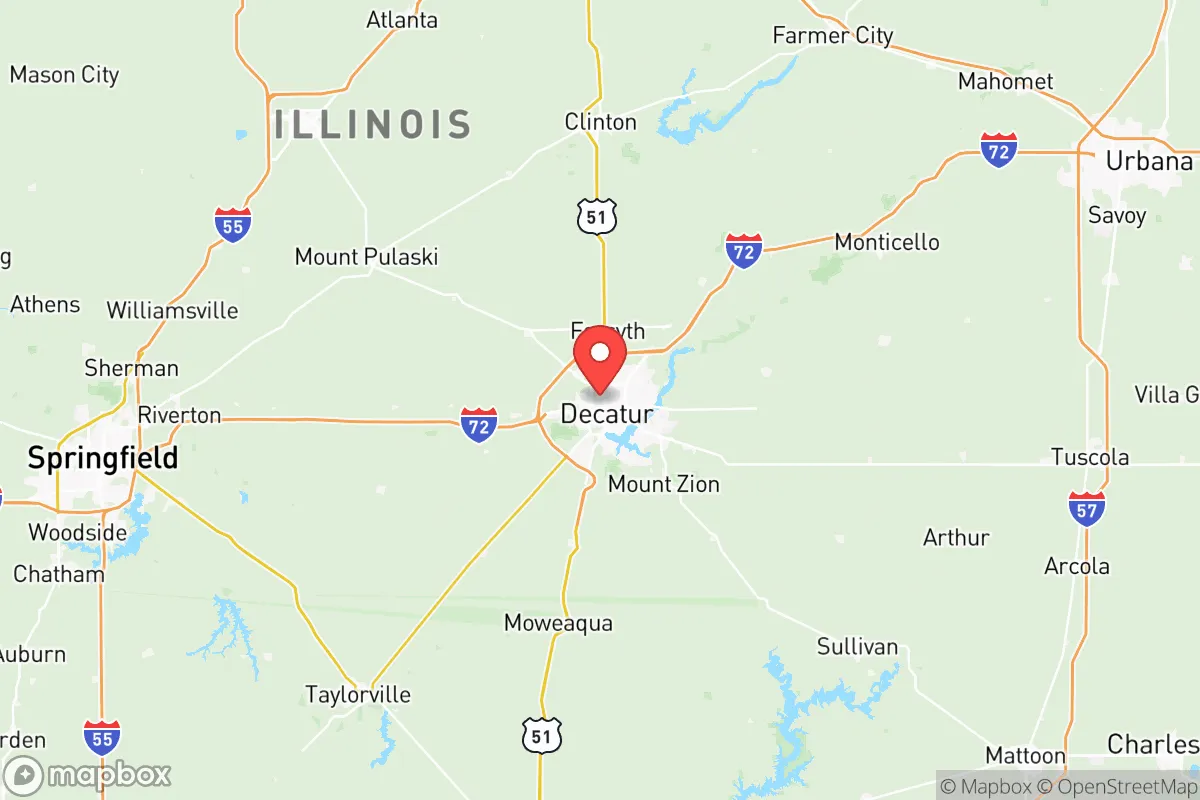
Macon County, anchored by Decatur, has a Cook PVI of D+5, making it a reliably Democratic area in a state that leans D+7 overall. However, that county-level number masks a more nuanced reality: the city of Decatur itself is the Democratic stronghold, while the surrounding towns and rural precincts—like Mount Zion, Forsyth, and Warrensburg—vote reliably Republican. The county has been drifting rightward over the past decade, a shift driven by the same rural-urban polarization seen across Illinois, but it hasn't flipped yet. If you're moving here, you'll find a place where the local political conversation is less about national culture wars and more about the health of the local economy, especially the fate of the ADM (Archer Daniels Midland) complex and the broader agribusiness sector.
How it compares
Illinois as a whole is D+7, meaning Macon County is about two points more conservative than the state average. That gap is largely explained by the county's smaller urban core and larger rural footprint. In Decatur's central and near-east side precincts, Democrats routinely win by 30-40 points, while in places like Mount Zion (a fast-growing bedroom community southeast of Decatur) and Forsyth (north of the city), Republicans win by similar margins. The swing precincts are in the South Shores area and parts of Oakley township, where ticket-splitting is still common—voters here might back a Democrat for county board but a Republican for state legislature. This is a sharp contrast to the Chicago collar counties, where the Democratic margin is both larger and more uniformly distributed. In Macon County, the political divide is geographic and economic: the city depends on manufacturing and service jobs, while the towns rely on farming and small business, and those different economic bases produce different voting patterns.
What this means for residents
For a conservative resident, living in Macon County means you're in the minority countywide, but you're likely in the majority in your immediate neighborhood if you live in Mount Zion, Forsyth, or Warrensburg. You'll find that local school board races and city council elections in those towns are competitive and often tilt right. For a liberal resident, Decatur itself is a comfortable environment politically, but you'll notice the shift as soon as you drive five miles outside the city limits. The practical effect is that county-level policy tends to be moderate—neither side has a veto-proof majority, so budgets and land-use decisions are negotiated rather than imposed. The county board, as of 2026, has a narrow Democratic majority, but it's a coalition that includes several conservative Democrats who vote with Republicans on fiscal issues. This means taxes are kept relatively low compared to Cook County, but public services—especially rural road maintenance and the county health department—are adequately funded.
Culturally, the biggest distinction between Macon County and the rest of Illinois is the absence of the Chicago-centric political dynamic. You won't hear much about lakefront development or CTA funding here; the local news is dominated by ADM layoffs, soybean prices, and the condition of Route 51. The county's politics are pragmatic and deal-driven, with less ideological posturing than you'd find in the state capital or the suburbs of Chicago. Both conservatives and liberals here tend to agree on one thing: the state government in Springfield doesn't pay enough attention to central Illinois. That shared grievance creates a kind of cross-party solidarity that's rare in more polarized parts of the state. If you're moving here, expect local elections to be decided on local issues—potholes, school funding, and the hospital's financial health—rather than national talking points.

State Political ClimatePolitical Climate in Illinois
State Political AnalysisPolitical Environment in the State
Illinois is a solidly Democratic state with a Cook PVI of D+7, but that top-line number masks one of the most dramatic urban-rural political chasms in the country. The state has shifted leftward over the past 20 years, driven overwhelmingly by the Chicago metro area, while downstate counties have moved just as sharply in the opposite direction. For a conservative-leaning relocator, the reality is that Illinois offers a mixed bag: deep-blue governance in Springfield and Chicago, but a patchwork of red-leaning communities where conservative values are the local norm, especially outside the northeastern corner of the state.
Urban vs. rural divide
The political map of Illinois is essentially a story of Cook County versus everything else. Chicago and its inner suburbs produce the Democratic majorities that decide statewide elections, while the rest of the state votes reliably Republican. In 2024, Cook County delivered roughly 70% of its vote to the Democratic presidential candidate, while counties like Effingham, Jasper, and Wayne in the southeastern part of the state gave 80% or more to the Republican. The collar counties around Chicago — DuPage, Lake, Kane, Will, and McHenry — have been trending bluer over the past decade, particularly in suburban areas like Naperville and Arlington Heights, as educated professionals have shifted left. Meanwhile, downstate cities like Springfield, Peoria, and Rockford remain competitive but lean Democratic, while rural towns like Effingham, Quincy, and Mount Vernon are solidly red. The divide is stark: a conservative family moving to a place like Edwardsville or O'Fallon in the Metro East region will find a much different political environment than one settling in Evanston or Oak Park.
Policy environment
Illinois has a progressive tax structure — a flat income tax of 4.95% — but property taxes are among the highest in the nation, averaging over 2% of home value statewide, with Cook County and the collar counties often exceeding 2.5%. The state's regulatory posture is generally business-friendly in some sectors, particularly agriculture and manufacturing, but labor unions remain powerful, especially in construction and public education. Education policy is dominated by the Chicago Teachers Union, which has significant influence in Springfield, and the state has a robust school funding formula that directs more money to low-income districts. Healthcare policy is liberal: Illinois expanded Medicaid under the Affordable Care Act, and the state has strong protections for abortion access, including the Reproductive Health Act of 2019. Election laws are among the most accessible in the country, with automatic voter registration, no-excuse mail-in voting, and same-day registration. For a conservative relocator, the high property taxes and union influence are likely the most immediate practical concerns, while the election and healthcare policies may be less relevant to daily life.
Recent policy direction
Illinois has moved decisively left in recent years, particularly on social and criminal justice issues. In 2021, the state became the first in the nation to eliminate cash bail entirely through the Pretrial Fairness Act, a provision of the broader SAFE-T Act. Gun laws have tightened significantly: Illinois now requires a Firearm Owner's Identification (FOID) card, universal background checks, and a 72-hour waiting period for handgun purchases, and in 2023 the state banned the sale of assault weapons and high-capacity magazines. On education, the state passed a law requiring schools to teach LGBTQ+ inclusive history, and parental rights in education have been a flashpoint, with conservative groups pushing back against curriculum transparency laws. On privacy and surveillance, Illinois has the Biometric Information Privacy Act (BIPA), one of the strongest privacy laws in the country, which has led to major class-action lawsuits against tech companies. Medical and bodily autonomy is broadly protected, with no restrictions on abortion and strong protections for gender-affirming care. Property rights are relatively weak in the context of eminent domain, particularly in Chicago, where the city has used its power aggressively for development projects. For a conservative relocator, the gun laws and the elimination of cash bail are likely the most significant policy shifts to weigh.
Civil unrest & political movements
Illinois has seen its share of political flashpoints. The 2020 George Floyd protests in Chicago were among the largest in the country, with significant property damage and looting in the Loop and along the Magnificent Mile. The state has a strong sanctuary policy: the Illinois Trust Act (2017) limits local law enforcement's cooperation with federal immigration authorities, and Chicago remains a "Welcoming City." Immigration politics are a constant source of tension, particularly as the state has seen an influx of migrants bused from Texas since 2022, straining resources in Chicago and suburban communities. Election integrity has been a recurring controversy, with conservative groups challenging the state's mail-in voting expansion and alleging irregularities in downstate counties, though no widespread fraud has been proven. Secession rhetoric is common in downstate Illinois, with several counties passing symbolic resolutions to explore leaving the state and joining Indiana or Missouri, though these efforts have no legal force. A new resident in a place like Effingham or Mount Vernon will hear this talk regularly, while someone in Chicago's Lincoln Park neighborhood will likely never encounter it.
Projection
Over the next 5-10 years, Illinois is likely to remain a Democratic stronghold at the state level, but the internal divide will deepen. Chicago's population has been declining slowly, while the collar counties continue to grow and trend bluer, offsetting any gains Republicans might make downstate. The state's fiscal challenges — including a massive unfunded pension liability — will constrain future spending, but the Democratic supermajority in Springfield means progressive policies on guns, abortion, and criminal justice will continue. In-migration patterns are mixed: Illinois loses residents to neighboring states like Indiana, Wisconsin, and Missouri, but gains international immigrants, particularly in Chicago. For a conservative relocator, the practical outlook is that the state's political trajectory will not reverse, but the lived experience in red-leaning communities like Edwardsville, Quincy, or Effingham will remain largely unchanged, as local governance in those areas reflects conservative values. The key question is whether the state's fiscal health deteriorates enough to force a reckoning, or whether the Democratic majority can manage the pension crisis without drastic tax increases.
For a conservative family or individual considering Illinois, the bottom line is that the state offers a genuine choice: live in a blue metro or a red small town, each with its own trade-offs. The high property taxes and progressive state policies are unavoidable wherever you settle, but the day-to-day political climate varies enormously. If you value low taxes and a conservative local culture, Illinois is a harder sell than Indiana or Missouri. But if you need to be in the region for work or family, places like Edwardsville, O'Fallon, or even parts of the collar counties like McHenry can provide a comfortable conservative environment within a blue state. Just know that your state taxes and your vote for governor will be swimming against the current.
* Values derived from national, state, county, city and local statistics and may differ in a specific area. Last updated: 2026-07-01T10:47:46.000Z
Narrative content on this page is AI-generated and may contain mistakes. Verify any details that matter before acting on them.
ReloMaps may earn a commission from affiliate links at no extra cost to you.

