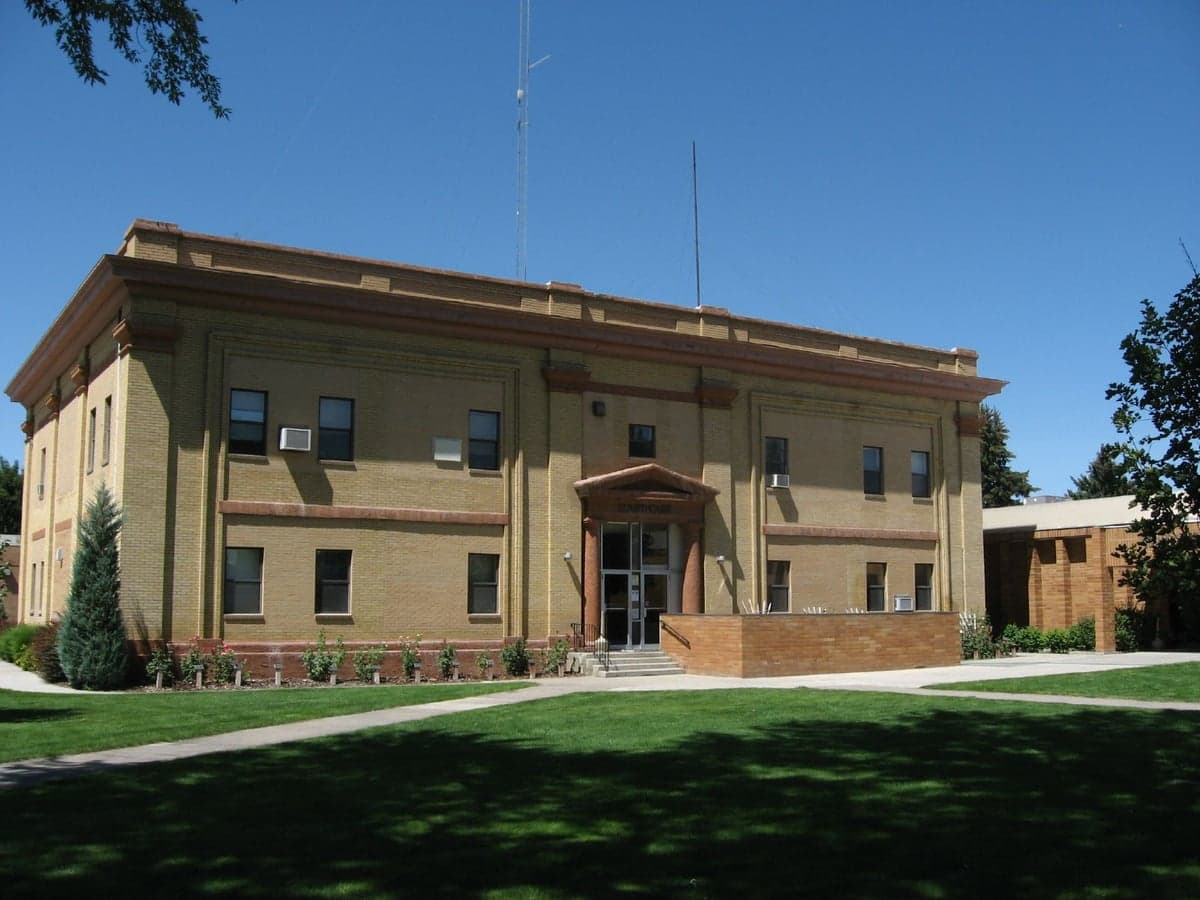
Photo: Wikipedia
Political ClimatePolitical Climate in Minidoka County
Showing district-level results — no local-only data available.
Local Political AnalysisPolitical Analysis of Minidoka County
Minidoka County has long been a solidly conservative stronghold, with a Cook PVI of R+13 that reflects a deep-rooted preference for limited government and traditional values. While the county is undeniably red, it's a bit less overwhelmingly so than the rest of Idaho (which sits at R+18), and that small gap tells a story worth paying attention to. The real political action here isn't between Republicans and Democrats—it's between the old-guard, self-reliant conservatives and the newer, more moderate influences creeping in from the Magic Valley's growing towns.
How it compares
The five-point difference between Minidoka County's R+13 and Idaho's R+18 might not sound like much, but it's noticeable on the ground. The county seat, Rupert, is reliably red, with most precincts voting 65-70% Republican in recent cycles—think of it as the bedrock of the area's conservative identity. However, Heyburn has shown a slight softening, with a handful of precincts dipping into the low 60s for GOP candidates, often driven by younger families and a few transplants from bluer states. The real outlier is Acequia, a tiny town where local races can get surprisingly competitive; it's not a blue dot, but it's the closest thing to a swing precinct in the county, with margins sometimes under 10 points. Meanwhile, the rural farming communities outside these towns—places like Paul and Minidoka itself—vote closer to 75% Republican, anchoring the county's overall red tilt. Compared to the rest of Idaho, Minidoka County feels a bit more exposed to outside influence, especially as the Twin Falls metro area's growth starts to ripple eastward.
What this means for residents
For folks who've lived here a while, the concern isn't about losing elections—it's about losing the culture. The county's R+13 rating masks a slow but real shift: more people moving in from places like California and Oregon, bringing with them ideas about bigger government and more regulations. You see it in local school board meetings, where debates over curriculum and parental rights are getting louder, and in city council discussions about zoning and property taxes. The old way of doing things—where neighbors solved problems without calling a bureaucrat—is under pressure. If you value personal freedoms and want to keep government out of your backyard, Minidoka County is still a good bet, but you can't afford to be complacent. The precincts in Heyburn and Acequia are the ones to watch; if they drift further left, the county's overall character could start to change.
Culturally, Minidoka County still holds onto a strong agricultural identity, with the Minidoka Irrigation District and local potato and dairy operations shaping daily life. There's a palpable resistance to progressive policy shifts, like the push for statewide land-use planning or stricter environmental rules that some see as federal overreach. The county's Republican leadership tends to focus on water rights, property rights, and keeping taxes low—bread-and-butter issues that resonate with the old-timers. But the worry is that as the county's PVI inches closer to purple, those priorities could get sidelined by more divisive, urban-focused agendas. For now, it's a place where a handshake still means something and the government is expected to stay out of the way, but the next decade will test whether that can hold.

State Political ClimatePolitical Climate in Idaho
State Political AnalysisPolitical Environment in the State
Idaho is about as red as it gets—Cook PVI of R+18, a state where Republicans hold every statewide office and supermajorities in the legislature. But that solid number hides a more interesting story: over the last 20 years, Idaho has actually shifted rightward even as its population boomed with newcomers from blue states. The dominant coalition is a mix of rural conservatives, Mormon cultural influence in the southeast, and libertarian-leaning transplants who fled California and Washington for lower taxes and fewer mandates. The trajectory has been toward more aggressive conservative governance, especially since 2020, though the Boise metro area has become a battleground within the state.
Urban vs. rural divide
The political map breaks down cleanly. Ada County (Boise, Meridian, Eagle) is the only real swing county—it voted for Trump by single digits in 2024, down from double digits in 2016. Boise itself leans left, but the sprawling suburbs of Meridian and Eagle are solidly conservative. Canyon County (Nampa, Caldwell) is deep red and growing fast. The rest of the state is overwhelmingly Republican. Idaho Falls and Rexburg in the east are among the most conservative metros in the nation, driven by the LDS Church's cultural influence. Coeur d'Alene in the north has seen an influx of out-of-staters, but Kootenai County still votes +30 R. The rural counties—like Lemhi, Custer, and Owyhee—are +50 or more. The only blue dots are small: Moscow (University of Idaho) and parts of Blaine County (Sun Valley). The urban-rural divide is less about ideology and more about intensity: rural Idahoans are deeply skeptical of any government growth, while Boise-area voters are more open to pragmatic conservatism.
Policy environment
Idaho's policy posture is aggressively pro-freedom by design. The state has a flat income tax of 5.8% (down from 6.5% in 2023), no corporate income tax, and no estate tax. Property taxes are low but vary by county. The regulatory environment is among the most business-friendly in the nation—no state-level occupational licensing for many trades, and a right-to-work law. Education policy has shifted right: the 2023 Idaho Parental Rights Act gives parents explicit authority over their children's education and medical decisions. School choice is expanding via charter schools and a new education savings account program (2024). Healthcare: Idaho expanded Medicaid via ballot initiative in 2018, but the legislature has resisted further expansion and passed a law requiring work requirements (blocked in court). Election laws are strict: voter ID required, no automatic mail-in ballots, and a ban on ballot drop boxes. The state also passed a constitutional carry law in 2016—no permit needed to carry a concealed firearm. Abortion is banned at all stages except to save the mother's life, with a trigger law that took effect after Dobbs. Overall, the policy environment is designed to maximize individual liberty and limit government reach—exactly what most conservatives want.
Trajectory & freedom
Is Idaho becoming more or less free? On most metrics, more. The last five years have seen a flurry of liberty-expanding legislation: permitless carry (2016), the parental rights act (2023), a law prohibiting vaccine mandates by private employers (2023), and a property rights bill limiting eminent domain for carbon pipelines (2024). The state also passed a Second Amendment Preservation Act in 2021, declaring that federal gun laws inconsistent with the Idaho constitution are null and void. On the other hand, there are worrying signs. The Boise city government has imposed zoning restrictions that limit housing supply, driving up costs. Some counties have adopted land-use regulations that feel like overreach. And the influx of new residents from California and Washington has brought more progressive voting blocs to Ada County—though so far, those newcomers tend to be conservative-leaning themselves. The net trajectory is still toward more freedom, but the battle lines are forming around local control vs. state preemption. A new resident should expect the state to continue passing laws that protect individual rights, but should also watch local city councils closely.
Civil unrest & political movements
Idaho is not a place of frequent protests or visible unrest. The most notable flashpoint in recent years was the 2020 Black Lives Matter protests in Boise, which drew a few hundred people and were met with counter-protests. The state's organized activist movements are overwhelmingly on the right: the Idaho Freedom Foundation is a powerful think tank that pushes for limited government and has successfully killed tax increases. There's a visible militia presence in north Idaho, particularly around Sandpoint and Bonners Ferry, but they're mostly low-key and not violent. Immigration politics are muted—Idaho has no sanctuary cities, and the legislature passed a law requiring local law enforcement to cooperate with ICE. Election integrity has been a hot topic: after 2020, the legislature passed a law requiring hand-counting of ballots in some counties (later modified), and there's ongoing debate about voting machines. A new resident would notice that political conversations are common and open, but rarely heated in public. The culture is one of live-and-let-live, as long as you don't try to impose big-government solutions.
Projection
Over the next 5-10 years, Idaho will likely remain solidly red, but the internal dynamics will shift. In-migration is the wild card: the state added over 200,000 people between 2020 and 2025, mostly from California, Washington, and Oregon. Many of these newcomers are conservative or libertarian, but they bring different expectations—they want low taxes and freedom, but also amenities like good schools and infrastructure. This will create tension between the old-guard rural libertarians and the new suburban conservatives. The Boise metro will continue to purple, but the legislature will remain deeply conservative due to rural overrepresentation. Expect more preemption laws to block local progressive ordinances (like plastic bag bans or rent control). The biggest threat to freedom is likely zoning and housing costs—if the state doesn't address supply, it could price out the very people who moved there for affordability. A new resident moving in now should expect to find a state that is still a conservative haven, but one where the culture is evolving. Choose your location carefully: if you want the most freedom, look at rural counties or the eastern cities like Idaho Falls. If you want a mix of conservative values and urban amenities, Meridian or Eagle are good bets. Avoid Boise city proper if you're wary of creeping progressivism.
Bottom line for a new resident: Idaho is one of the last states where you can still live free from heavy-handed government. The taxes are low, the gun laws are light, and the culture respects individual choice. But it's changing fast—the same freedoms that attract people also attract development and the political pressures that come with it. If you move here, get involved in local politics early, because the fight for freedom is won at the county commission and city council level. Idaho is still worth it, but it's not the sleepy backwater it was 20 years ago. Come for the liberty, stay for the lifestyle, but keep an eye on the ballot box.
* Values derived from national, state, county, city and local statistics and may differ in a specific area. Last updated: 2026-05-08T19:05:20.000Z
Narrative content on this page is AI-generated and may contain mistakes. Verify any details that matter before acting on them.
ReloMaps may earn a commission from affiliate links at no extra cost to you.

