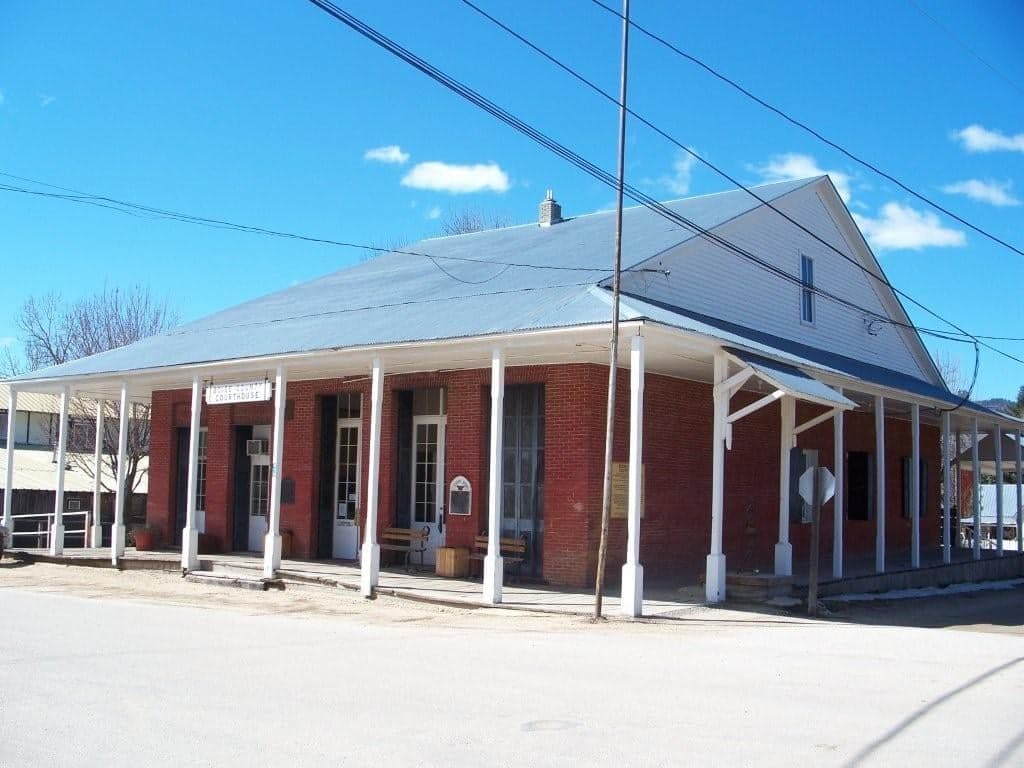
Photo: Wikipedia
Political ClimatePolitical Climate in Boise County
Showing county-level results — no local-only data available.
Lean and PVI are calculated from this county’s 2020 and 2024 presidential results, Cook-style.
Political rankings in Idaho
- Most Conservative Cities in Idaho
- Most Liberal Cities in Idaho
- Best Liberal-Leaning Towns in the Mountain West
- Safest Liberal-Leaning Towns in the Mountain West
- Safest Conservative-Leaning Cities in the Mountain West
- Affordable Small Towns for Conservatives
- Most Affordable Liberal-Leaning Small Towns in the U.S.
- Safest Conservative-Leaning Cities in the U.S.
- Most Conservative Counties in Idaho
- Most Liberal Counties in Idaho
Local Political AnalysisPolitical Analysis of Boise County
Boise County, Idaho, is one of the most reliably conservative areas in the state, with a Cook Partisan Voting Index (PVI) of R+22, making it four points more Republican than Idaho as a whole (R+18). This isn't a new development; the county has been a GOP stronghold for decades, but the intensity of that lean has deepened in recent years as the rural character of the area has clashed with the growth spilling out of the Treasure Valley. The political center of gravity here is firmly in the hills, not the suburbs.
How it compares
While Idaho as a state is solidly red, Boise County is a deeper shade of that red. The difference of four PVI points is significant because it reflects a county that is more resistant to the moderate, suburban drift seen in places like Ada County (home to Boise). In Boise County, the political landscape isn't uniform. The county seat, Idaho City, is a small, historic mining town that leans conservative but has a small, vocal progressive minority, often centered around the arts and the local historical society. In contrast, the unincorporated areas around Banks and Lowman are among the most conservative precincts in the entire state, driven by a strong libertarian streak and a deep distrust of federal land management. The only real swing area is the Horseshoe Bend precinct, which has a mix of longtime ranchers and newer commuters who work in Eagle and Meridian, creating a more moderate, though still Republican-leaning, voting bloc. The county's trajectory is toward an even harder red, as new residents are often drawn specifically by the promise of low taxes and minimal regulation, reinforcing the existing political culture.
What this means for residents
For conservative residents, Boise County is close to an ideal political environment. Local offices—from the county commission to the sheriff—are reliably held by Republicans, and policy debates tend to focus on property rights, Second Amendment protections, and limiting county government's footprint. There is little to no organized Democratic Party presence, so primaries are often the real election. For liberal or moderate residents, the reality is more isolating. While they are not actively persecuted, they often find themselves politically invisible. Local public meetings can feel unwelcoming, and social circles are often defined by church or gun clubs, which can be a barrier for newcomers who don't share those affiliations. The practical effect is that progressive residents tend to keep their politics private or drive to Boise for community and events that align with their views.
Culturally, Boise County is distinct from the rest of Idaho in its fierce independence. The county has a long history of conflict with the U.S. Forest Service over road access and logging, and this anti-federal sentiment is a defining feature of local politics. You'll see more "Don't Tread on Me" flags here than in the more suburban parts of the state. This isn't just a voting pattern; it shapes daily life. Local businesses are more likely to post political signs, and community events like the Idaho City Rodeo are as much a celebration of a rural, conservative way of life as they are entertainment. For anyone moving here, understanding that this is a place where politics is personal and deeply tied to the land is essential. The county's trajectory suggests this will only intensify as more people seek an escape from the increasingly moderate politics of the Treasure Valley.

State Political ClimatePolitical Climate in Idaho
State Political AnalysisPolitical Environment in the State
Idaho is one of the most reliably Republican states in the nation, with a Cook Partisan Voting Index of R+18, meaning it votes about 18 points more Republican than the national average. Over the past two decades, the state has shifted even further right, driven by explosive growth in the conservative Treasure Valley and a simultaneous exodus of moderate Democrats from rural areas. The dominant coalition is a mix of libertarian-leaning ranchers, socially conservative Mormons in the southeast, and a wave of out-of-state transplants from California and Washington seeking lower taxes and less regulation.
Urban vs. rural divide
The political map of Idaho is stark. The Treasure Valley, anchored by Boise, Meridian, and Nampa, is the state’s population center and the engine of its Republican dominance. Ada County (Boise) has trended rightward in recent cycles, though it still contains a sizable Democratic minority concentrated in the city core and the North End. Canyon County (Nampa, Caldwell) is deeply conservative, with a strong evangelical and agricultural base. The Panhandle, including Coeur d’Alene and Post Falls, has seen an influx of conservative refugees from Washington and Oregon, turning what was once a swing region into a solid red stronghold. In contrast, the central and eastern parts of the state—places like Idaho Falls, Rexburg, and Pocatello—are overwhelmingly Republican, driven by the LDS Church’s cultural influence and a rural economy tied to farming and energy. The only reliably blue pockets are the university towns of Moscow (University of Idaho) and Boise State University’s immediate vicinity, plus a few liberal enclaves in Blaine County (Sun Valley). The rural-urban divide is less about a city vs. country split and more about a metro vs. everything-else dynamic: the fast-growing suburbs are pulling the state right, while the shrinking rural counties are staying put.
Policy environment
Idaho’s policy environment is defined by low taxes, minimal regulation, and a strong tilt toward local control. The state has a flat income tax of 5.8% (recently cut from 6.5%), no corporate income tax on pass-through entities, and a sales tax of 6% that applies to most goods but not groceries. Property taxes are relatively low, though they vary by county. The regulatory posture is business-friendly: no state-level minimum wage above the federal $7.25, no paid family leave mandate, and a right-to-work law. Education policy is a flashpoint: the state has one of the nation’s most robust charter school and open enrollment systems, but per-pupil funding ranks near the bottom nationally. The legislature has passed multiple school choice bills, including a 2023 expansion of education savings accounts. Healthcare policy is limited: Idaho did not expand Medicaid until 2020 (via ballot initiative), and the state has some of the most restrictive abortion laws in the country, with a near-total ban after six weeks (the "Fetal Heartbeat" law, SB 1309, passed in 2023). Election laws are moderately restrictive: voter ID is required, same-day registration is not available, and mail-in voting is allowed only with an excuse. The state has no automatic voter registration.
Recent policy direction
The last three legislative sessions have pushed Idaho sharply right on nearly every front. On gun rights, the state passed a permitless carry law in 2023 (HB 124), allowing any adult 18 or older to carry a concealed firearm without a license. On parental rights, the "Parents’ Bill of Rights" (HB 93, 2023) requires schools to notify parents of any curriculum involving sexuality or gender identity and prohibits instruction on sexual orientation or gender identity in grades K-3. On speech and privacy, the state banned TikTok on government devices (2023) and passed a law requiring age verification for adult websites (HB 258, 2024). On medical autonomy, the "Medical Freedom" bill (SB 1019, 2023) prohibits any requirement for COVID-19 vaccines or masks in public schools and state buildings. On property rights, the state passed a law limiting county-level zoning restrictions on residential development (HB 389, 2024), aimed at boosting housing supply. On taxation, the legislature cut the corporate income tax rate from 6.5% to 5.8% in 2023 and eliminated the personal property tax on business equipment. On voting, the state tightened ballot access by requiring proof of citizenship for voter registration (HB 124, 2024) and banning ballot drop boxes. The overall direction is toward maximum individual liberty on guns, education, and medical choice, combined with strict social conservatism on abortion and LGBTQ+ issues.
Civil unrest & political movements
Idaho has a history of fringe political movements, but the mainstream is now more aligned with them than in the past. The Ammon Bundy family’s influence remains visible in the rural north, where anti-government sentiment runs deep. In 2022, a standoff between the FBI and a white nationalist group in Sandpoint (the "Patriot Front" incident) drew national attention, though the group was small. The state has seen organized protests from both sides: the "Idaho Women’s March" in Boise draws thousands annually, while the "Idaho Freedom Foundation" rallies at the capitol against mask mandates and property taxes. Immigration politics are less volatile than in border states, but the legislature passed a law in 2024 (HB 421) requiring local law enforcement to cooperate with ICE, effectively banning sanctuary cities. There is no serious secession or nullification movement, though some rural counties have floated "Greater Idaho" proposals to join Wyoming or Montana. Election integrity controversies are muted: the 2020 and 2022 elections were certified without major disputes, though the state’s Republican Party has purged some moderate incumbents in primaries. A new resident would notice the heavy presence of "Don’t Tread on Me" flags and "Thin Blue Line" decals in rural areas, but actual civil unrest is rare—most political energy goes into legislative battles, not street protests.
Projection
Over the next 5-10 years, Idaho will likely become even more Republican, but the character of that conservatism is shifting. The in-migration from California and Washington is bringing a more libertarian, less socially conservative strain of Republicanism, especially in the Treasure Valley and Panhandle. This could create tension with the older, Mormon-dominated Republican establishment in eastern Idaho. The state’s population is projected to grow by 15-20% by 2030, with most growth in Ada and Canyon counties, which will further dilute the influence of rural counties. The Democratic Party will remain a permanent minority, but the urban-rural divide may widen as Boise becomes more diverse and liberal-leaning. Expect continued battles over school funding (as the state struggles to keep up with growth), housing affordability (a major issue in Boise and Coeur d’Alene), and water rights (a looming crisis in the Snake River Plain). The state’s tax structure will likely shift further toward consumption taxes (sales tax) and away from income taxes, as the legislature eyes a path to eliminating the income tax entirely. Social issues will remain front and center: expect more laws on transgender rights, library content, and vaccine mandates. The overall trajectory is toward a state that is freer in economic and self-defense terms, but more restrictive on social and medical choices.
For a new resident, the bottom line is this: Idaho offers a low-tax, high-autonomy environment for those who align with its conservative tilt, but it is not a libertarian paradise—the state government is actively involved in social regulation, especially around family, education, and healthcare. If you are a conservative or a libertarian-leaning moderate, you will find a welcoming policy landscape and a like-minded community in most places outside of Boise and Moscow. If you are a liberal, you will face a hostile state government and limited political influence, though you can find a supportive community in the urban core or the university towns. The state’s rapid growth means infrastructure is strained, housing is expensive in the desirable areas, and the political climate is likely to become more polarized, not less. Come for the mountains and the tax rate, but understand that the politics are as rugged as the terrain.
* Values derived from national, state, county, city and local statistics and may differ in a specific area. Last updated: 2026-11-09T10:24:00.000Z
Narrative content on this page is AI-generated and may contain mistakes. Verify any details that matter before acting on them.
ReloMaps may earn a commission from affiliate links at no extra cost to you.

