Photo: Wikipedia
Demographics of Idaho Springs, CO
Affluence Level in Idaho Springs, CO
A middle-class area roughly in line with national averages across income, home values, education, and employment.
People of Idaho Springs, CO
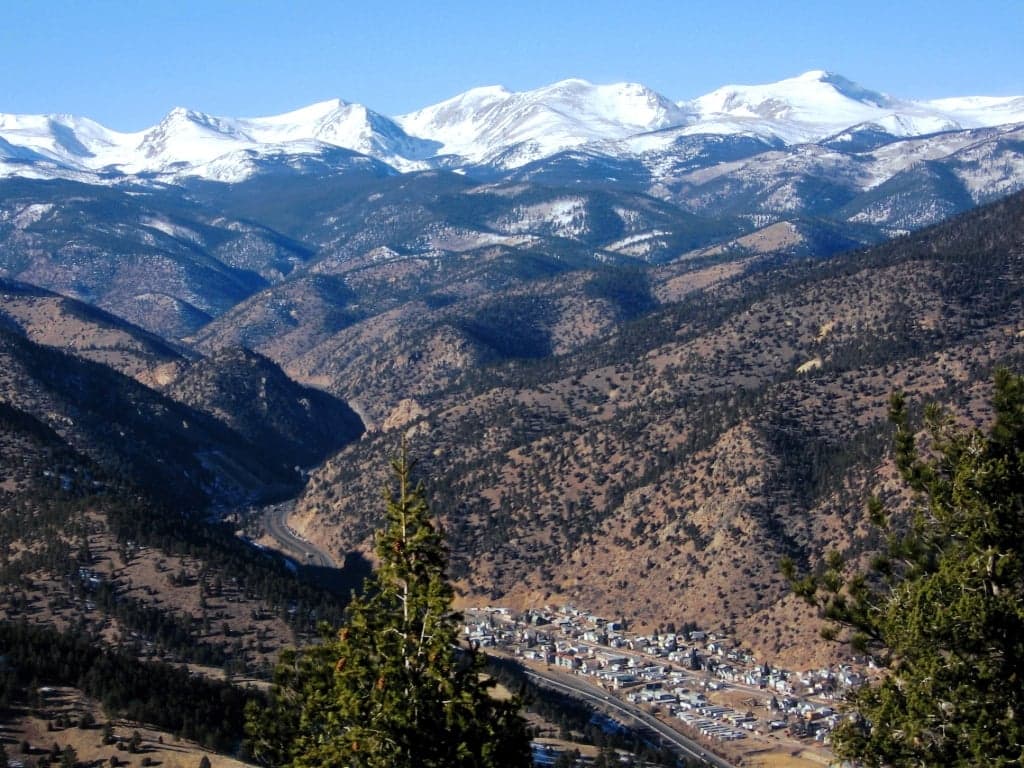
The people of Idaho Springs, Colorado, today number just under 2,000 residents, forming a tight-knit, historically rooted mountain community with a distinctly Western character. With a population of 1,968, the city is predominantly White (77.1%) and has a significant Hispanic presence (15.2%), reflecting its deep mining-era and railroad-era origins. The city is notably well-educated, with 50.0% of adults holding a college degree, a figure that points to a recent influx of remote workers and outdoor recreation enthusiasts. Idaho Springs retains a working-class, independent streak, balancing its historic identity as a gold-mining hub with a growing role as a bedroom community for commuters heading to Denver and the Front Range.
How the city was settled and grew
Idaho Springs was born directly from the Colorado Gold Rush of 1859, when prospectors discovered placer gold in Clear Creek. The original settlement, known as Idaho City, was a chaotic tent camp of fortune seekers from the eastern United States, Europe, and China. The earliest permanent structures went up in what is now the Historic Downtown District, centered on Miner Street, where saloons, assay offices, and supply stores served the mining camps. A distinct Chinese community formed in the Lower Town area along Clear Creek, where Chinese laborers—many of whom had worked on the transcontinental railroad—built laundries, gardens, and small businesses. By the 1870s, hard-rock mining replaced placer mining, drawing Cornish, Irish, and German immigrants who settled in the West End neighborhood, building modest frame houses on the hillsides above the creek. The railroad's arrival in the 1880s solidified the town as a supply and smelting center, and the population peaked at roughly 3,000 by 1900. The decline of mining after World War I led to a long population slide, with many families leaving for Denver or the Front Range, leaving the historic neighborhoods largely intact but aging.
Modern era (post-1965)
The post-1965 era brought a slow demographic shift, driven less by international immigration and more by domestic in-migration from the Denver metro area. The foreign-born share remains low at 2.6%, and the city has not seen the large-scale Asian or Indian-subcontinent immigration that has reshaped other Colorado towns. Instead, the Hispanic population grew steadily from the 1970s onward, as families from northern New Mexico and southern Colorado moved in for work in construction, tourism, and the remaining mining operations. Many of these families settled in the East Idaho Springs area, along Colorado Boulevard and the flatter land near I-70, where housing was more affordable. The Black population, at 2.3%, is small but has a visible presence, with families concentrated in the South Clear Creek neighborhood, near the county fairgrounds. The most transformative modern trend has been the arrival of college-educated professionals from Denver and Boulder, drawn by lower home prices and the ability to work remotely. These newcomers have gravitated toward the Historic Downtown District and the West End, renovating Victorian-era homes and opening boutique businesses, which has gradually raised property values and shifted the cultural tone toward a more outdoorsy, amenity-oriented identity.
The future
The population of Idaho Springs is projected to grow modestly over the next decade, likely reaching 2,200–2,400 by 2035, driven by continued spillover from the Denver metro area. The city is becoming slightly more diverse, with the Hispanic share expected to rise toward 18–20% as families are priced out of closer-in suburbs like Golden and Wheat Ridge. The White share, while still dominant, will likely decline gradually as younger, more diverse households move in. The Asian and Indian-subcontinent populations are expected to remain negligible, as the city lacks the job base or ethnic infrastructure to attract those groups. New residential development is concentrated in the East Idaho Springs area, where a few small subdivisions and townhome projects are being built on vacant lots, and in the South Clear Creek corridor, where zoning changes have allowed for higher-density housing. The city's cultural identity is evolving from a gritty mining town into a hybrid: part historic tourist destination, part commuter suburb, part outdoor recreation hub. This creates some tension between long-time residents, who value the town's quiet, independent character, and newcomers, who push for more amenities, bike lanes, and event programming.
For someone moving in now, Idaho Springs offers a genuine mountain-town experience with a strong sense of place, but it is no longer the cheap, overlooked backwater it was twenty years ago. The population is stable, educated, and increasingly oriented toward recreation and remote work, while the historic working-class and Hispanic communities remain the backbone of local civic life. The city is becoming more expensive and slightly more diverse, but it retains a distinctly Western, small-town identity that sets it apart from the homogenized suburbs of the Front Range.

* Values derived from national, state, county, city and local statistics and may differ in a specific area. Last updated: 2026-10-17T04:06:29.000Z
Narrative content on this page is AI-generated and may contain mistakes. Verify any details that matter before acting on them.
ReloMaps may earn a commission from affiliate links at no extra cost to you.

