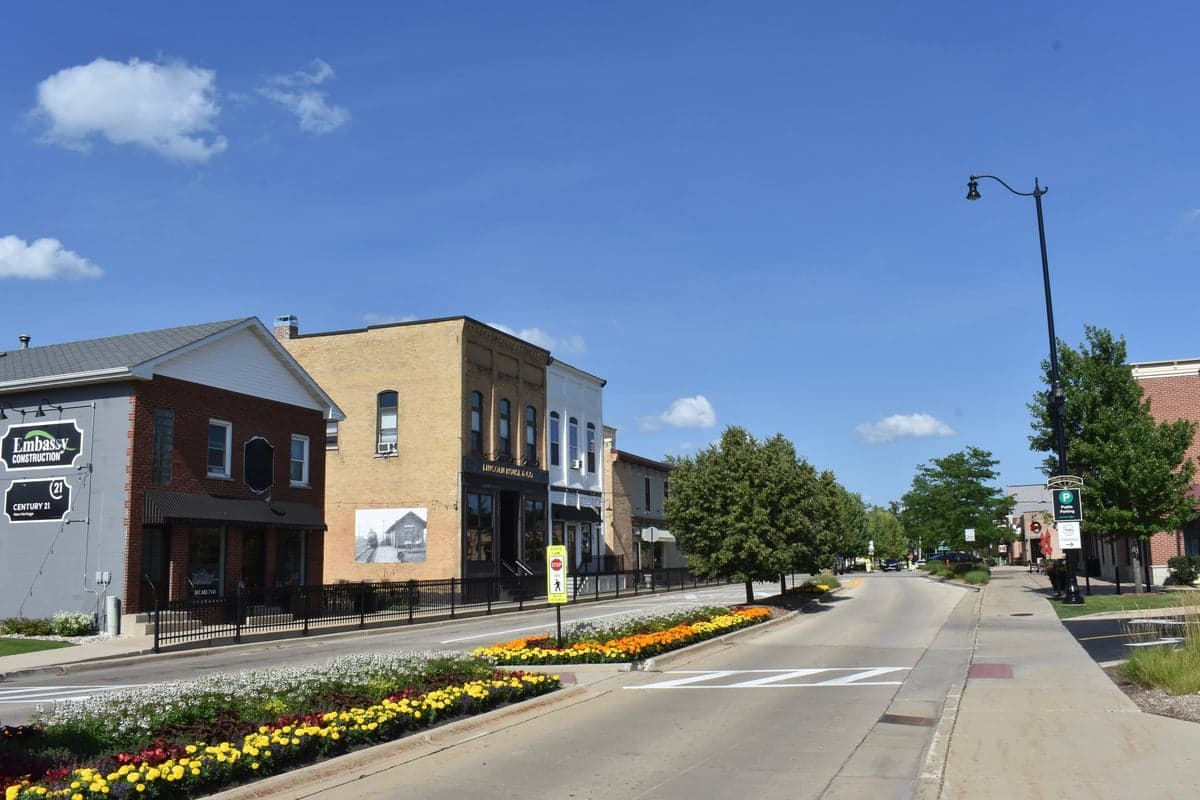
Photo: Wikipedia
Political ClimatePolitical Climate in Huntley, IL
District shown is the primary district for this city’s centroid. Cities may span multiple districts.
* Lean and PVI are calculated from Huntley, IL’s own 2020 presidential results (precinct returns summed to the city), with 2024 estimated from the surrounding county’s 2020–2024 shift, Cook-style. Sources: state election offices; VEST 2020 precinct results (CC BY 4.0).
Political rankings in Illinois
- Most Conservative Cities in Illinois
- Most Liberal Cities in Illinois
- Best Liberal-Leaning Towns in the Midwest
- Safest Liberal-Leaning Towns in the Midwest
- Safest Conservative-Leaning Towns in the Midwest
- Affordable Small Towns for Conservatives
- Most Affordable Liberal-Leaning Small Towns in the U.S.
- Safest Conservative-Leaning Cities in the U.S.
- Most Conservative Counties in Illinois
- Most Liberal Counties in Illinois
Local Political AnalysisPolitical Analysis of Huntley, IL
Huntley, Illinois, sits in a politically interesting pocket where its own lean is slightly more moderate than the state as a whole, but still firmly in Democratic territory. The area carries a Cook PVI of D+6, meaning it votes about six points more Democratic than the national average, while Illinois overall is D+7. That one-point difference might sound small, but it reflects a real local dynamic: Huntley is a bit more purple than the deep-blue Chicago core, and that shows in local elections and everyday conversations. Over the past decade, the village has shifted leftward alongside the rest of the collar counties, but it hasn't swung as hard as places like Elgin or Carpentersville to the east.
How it compares
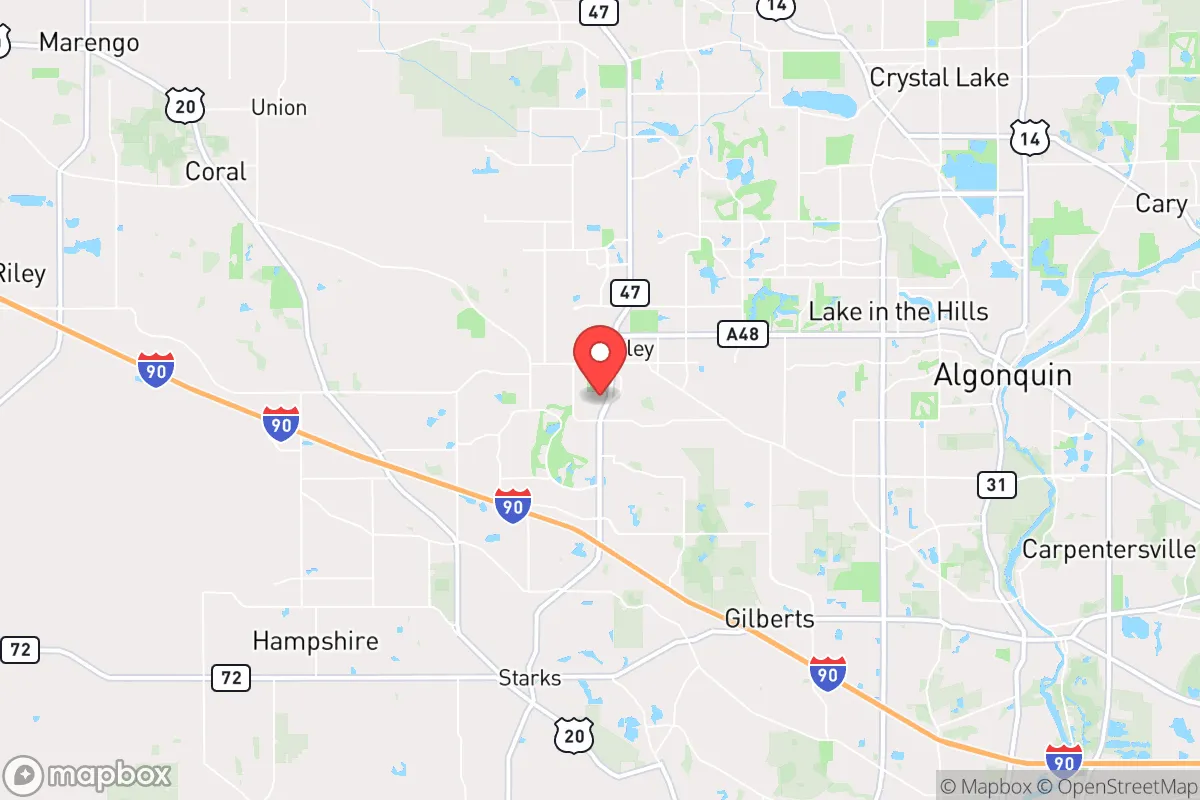
When you stack Huntley against its neighbors, the political contrast is clear. Head west a few miles into rural McHenry County—towns like Marengo or Harvard—and you're in solidly red territory, with many precincts voting Republican by double digits. Drive east toward Algonquin or Lake in the Hills, and the tilt becomes more competitive, often leaning slightly Democratic. But the real gap shows when you compare Huntley to Chicago proper, which is D+30 or more in many wards. Huntley's D+6 PVI puts it closer to the national average than the state average, meaning it's a place where neither party can take voters for granted. The surrounding Kane County has been trending blue steadily since the 1990s, and Huntley's growth—fueled by new subdivisions and commuters—has accelerated that shift. Still, the village's Republican base remains active, especially in older, more established neighborhoods and among long-time farming families.
What this means for residents
For conservative residents, Huntley isn't a hostile environment, but it's not a stronghold either. You'll find plenty of neighbors who share your views, especially at local diners or church groups, and the village council has historically had a mix of both parties. The downside is that state-level policies—like progressive income taxes or gun laws—will almost always reflect Chicago's priorities, not Huntley's. For liberal residents, the area feels welcoming without being overwhelming. You won't get the intense activism of Evanston or Oak Park, but you'll find like-minded people at school board meetings or community events. The practical reality is that most local issues—road repairs, school funding, zoning—don't break cleanly along party lines. Huntley's rapid growth has made development the dominant political topic, and that tends to unite or divide residents based on whether they want more rooftops or more open space, not on their presidential vote.
Culturally, Huntley retains a Midwestern pragmatism that softens the edges of partisan division. You'll see Trump signs and Harris signs on the same block, and people mostly get along. The village's annual events—like the Huntley Fall Festival or the farmers market—draw everyone regardless of party. The biggest policy distinction from the rest of Illinois is probably in local taxation: Huntley keeps property taxes relatively moderate compared to Cook County suburbs, which appeals to both conservatives who want lower taxes and liberals who want predictable costs. Looking ahead, the trend is toward a slow, steady blue shift as the population grows younger and more diverse, but Huntley will likely remain a bellwether community where elections are decided by turnout and local issues, not by party registration alone.

State Political ClimatePolitical Climate in Illinois
State Political AnalysisPolitical Environment in the State
Illinois is a solidly Democratic state in federal elections, carrying a Cook PVI of D+7, but that top-line number masks a deeply fractured political landscape where Chicago and its inner suburbs drive the state’s blue lean, while the rest of the state—from the collar counties to the Mississippi River—votes increasingly Republican. Over the last 20 years, the state has shifted leftward at the statewide level, with Democrats winning every gubernatorial race since 2003 except for Bruce Rauner’s single term (2015-2019), and holding supermajorities in the legislature for most of the last decade. Yet that same period saw rural counties like Williamson and Effingham become reliably red by 30-40 points, and once-competitive suburbs like DuPage County—which voted for George W. Bush in 2004—now routinely back Democrats by double digits. For a conservative relocator, the practical reality is that Illinois offers a stark choice: live in a blue metro or a red small town, with state policy heavily tilted toward the former.
Urban vs. rural divide
The political map of Illinois is essentially a story of Chicago versus everything else. Cook County, home to Chicago, casts about 40% of the state’s vote and delivers margins of 60-70% for Democrats. The inner ring of collar counties—Cook, Lake, and DuPage—have flipped from swing to solid blue over the past 15 years, driven by suburban professionals and growing minority populations. DuPage County, once the heart of Illinois Republicanism, voted for Biden by 10 points in 2020. Meanwhile, the rest of the state is a sea of red. Downstate counties like Marion, Jefferson, and Franklin routinely vote 70-80% Republican. The St. Louis metro area (Madison and St. Clair counties) leans blue thanks to East St. Louis and working-class Black suburbs, but the surrounding exurbs are deep red. Rockford (Winnebago County) is a classic swing area—Obama won it twice, Trump flipped it in 2016, and Biden barely carried it in 2020. The Quad Cities (Rock Island County) lean blue but are surrounded by red farmland. For a conservative, the safest bet is any county south of I-80 or west of the Fox River, where you’ll find like-minded neighbors and local governments that resist Chicago’s policy direction.
Policy environment
Illinois’s state-level policy is shaped by one-party Democratic control, with a progressive tax-and-spend posture that conservatives find frustrating. The state income tax is a flat 4.95% (after voters rejected a graduated rate amendment in 2020), but property taxes are among the highest in the nation—averaging 2.07% of home value, with Cook County often exceeding 2.5%. Sales tax can hit 10.25% in Chicago. The regulatory environment is business-friendly in name only; the state has a complex licensing regime and a strong union presence, especially in construction and public schools. Education policy is dominated by the Chicago Teachers Union, which has pushed for progressive curricula and resisted charter schools. The state’s election laws are among the most accessible in the country: no-excuse mail voting, automatic voter registration, and same-day registration are all law. For conservatives, the policy environment feels like a one-way ratchet toward higher taxes and more regulation, with little chance of reversal given the Democratic supermajority.
Recent policy direction
Over the past five years, Illinois has passed a series of laws that signal a clear progressive direction, with implications for every liberty a relocator might weigh. On gun and self-defense law, the state enacted a ban on assault weapons and high-capacity magazines in 2023 (the Protect Illinois Communities Act), and requires a Firearm Owner’s Identification (FOID) card for all gun purchases—a system conservatives argue is burdensome and prone to administrative delays. Parental and education rights saw a major shift with the 2021 repeal of the Parental Notice of Abortion Act, removing the requirement that minors notify parents before an abortion. The state also mandates LGBTQ+ inclusive curriculum in public schools. On speech and privacy, Illinois has a strong biometric privacy law (BIPA) that has led to massive class-action lawsuits against employers, but no specific protections for political speech on social media. Medical and bodily autonomy is fully protected: abortion is legal up to viability, and the state has become a regional haven for out-of-state patients. Property rights are constrained by high property taxes and a strong eminent domain framework, though there’s no statewide rent control. Taxation remains a flashpoint: the 2020 graduated income tax amendment failed, but the flat tax rate has crept up from 3.75% in 2011 to 4.95% today. Voting and ballot access has expanded significantly, with automatic voter registration and mail-in ballots now permanent. For a conservative, the cumulative effect is a state that prioritizes individual autonomy on social issues (abortion, LGBTQ rights) while restricting it on gun rights and taxation.
Civil unrest & political movements
Illinois has seen its share of political flashpoints. The 2020 George Floyd protests in Chicago were among the largest in the country, with looting and property damage in the Loop and along Michigan Avenue. The city’s response—a mix of curfews and progressive prosecutor Kim Foxx’s lenient charging policies—became a national conservative talking point. On the right, the Illinois Family Institute and local gun rights groups have organized against the assault weapons ban, with lawsuits working through federal courts. Immigration politics are a live wire: Chicago is a sanctuary city, and the state passed the Illinois Way Forward Act in 2021, limiting local law enforcement cooperation with ICE. The influx of asylum seekers bused from Texas in 2022-2023 overwhelmed city shelters and sparked tension between suburban and city Democrats. Election integrity controversies are muted compared to swing states, but some rural counties (like McHenry and Ogle) have passed resolutions calling for election audits. Secession talk is a perennial undercurrent: several downstate counties have floated resolutions to join Indiana or form a new state, but none have advanced. The most visible flashpoint for a new resident is likely the contrast between Chicago’s visible homelessness and drug crisis and the quiet, orderly small towns downstate.
Projection
Over the next 5-10 years, Illinois’s political trajectory points toward continued Democratic dominance at the state level, but with growing internal friction. Demographic trends favor the blue side: Chicago’s population loss has slowed, and the suburbs continue to diversify and shift left. Downstate counties are aging and shrinking, reducing their electoral weight. The state’s fiscal situation—$140 billion in unfunded pension liabilities—will force hard choices, likely leading to either tax increases or service cuts, both of which will accelerate out-migration of higher-income residents to Indiana, Wisconsin, and Tennessee. For a conservative moving in now, expect the state to remain a progressive laboratory on social issues and gun control, while economic pressures may eventually force moderation on taxes. The most realistic scenario is a state that becomes more like California: high taxes, strong regulatory environment, and a two-tier society of wealthy blue metros and struggling red rural areas.
For a new resident, the bottom line is that Illinois offers a clear trade-off. If you want low taxes, strong gun rights, and a conservative cultural environment, you’ll find it in places like Effingham, Quincy, or Marion—but you’ll still pay high property taxes and live under state laws you likely oppose. If you’re a conservative who values proximity to Chicago’s jobs and culture, you’ll find a more moderate environment in exurbs like Yorkville or Huntley, where local politics lean red but state policy doesn’t. Either way, expect to pay for the privilege of living in a state with strong public services, a world-class city, and a political direction you can’t change at the ballot box alone.
* Values derived from national, state, county, city and local statistics and may differ in a specific area. Last updated: 2026-11-09T21:55:00.000Z
Narrative content on this page is AI-generated and may contain mistakes. Verify any details that matter before acting on them.
ReloMaps may earn a commission from affiliate links at no extra cost to you.

