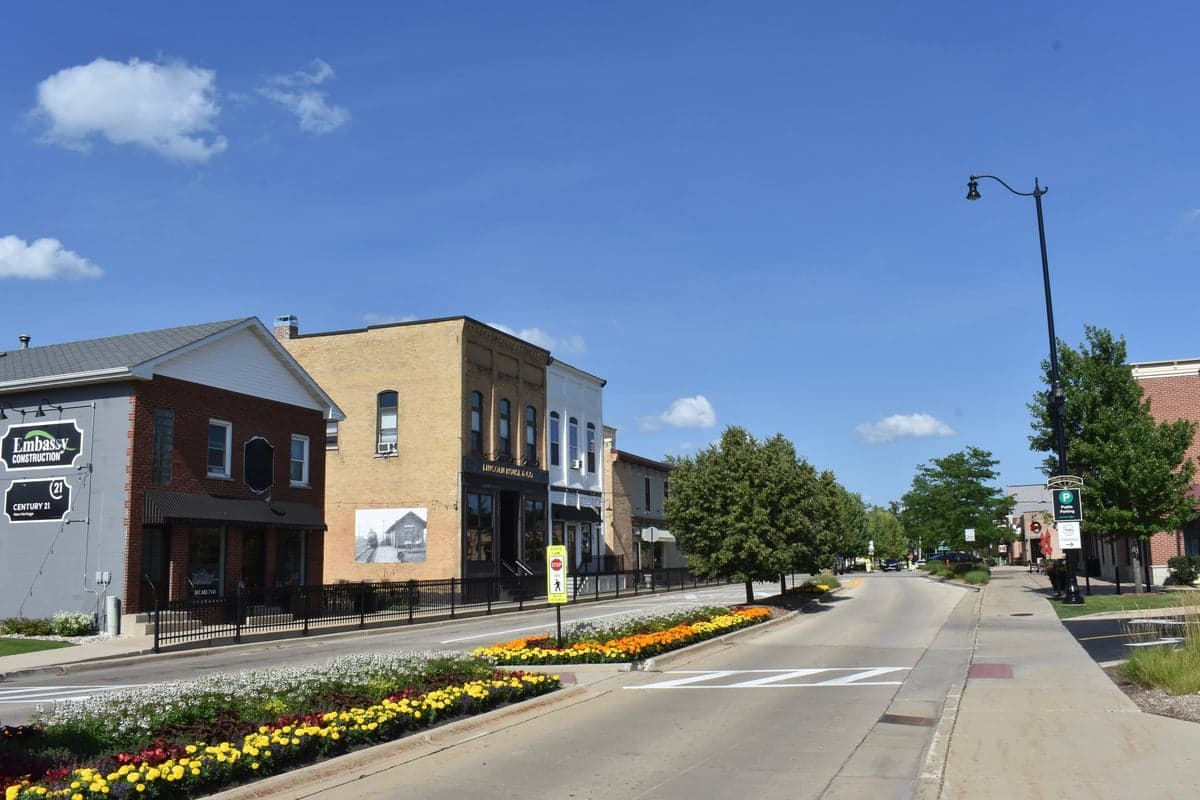
Photo: Wikipedia
Personal Sovereignty in Huntley, IL
Viable for self-reliance. Generally workable, though some barriers may limit total independence.
What does Personal Sovereignty tell us?
Personal Sovereignty measures your capacity for self-reliance and independence with minimal government friction. Higher scores mean fewer barriers between you and the way you want to live... but it assumes you have the space you need and good neighbors.
What does this tell us?
Personal Sovereignty measures your capacity for self-reliance and independence with minimal government friction. Higher scores mean fewer barriers between you and the way you want to live... but it assumes you have the space you need and good neighbors.
State Policy
Energy independence: Importer (63% of energy produced in-state)
Personal Liberty
Homesteading

Personal Liberty Analysis
Huntley, Illinois, offers a nuanced personal sovereignty environment that balances the state’s progressive regulatory framework with strong local traditions of self-reliance and community autonomy. For individuals and families prioritizing personal freedom, the village provides a relatively light-touch local governance structure, but residents must navigate Illinois’s statewide tax burden and regulatory posture. The key to maximizing autonomy here lies in understanding where local control ends and state mandates begin, particularly in areas like property rights, self-defense, and homesteading feasibility.
Tax burden and regulatory posture in Huntley compared to surrounding areas
Illinois carries a reputation for high taxes, and Huntley residents feel this primarily through property taxes. The effective property tax rate in McHenry County, where most of Huntley sits, hovers around 2.1% of assessed value, one of the highest in the nation. A $350,000 home can expect annual taxes near $7,350. This is a significant ongoing cost that directly impacts disposable income and the ability to build wealth through property. However, the state’s income tax is a flat 4.95%, and there is no local income tax in Huntley, which provides some predictability. Sales tax in Huntley is 8.25%, slightly above the state average but in line with the Chicago collar counties. On the regulatory side, Huntley’s local government is generally business-friendly, with a streamlined permitting process for home renovations and small-scale commercial projects. The village does not impose rent control, and zoning ordinances are typical for a suburban community—single-family residential zones are the norm, with clear but not overly burdensome setback and lot coverage rules. The real regulatory weight comes from the state: Illinois mandates strict environmental reviews for any land disturbance over one acre, and the state’s building codes are among the most detailed in the Midwest. For a resident looking to minimize bureaucratic friction, the local level is manageable, but the state-level compliance costs are unavoidable.
Self-defense and gun law specifics for Huntley residents
Illinois is a shall-issue state for concealed carry, and Huntley residents can obtain a Firearm Owner’s Identification (FOID) card and a Concealed Carry License (CCL). The process is not trivial: applicants must complete a 16-hour training course, pass a live-fire qualification, and submit to a background check through the Illinois State Police. The FOID card itself requires a separate application and is a prerequisite for any firearm purchase or possession. Huntley is not a home-rule municipality that imposes its own gun ordinances, so the state’s preemptive framework applies. This means no local bans on specific firearm types, no magazine capacity limits beyond the state’s 15-round restriction for handguns, and no local waiting periods beyond the state-mandated 72-hour delay for long guns and 24-hour delay for handguns. Castle Doctrine is recognized in Illinois, meaning there is no duty to retreat in one’s home or vehicle when facing a threat. However, the state does not have a Stand Your Ground law outside the home; in public, a duty to retreat applies if safe to do so. For the self-defense-minded resident, Huntley offers a legally clear path to carry and defend one’s home, but the administrative burden of FOID and CCL compliance is higher than in states like Indiana or Wisconsin. The local sheriff’s office in McHenry County is known for reasonable processing times, typically 90-120 days for a CCL, which is faster than Cook County but slower than many rural Illinois counties.
Self-reliance and homesteading viability: lot sizes, zoning, and off-grid feasibility
Huntley’s residential landscape is predominantly suburban subdivisions with lot sizes averaging 0.25 to 0.5 acres in the newer developments. Older sections of the village, particularly near the historic downtown, offer lots up to one acre, but these are rare and command a premium. For serious homesteading—raising livestock, substantial vegetable gardens, or keeping chickens—the zoning code is permissive but limited. Chickens are allowed on lots of 20,000 square feet or more, with a maximum of six hens and no roosters. Goats and other small livestock require a special use permit and a minimum of two acres. Beekeeping is permitted with registration and setback requirements. Off-grid living is effectively impossible within village limits. Huntley requires connection to municipal water and sewer for all habitable structures, and the village code mandates grid-tied electrical service. Solar panels are allowed but must be grid-tied; battery storage for full off-grid operation is not prohibited, but the net-metering agreement with ComEd makes it economically unattractive. Rainwater collection for outdoor use is permitted, but potable rainwater systems are not allowed due to state plumbing codes. For the resident seeking true self-reliance, the unincorporated areas of McHenry County just outside Huntley offer more flexibility—lots of 5-10 acres are common, and private wells and septic systems are standard. However, those properties come with their own regulatory hurdles, including county-level stormwater management and well-testing requirements. Huntley itself is best viewed as a base for self-reliance within a suburban framework, not a frontier for off-grid independence.
Personal liberties: parental rights, medical autonomy, speech, and property
Illinois has a mixed record on personal liberties that directly affects Huntley residents. Parental rights are strong in practice but legally contested. The state mandates that schools notify parents of any medical services provided to minors, but a 2023 law allows minors aged 12 and older to consent to mental health and substance abuse treatment without parental knowledge. This creates a tension for families who prioritize parental authority. Medical autonomy is limited: Illinois has a vaccine mandate for school attendance, though medical and religious exemptions are available. The state also has a strict mask mandate authority that can be reinstated by the governor during public health emergencies, which was a flashpoint in 2020-2021. On speech, Huntley is in the Seventh Circuit, which has generally upheld First Amendment protections, but the state has enacted a social media censorship law that requires platforms to report hate speech—a provision that some free-speech advocates view as chilling. Property rights are the strongest liberty for Huntley homeowners. The village has a clear, published zoning code, and variances are granted through a public hearing process that is transparent and generally fair. Eminent domain is rarely used for private development, and the village has not engaged in aggressive tax increment financing (TIF) that displaces residents. The biggest property rights concern is the state’s property tax appeal process, which is cumbersome and often requires legal representation to achieve meaningful reductions. Overall, Huntley offers a solid baseline of personal liberties, but residents must be proactive in understanding state-level laws that can override local norms.
Compared to other Chicago collar suburbs, Huntley ranks as a moderate-to-strong environment for personal sovereignty. It avoids the heavy-handed local ordinances seen in Evanston or Oak Park, while still benefiting from the infrastructure and services of a well-managed village. The tax burden is the primary drag on autonomy, as it limits financial freedom and wealth accumulation. For the conservative-leaning individual or family, Huntley provides a community where self-reliance is culturally valued, local government is responsive, and the regulatory environment is navigable with due diligence. The trade-off is clear: you gain a safe, well-serviced community with strong property rights and a clear legal path for self-defense, but you pay for it through higher taxes and must comply with state-level mandates that may not align with your personal philosophy. For those willing to engage with the system, Huntley offers a viable base for a self-determined life in the greater Chicago region.

* Values derived from national, state, county, city and local statistics and may differ in a specific area. Last updated: 2026-11-09T21:55:00.000Z
Narrative content on this page is AI-generated and may contain mistakes. Verify any details that matter before acting on them.
ReloMaps may earn a commission from affiliate links at no extra cost to you.

