Photo: Wikipedia
Demographics of Huntley, IL
Affluence Level in Huntley, IL
A middle-class area roughly in line with national averages across income, home values, education, and employment.
People of Huntley, IL
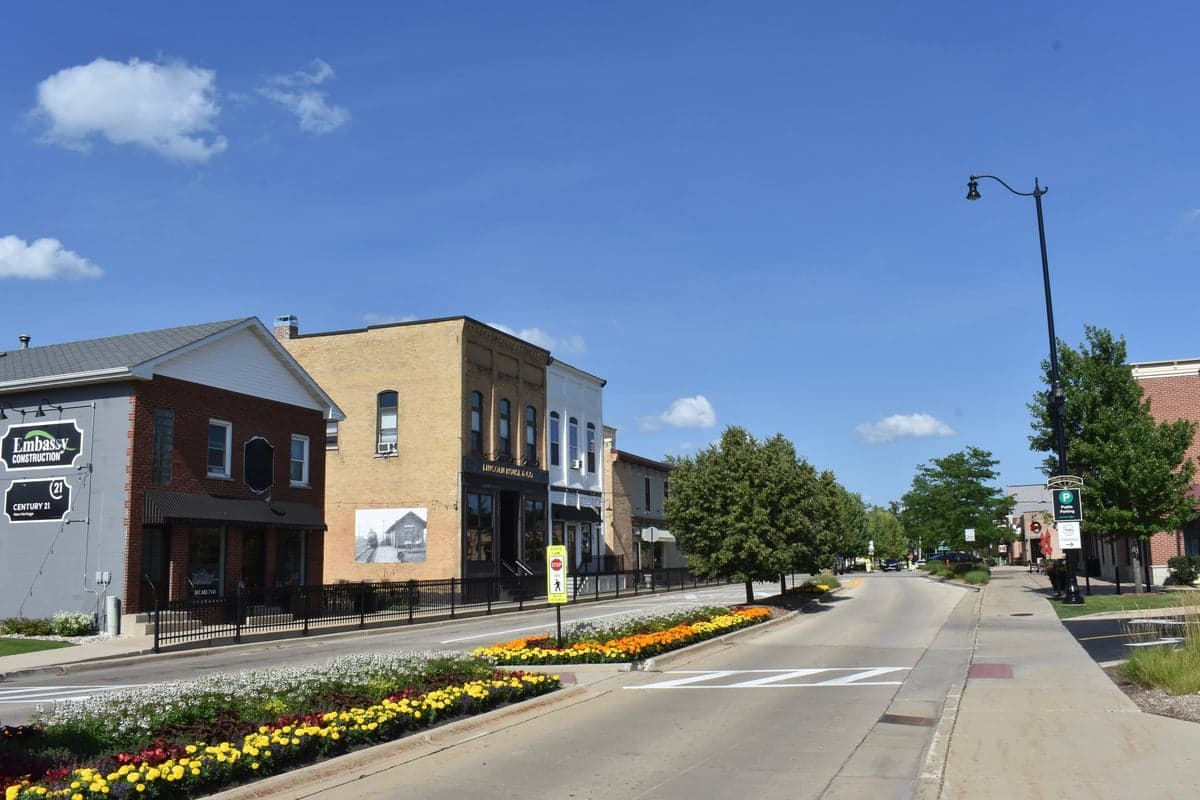
The people of Huntley, Illinois, today form a community of roughly 27,859 residents that blends small-town Midwestern roots with the outward expansion of Chicago’s exurbs. The city is notably more homogeneous than the national average, with a white population of 77.4% and a foreign-born share of just 3.5%, yet it is gradually diversifying through Hispanic (9.6%), Black (4.9%), East/Southeast Asian (4.2%), and Indian-subcontinent (1.6%) communities. Huntley’s identity is shaped by its history as a railroad and farming hub, its recent transformation into a master-planned suburb, and a population that is older and more family-oriented than the regional norm. For those moving in now, Huntley offers a stable, predominantly white-collar environment where 39.3% of adults hold a college degree and the sense of community remains tightly knit.
How the city was settled and grew
Huntley’s original population was drawn by the railroad and fertile farmland in the 1850s. The Chicago and North Western Railway arrived in 1851, and the village was platted in 1851 by Thomas Huntley, a farmer and speculator who sold lots to Yankee settlers from New England and upstate New York. These early families—many of English, Scottish, and German descent—built the core of what is now Downtown Huntley, centered on Main Street and the historic train depot. The village grew slowly as a grain and dairy shipping point, with Irish immigrants arriving to work on the railroad and in local mills, settling in the Irish Grove area near the tracks (roughly modern-day Church Street and Route 47). By 1900, Huntley had fewer than 500 residents, and its population remained overwhelmingly white and native-born through the mid-20th century, with a small number of German and Polish farming families moving into the surrounding Huntley Township countryside.
Modern era (post-1965)
The post-1965 era brought two major shifts: the rise of master-planned subdivisions and a modest wave of domestic in-migration from the Chicago suburbs. The 1990s and 2000s saw explosive growth as developers built large, single-family-home communities aimed at families and retirees fleeing higher taxes and congestion in Cook and DuPage counties. The most notable of these is Sun City Huntley, a massive age-restricted (55+) community that opened in 1999 and now houses thousands of residents. Sun City drew mostly white, middle-class retirees from across the Midwest, reinforcing the city’s older demographic profile. Meanwhile, younger families moved into subdivisions like Deerwood and Willow Creek, which attracted a mix of white and Hispanic households, many of whom work in nearby manufacturing and logistics centers in Elgin and Crystal Lake. The Hispanic population grew from under 2% in 1990 to 9.6% today, concentrated in the West Huntley area near Route 47 and I-90, where newer, more affordable townhomes and apartments have been built. The East/Southeast Asian and Indian-subcontinent communities are smaller but visible in the East Huntley neighborhoods near the Huntley Outlet Center and the new Metra station, drawn by professional jobs in healthcare and technology in the broader Fox Valley region. Black residents, at 4.9%, are dispersed across newer subdivisions but remain a small share compared to neighboring Elgin (11.2% Black).
The future
Huntley’s population is projected to continue growing slowly, likely reaching 30,000–32,000 by 2035, driven by infill development and the completion of the Huntley 158 corridor. The city is becoming slightly more diverse, but at a slower pace than the Chicago metro area as a whole. Hispanic and East/Southeast Asian shares are expected to rise to 12–14% and 5–6%, respectively, as younger families move into new developments like Huntley Farms and Huntley Crossing—both planned mixed-use communities near the I-90 interchange. The Indian-subcontinent population will likely remain small (under 2.5%) but may grow if tech employers expand in the nearby Randall Road corridor. The white population, while still dominant, is aging in place in Sun City, which could lead to a gradual turnover of homes to younger, more diverse buyers. Culturally, Huntley is likely to retain its conservative-leaning, family-oriented character, with local politics focused on maintaining low property taxes and good schools (Huntley Community School District 158). For a mover today, this means joining a community that is stable, safe, and slowly opening to new groups, but where the core identity remains rooted in its agricultural and railroad past.
Huntley is becoming a slightly more diverse, still predominantly white exurb where master-planned communities and an aging population define daily life. For families and retirees seeking a low-crime, well-rated school district with a small-town feel and easy access to Chicago via I-90 and Metra, it offers a predictable and welcoming environment. The city’s demographic trajectory is one of gradual change rather than rapid transformation, making it a solid choice for those who value stability over urban energy.

* Values derived from national, state, county, city and local statistics and may differ in a specific area. Last updated: 2026-11-09T21:55:00.000Z
Narrative content on this page is AI-generated and may contain mistakes. Verify any details that matter before acting on them.
ReloMaps may earn a commission from affiliate links at no extra cost to you.

