
Photo: Wikipedia
Political ClimatePolitical Climate in Hiram, OH
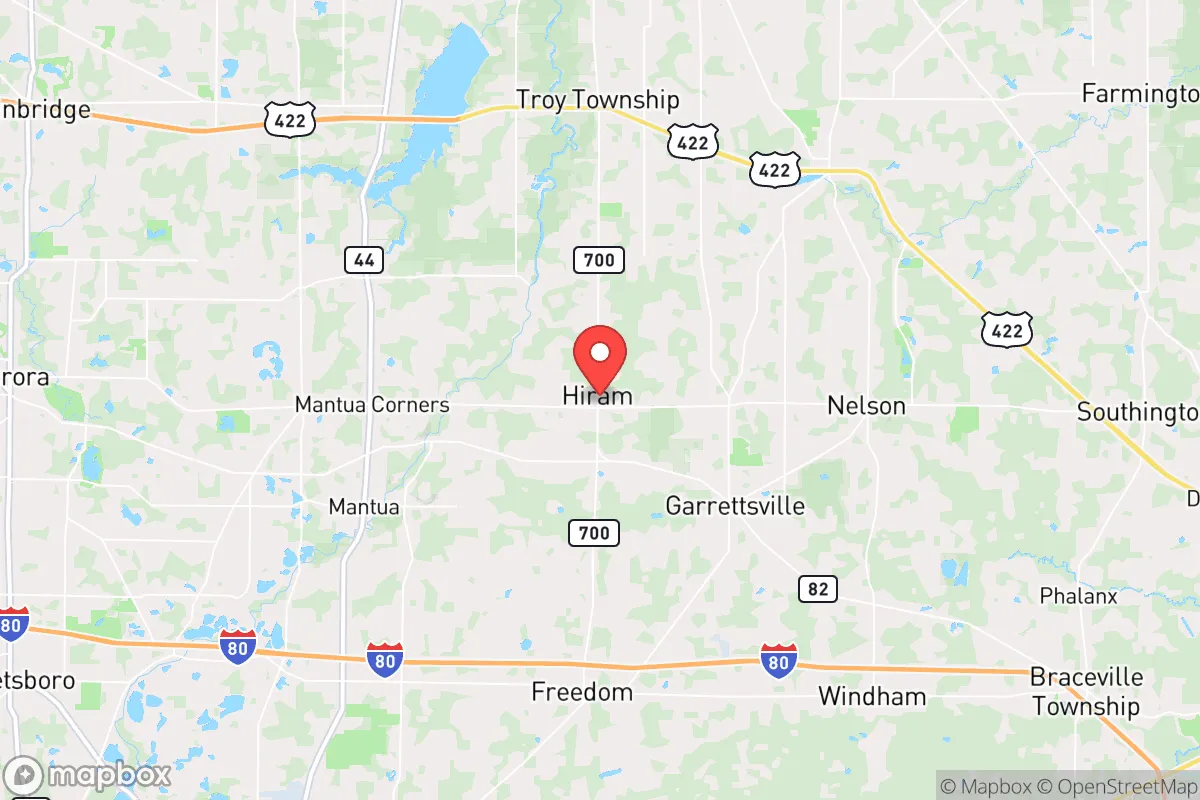
District shown is the primary district for this city’s centroid. Cities may span multiple districts.
Local Political AnalysisPolitical Analysis of Hiram, OH
Hiram, Ohio, is a reliably conservative pocket in a state that already leans right, with a Cook PVI of R+9 compared to Ohio’s overall R+5. That four-point gap might not sound huge, but it translates into a political reality where Republican candidates routinely win by double-digit margins in local races. The village itself, home to Hiram College, introduces a small liberal-leaning academic influence, but the surrounding township and county (Portage County’s rural western edge) vote solidly red. Over the past decade, the area has drifted further right, mirroring the broader rural shift in Ohio, though the college keeps things from becoming a one-party echo chamber.
How it compares
Hiram’s R+9 rating puts it noticeably to the right of Ohio’s statewide R+5, meaning it’s a stronger Republican stronghold than the state average. For context, nearby Kent (home to Kent State University) leans blue, with a Cook PVI around D+5, creating a stark 14-point swing just 15 miles south. Ravenna, the Portage County seat, is more purple but still leans Republican, roughly R+4. So Hiram sits as the most conservative node in a county that’s otherwise a mix of college towns and exurban commuters. Statewide, Hiram votes more like rural counties such as Geauga or Medina than the swingier suburbs of Columbus or Cincinnati. The college’s presence does soften the edge—you’ll see more yard signs for local Democratic candidates near campus than you would in, say, neighboring Garrettsville—but the overall trajectory is steady red.
What this means for residents
For conservative residents, Hiram is a comfortable fit. Local government, school board meetings, and county commission decisions generally align with traditional values—lower taxes, Second Amendment support, and a focus on rural development. You’ll find Republican candidates unopposed in many local races, which keeps policy predictable. For liberal residents, it’s a different story. You’re not isolated—the college provides a social and intellectual haven—but you’ll be in the minority in most civic settings. That said, the political divide here is less heated than in bigger cities; people tend to know their neighbors across party lines, and local issues like road maintenance or school funding rarely break down along partisan lines. The real tension surfaces during presidential years, when national rhetoric amplifies local differences, but day-to-day life remains civil.
What this means for residents
In practice, Hiram’s political climate means a few concrete things. Property taxes are lower than in blue-leaning areas like Kent or Cleveland Heights, and zoning tends to favor agricultural and residential use over dense development. The local school board has resisted controversial curriculum changes, keeping a focus on traditional academics. For liberals, the main frustration is feeling underrepresented—there’s no local Democratic club, and progressive candidates rarely get traction outside the college precinct. But the college itself acts as a buffer, hosting speakers and events that bring diverse viewpoints. Looking ahead, I’d expect Hiram to stay R+9 or even nudge to R+10 as rural Ohio continues to trend right, while the college’s influence holds steady. It’s a place where you can live your politics without much friction, as long as you’re okay with being in the majority or the minority, depending on your lean.
Culturally, Hiram stands out for its small-town New England feel—the college’s historic architecture and the village’s compact layout give it a distinct character from the strip-mall sprawl of nearby Streetsboro or Aurora. Policy-wise, the village council tends to be fiscally conservative but socially moderate on issues like local business regulation. You won’t see the kind of culture-war battles that dominate larger Ohio suburbs; here, the biggest political fights are usually about whether to fix the water tower or pave a road. That’s the Hiram way—practical, neighborly, and quietly conservative, with just enough academic seasoning to keep things interesting.

State Political ClimatePolitical Climate in Ohio
State Political AnalysisPolitical Environment in the State
Ohio has shifted from a classic presidential bellwether to a solidly Republican state, carrying a Cook PVI of R+5 after voting for Donald Trump by 8 points in both 2016 and 2020 and by 11 points in 2024. The dominant coalition is a mix of working-class voters in small cities and rural areas, combined with exurban and suburban conservatives in the outer rings of Cincinnati, Columbus, and Cleveland. Over the past 20 years, the state has moved rightward by about 10 points relative to the national average, driven by the collapse of union-aligned Democratic strength in the Mahoning Valley and Appalachian counties, and by the exodus of moderate Republicans from the suburbs of Columbus and Cincinnati.
Urban vs. rural divide
The political map of Ohio is a study in stark contrasts. The three major metros — Cleveland, Columbus, and Cincinnati — are Democratic strongholds, with Cuyahoga County (Cleveland) delivering 66% for Biden in 2020 and Franklin County (Columbus) hitting 62%. But the rest of the state is deeply red. The rural northwest, including counties like Van Wert and Mercer, routinely vote 75-80% Republican. The Appalachian southeast, once a Democratic bastion due to unionized coal and steel, has flipped hard: Belmont County voted for Obama in 2012 and then for Trump by 38 points in 2020. The suburbs tell a more nuanced story: Delaware County (north of Columbus) remains reliably Republican but has shifted from +35 to +20 over the past decade as educated professionals move in, while Hamilton County (Cincinnati) flipped from red to blue in 2020 as the city's liberal core expanded. The Mahoning Valley around Youngstown, once the heart of the "blue dog" Democrat, is now a competitive toss-up area where Trump won by 4 points in 2024.
Policy environment
Ohio's policy environment reflects its Republican trifecta — the governor, state House, and state Senate have all been under GOP control since 2011. The state income tax has been cut from a top rate of 5.925% in 2021 to 3.5% in 2025, with a flat tax structure set to phase in by 2026. Property taxes are moderate, with an effective rate around 1.5% of home value, but local levies vary widely. The state has a right-to-work law (passed in 2011, upheld by referendum in 2012) and is a "shall-issue" concealed carry state with permitless carry since 2022. Education policy is dominated by the school voucher system — the EdChoice program now covers nearly all families, with over 100,000 students using vouchers in 2024. Healthcare is a mixed bag: Ohio expanded Medicaid under the Affordable Care Act in 2014, but the state legislature has resisted further expansion and has passed laws restricting abortion after six weeks (the "Heartbeat Bill," signed in 2019, currently blocked by court order). Election laws have tightened: voter ID requirements were strengthened in 2023, absentee ballot drop boxes are limited to one per county, and early voting hours were standardized. The state also passed a constitutional amendment in 2023 enshrining abortion rights, which passed with 57% of the vote despite legislative opposition.
Recent policy direction
The last five years have seen Ohio move decisively in a conservative direction on most fronts, with notable exceptions. On gun and self-defense law, the 2022 permitless carry law (HB 227) eliminated the requirement for a license to carry a concealed handgun, though a background check is still required for purchases. On parental and education rights, the state passed the "Parents' Bill of Rights" (HB 8) in 2023, requiring schools to notify parents of any changes to a student's health or well-being and banning instruction on sexual orientation in grades K-3. On speech and privacy, Ohio has no broad privacy law, but a 2024 law (SB 29) restricts social media platforms from censoring political speech, though it faces First Amendment challenges. On medical and bodily autonomy, the 2023 abortion amendment (Issue 1) overrode the six-week ban, but the legislature has since passed a law requiring parental consent for minors and banning telehealth prescriptions for abortion pills. On property rights, Ohio is a "strong" property rights state with no statewide rent control and limited eminent domain use, though a 2023 law (HB 187) restricted local governments from banning natural gas hookups in new construction. On taxation, the flat income tax is the headline, but sales taxes have crept up to a combined state-local average of 7.25%, and the state gas tax was raised by 10.5 cents per gallon in 2019. On voting and ballot access, the 2023 voter ID law (SB 92) requires a photo ID for in-person voting and a driver's license number for absentee ballots, and early voting was cut from 28 days to 21 days.
Civil unrest & political movements
Ohio has seen its share of political flashpoints. The 2020 protests in Columbus and Cincinnati over George Floyd's death were large but largely peaceful, though the state saw property damage in downtown Columbus. The 2023 abortion amendment campaign drew massive grassroots organizing on both sides, with over 1 million signatures collected for the ballot initiative. On the right, the "Ohio Freedom Alliance" and local Moms for Liberty chapters have been active in school board races, particularly in Delaware County and Warren County. Immigration politics are less heated than in border states, but a 2024 law (HB 180) requires local law enforcement to cooperate with ICE detainers, and Dayton and Columbus have seen protests over refugee resettlement. Election integrity remains a live issue: the 2020 election in Ohio was certified without major controversy, but the 2024 primary saw a lawsuit over drop box access that went to the state Supreme Court. The "nullification" movement is marginal, though a few rural counties have passed symbolic resolutions declaring themselves "Second Amendment sanctuaries." A new resident would notice the prevalence of yard signs and bumper stickers — the state is deeply polarized, but the political conversations in bars and coffee shops are generally civil, with most people respecting the other side's right to exist.
Projection
Over the next 5-10 years, Ohio is likely to remain R+5 to R+7, with the Republican lean solidifying as the Appalachian and rural base continues to age and the Democratic vote concentrates in the three major metros. In-migration is modest — the state's population grew by only 0.5% from 2020 to 2024 — and the newcomers are split: some are retirees from the Northeast moving to Hocking Hills or Lake Erie counties, while others are remote workers from the coasts settling in Columbus and Cincinnati suburbs. The key demographic shift is the continued suburbanization of the Columbus metro, which is growing faster than the rest of the state and could flip Franklin County from blue to purple over the next decade. The Republican trifecta is likely to hold, but the margin may narrow as the suburbs drift left. A new resident moving in now should expect a state where conservative policies on taxes, guns, and education are the norm, but where the urban centers provide a counterbalance on social issues. The abortion amendment will remain a flashpoint, with likely legislative attempts to restrict access further within the amendment's limits. The flat income tax will likely stay, but property tax relief may become a major issue as home values rise in the suburbs.
For a new resident, the bottom line is that Ohio offers a stable, predictable political environment where conservative values dominate state policy but where you can find liberal enclaves in the cities. If you're a conservative, you'll find a state that has delivered on tax cuts, gun rights, and school choice. If you're a liberal, you'll find that the urban areas provide a supportive community, but you'll need to accept that state-level policy will often run counter to your preferences. The state's political trajectory is steady — no dramatic flips are likely — so what you see now is largely what you'll get for the next decade. The practical takeaway: Ohio is a place where your vote matters in primaries and local races, but the general election outcome is rarely in doubt.
* Values derived from national, state, county, city and local statistics and may differ in a specific area. Last updated: 2026-06-16T10:05:31.000Z
Narrative content on this page is AI-generated and may contain mistakes. Verify any details that matter before acting on them.
ReloMaps may earn a commission from affiliate links at no extra cost to you.

