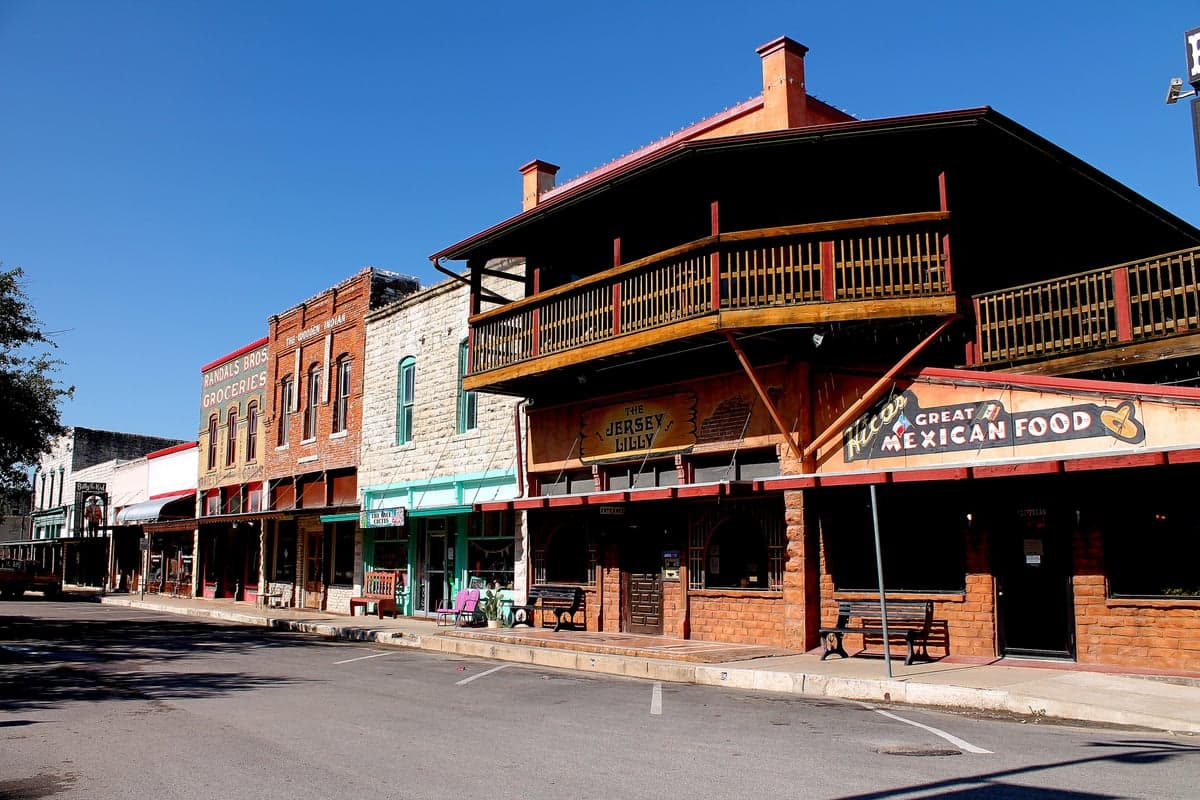
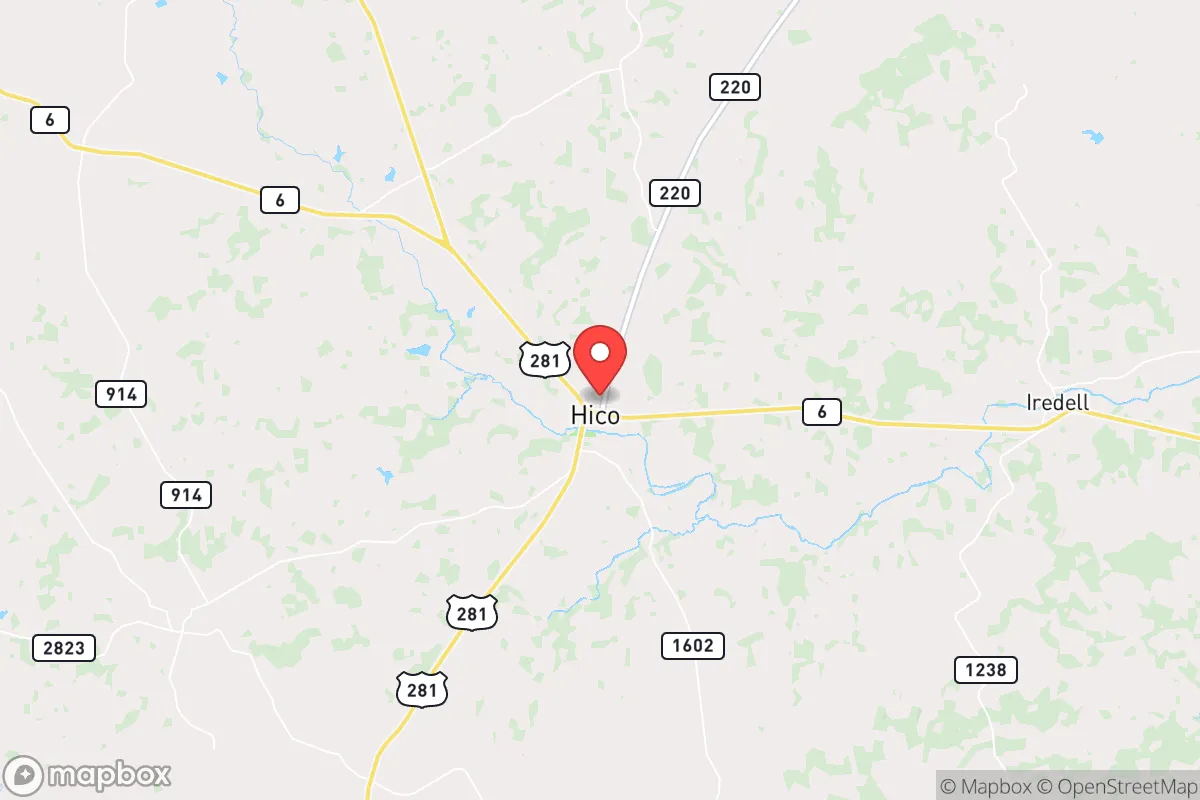

Photo: Wikipedia
Political ClimatePolitical Climate in Hico, TX
District shown is the primary district for this city’s centroid. Cities may span multiple districts.
Local Political AnalysisPolitical Analysis of Hico, TX
Hico, Texas, sits in a political landscape that leans decisively Republican, with a Cook PVI of R+11 — meaning the area votes about 11 points more Republican than the national average. That’s not quite as deep-red as some neighboring counties further west, but it’s a solid, dependable conservative vote in most elections. The trajectory here has been fairly stable over the last decade; while the country has polarized, Hico’s politics have stayed put, with local races often decided in the Republican primary rather than the general election.
How it compares
To understand Hico’s politics, you have to look at the surrounding region. Hamilton County, where Hico is the county seat, has voted Republican by wide margins in every presidential election this century — typically 75-80% of the vote going to the GOP candidate. That puts it in line with nearby towns like Stephenville and Dublin, which are also reliably red. The contrast comes when you drive east toward Waco or south to Austin; those metros are increasingly Democratic, and their politics feel like a different world. Hico itself is more moderate than the surrounding rural areas in some ways — it’s a small town with a tourist-friendly square, and it attracts some newcomers from the cities, but that hasn’t shifted the overall numbers much. Compared to Texas as a whole, Hico is noticeably more conservative than the state’s urban centers, though Texas overall is still a Republican state. The difference is that in Hico, you rarely hear a dissenting political voice in day-to-day conversation; in Austin or Dallas, you’d hear plenty.
What this means for residents
For conservative residents, the political climate in Hico means their values are largely reflected in local policy. The county commission, school board, and city council are all Republican-leaning, and issues like gun rights, low taxes, and limited regulation are generally supported. There’s a strong sense that local government is small and accessible — you can call your commissioner directly and get a straight answer. For liberal residents, the reality is different. They’re a clear minority, and they often keep their politics private to avoid friction in social or business settings. That said, Hico isn’t hostile; it’s more that political disagreement is just not part of the public conversation. The practical effect is that progressive residents may feel they have little influence on local decisions, but they also rarely face outright confrontation. The bigger shift in recent years has been the influx of retirees and remote workers from Dallas-Fort Worth, who bring slightly more moderate views — but so far, that’s been a trickle, not a wave.
What sets Hico apart culturally
Culturally, Hico is a town that prizes its history — it’s famously tied to the Billy the Kid legend, and the local museum and old-fashioned soda fountain draw visitors. That sense of heritage feeds into a political culture that’s skeptical of rapid change. You see it in the way the town has resisted chain stores on the square, preferring local businesses. There’s also a strong libertarian streak here, not just straight-line Republicanism; people value personal freedom and self-reliance, and they’re as likely to complain about government overreach from a Republican administration as a Democratic one. Looking ahead, the near-term future probably looks like the present: solidly red, with a slow demographic shift as more city folks discover the area’s low cost of living and small-town pace. If that migration accelerates, Hico could inch toward the political center over the next 20 years — but don’t expect it to turn blue anytime soon.

State Political ClimatePolitical Climate in Texas
State Political AnalysisPolitical Environment in the State
Texas has been a reliably Republican state for over three decades, but the nature of that dominance is shifting. The GOP has won every statewide race since 1994, and Donald Trump carried the state by 5.6 points in 2024 — a margin down from 8.5 in 2016. The coalition is a familiar one: rural and small-town voters, evangelical Christians, and the oil and gas economy form the base, while the explosive growth of the Dallas-Fort Worth and Houston suburbs is slowly changing the math. It’s still a red state, but the shade is getting lighter every cycle.
Urban vs. rural divide
Texas politics is a tale of two geographies. The big metros — Austin, Houston, Dallas, San Antonio, and El Paso — are solidly Democratic, with Austin’s Travis County delivering a 74-point margin for Biden in 2020. But the real action is in the suburbs. Places like Collin County (north of Dallas) and Fort Bend County (southwest of Houston) were once GOP strongholds; Fort Bend flipped to Biden in 2020 and stayed blue in 2024. Meanwhile, the rural west and the Panhandle — think Lubbock, Midland, and Odessa — are deep red, often voting 80-90% Republican. The border towns like McAllen and Brownsville are the wild card: historically Democratic, they’ve drifted right in recent cycles, with Trump cutting Democratic margins significantly in 2024. The fastest-growing counties are the suburbs, and that’s where the political future is being decided.
Policy environment
Texas runs on a low-tax, low-regulation model. There’s no state income tax — the state funds itself through property taxes, sales tax (6.25% state rate, plus local add-ons), and oil and gas severance taxes. The regulatory posture is business-friendly by design; the Texas Economic Development Act (Chapter 313) has been used to lure corporate relocations, though it expired in 2022 and was replaced by a similar program. Education policy is a flashpoint: the state uses a school funding formula heavily reliant on local property taxes, which creates wide disparities between wealthy and poor districts. In 2023, the legislature passed a school choice bill (HB 1) creating education savings accounts, though it was later struck down by a Travis County judge — the fight is ongoing. Healthcare is a mixed bag: Texas has the highest uninsured rate in the nation (around 17%), and the state has refused Medicaid expansion under the ACA. Election laws are restrictive by national standards — SB 1 (2021) tightened mail-in ballot rules, added ID requirements, and limited drive-through voting. It’s a state where the government’s footprint is intentionally small, but the culture wars are fought hard at the local level.
Recent policy direction
The last few legislative sessions have pushed Texas sharply to the right on social and cultural issues, while staying the course on economics. The 2023 session was a banner year for conservative priorities:
- Gun law: Texas became a permitless carry state in 2021 (HB 1927), allowing adults 21+ to carry handguns without a license or training. The legislature also passed a "Second Amendment Sanctuary" resolution.
- Abortion: The state enacted SB 8 (2021), the heartbeat bill with a private enforcement mechanism, and then a near-total ban (HB 1280) that took effect after Dobbs. Abortion is now illegal in nearly all cases, with no exceptions for rape or incest.
- Parental rights: HB 900 (2023) restricts "sexually explicit" books in school libraries, and the state has pushed for more parental oversight of curriculum. The "bathroom bill" debate continues, with a 2023 law (SB 14) banning gender-affirming care for minors.
- Property rights: Texas has strong eminent domain protections, and the 2023 session passed SB 2037, which limits how municipalities can regulate short-term rentals.
- Voting: SB 1 (2021) is the big one — it bans 24-hour and drive-through voting, adds ID requirements for mail ballots, and gives poll watchers more access. The law is currently being challenged in federal court.
On the economic side, the state has been aggressive on tax relief — the 2023 session passed an $18 billion property tax cut (SB 2), the largest in state history. The direction is clear: Texas is betting on a low-tax, high-freedom model, but with a heavy hand on social issues.
Civil unrest & political movements
Texas has seen its share of political flashpoints. The 2020 protests in Austin over George Floyd’s murder were large and occasionally violent, leading to a backlash that helped fuel the 2021 "defund the police" fight in the city council. The border is a constant pressure point — Operation Lone Star, launched by Governor Greg Abbott in 2021, has deployed state troopers and National Guard to the border, and the state has bused thousands of migrants to Democratic cities like New York and Chicago. That’s been a rallying cry for the right and a humanitarian flashpoint for the left. On the right, there’s a growing "Texas First" movement — the Texas Nationalist Movement, led by Daniel Miller, advocates for secession, though it remains a fringe cause with little mainstream support. Election integrity is a live issue: the 2020 and 2022 cycles saw intense scrutiny of Harris County’s voting processes, leading to the state taking over election administration there in 2023. A new resident will notice the political energy — yard signs, bumper stickers, and a lively local media ecosystem that ranges from the Texas Tribune (left) to the Texas Scorecard (right).
Projection
Over the next 5-10 years, Texas is likely to get more competitive, but not necessarily bluer. The in-migration is heavily domestic — people moving from California and the Northeast — and they tend to be moderate Republicans or independents who like the low taxes but aren’t culture-war crusaders. The suburbs of Dallas, Houston, and San Antonio are where this is playing out; they’re becoming more diverse and more educated, which historically trends Democratic. But the border counties are moving the other way, and the rural vote is as solid as ever. The 2026 governor’s race will be a bellwether — if Abbott wins by less than 5 points, the state is in play for 2028. Realistically, Texas stays Republican for the next decade, but the margins will keep shrinking. A new resident moving in now should expect a state that’s still red, but with a growing, vocal blue minority that has real power in the cities and a veto-proof grip on the legislature.
For a new resident, the bottom line is this: Texas is a place where your politics will be respected, but you’ll also be surrounded by people who disagree with you. If you’re conservative, you’ll find a state government that shares your priorities — low taxes, gun rights, school choice, and a tough-on-border stance. If you’re liberal, you’ll find your community in the cities, but you’ll be living under state laws that are often at odds with your values. The practical takeaway is to know your county — Travis County is a different world from Collin County, and the political climate you experience day-to-day depends almost entirely on which one you call home.
* Values derived from national, state, county, city and local statistics and may differ in a specific area. Last updated: 2026-10-28T12:01:16.000Z
Narrative content on this page is AI-generated and may contain mistakes. Verify any details that matter before acting on them.
ReloMaps may earn a commission from affiliate links at no extra cost to you.

