 Popular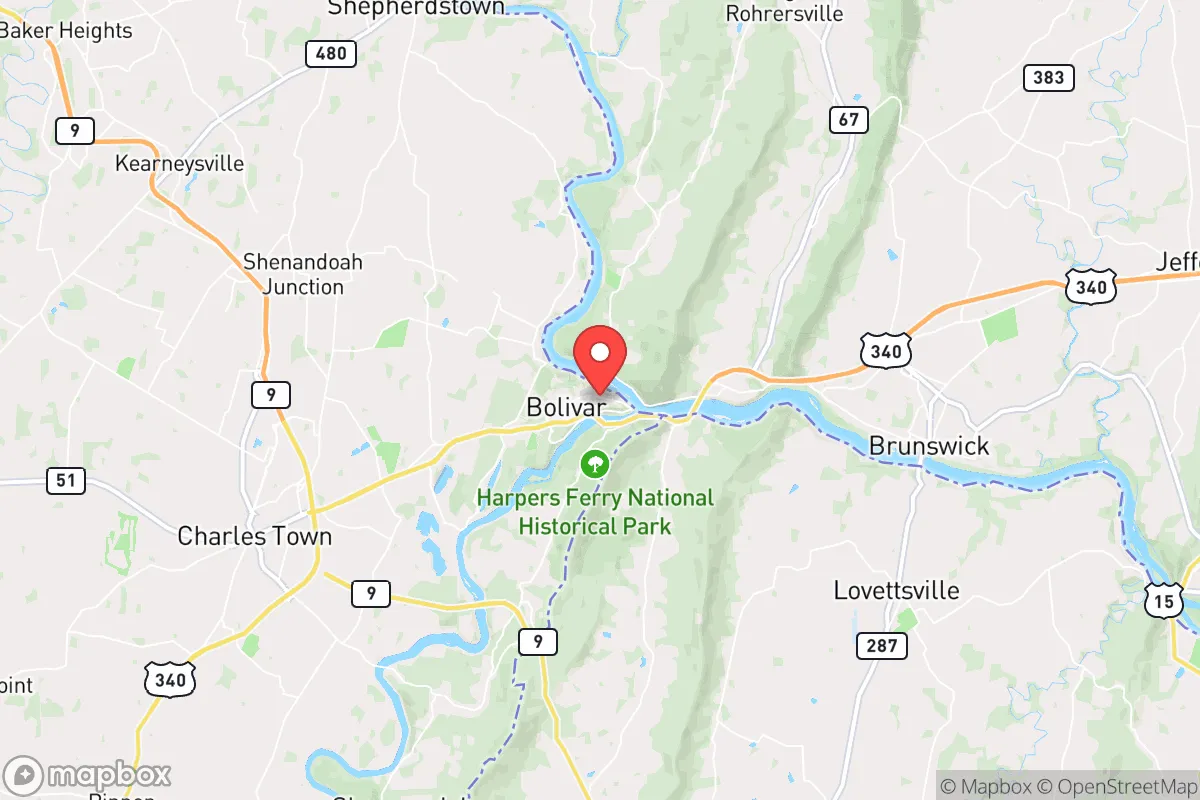
Political ClimatePolitical Climate in Harpers Ferry, WV
District shown is the primary district for this city’s centroid. Cities may span multiple districts.
Local Political AnalysisPolitical Analysis of Harpers Ferry, WV
Harpers Ferry leans heavily Republican, with a Cook Partisan Voting Index of R+20, making it one of the most conservative towns in the Eastern Panhandle. That said, the political reality here is more layered than a single number suggests. The town itself, with its historic district and tourism-driven economy, has a noticeable progressive undercurrent, especially among newer residents who commute to D.C. or work remotely. But once you step outside the old stone streets into the surrounding Jefferson County, the voting patterns shift hard red — and that gap has only widened since the 2020 election.
How it compares
Compared to West Virginia as a whole, Harpers Ferry is actually a bit of an outlier. The state overall leans even more conservative in many rural counties, but Jefferson County — where Harpers Ferry sits — is one of the few places in West Virginia that has seen Democratic votes hold steady, thanks largely to in-migration from the D.C. metro area. Neighboring towns like Charles Town and Ranson lean more moderate than the state average, while Shepherdstown, just a few miles up the road, is a genuine blue dot with a college-town vibe. Drive 20 minutes west to Martinsburg in Berkeley County, and you're back in deep-red territory. So Harpers Ferry sits right on a political fault line: the historic core tilts left, the county tilts right, and the state tilts hard right.
What this means for residents
For conservative residents, the area is broadly comfortable. Local government in Jefferson County is Republican-controlled, gun rights are strongly protected under state law, and the tax burden is low — West Virginia has no state income tax on Social Security and a flat 4.12% income tax on other earnings. For liberal residents, the experience is more mixed. You'll find like-minded neighbors in town and in Shepherdstown, but county-level policies on development, schools, and land use often reflect a more conservative majority. That said, the local Democratic Party chapter is active, and the proximity to Maryland and Virginia means you're never far from blue-leaning communities. The real tension shows up in zoning debates and school board elections, where the town's progressive voice often clashes with the county's rural conservatism.
Culturally, Harpers Ferry is a place where the past and present politics rub against each other in plain sight. The town's identity as a historic abolitionist and civil rights landmark — John Brown's raid, Storer College, the Niagara Movement — gives it a progressive origin story that some residents lean into heavily. But the surrounding county is also home to a strong Second Amendment culture, a growing evangelical presence, and a deep skepticism of federal land management, especially around the Appalachian Trail and the national park. The result is a community where you can have a neighbor with a "Coexist" bumper sticker and another with a "Don't Tread on Me" flag, and both will wave at you on the street. That civility is real, but it doesn't mean the politics aren't sharp underneath.

State Political ClimatePolitical Climate in West Virginia
State Political AnalysisPolitical Environment in the State
West Virginia has undergone one of the most dramatic political shifts in the country over the past 20 years, transforming from a reliably Democratic state in federal elections to a deep-red stronghold. In 2000, the state voted for George W. Bush by a narrow 6-point margin; by 2024, Donald Trump carried it by nearly 40 points. The dominant coalition today is a mix of rural, working-class voters, energy-sector workers, and culturally conservative families, with the GOP holding supermajorities in both chambers of the state legislature and every statewide office. The Democratic Party retains a foothold only in a shrinking number of union-heavy precincts and college towns, making West Virginia one of the most politically lopsided states in the nation.
Urban vs. rural divide
The political map of West Virginia is defined by a stark urban-rural split, though even the "urban" areas lean right by national standards. The state's largest metro, Charleston, is a bellwether that has drifted rightward: Kanawha County voted for Trump by 20 points in 2024, down from a 12-point margin in 2016, reflecting a broader consolidation of Republican support even in the capital. Huntington and the surrounding Cabell County are similarly red, with Trump winning by 28 points in 2024. The only reliably Democratic strongholds are Morgantown (home to West Virginia University) and Monongalia County, which voted for Biden in 2020 and Harris in 2024 by narrow margins, driven by faculty, students, and a younger professional class. Shepherdstown in Jefferson County, part of the D.C. exurbs, also leans blue, but its influence is limited. The rest of the state — from the coalfields of Logan and Mingo counties to the Potomac Highlands — votes overwhelmingly Republican, often by margins exceeding 50 points. The rural-urban divide here is less about competing ideologies and more about the complete absence of Democratic infrastructure outside a few small pockets.
Policy environment
West Virginia's policy environment is aggressively conservative, with a focus on low taxation, deregulation, and cultural conservatism. The state has no personal income tax on Social Security benefits and has been phasing down its personal income tax rate, which was cut from 6.5% to 3.99% as of 2025, with a goal of full elimination. Property taxes are among the lowest in the nation, capped by the state constitution at a maximum of 1% of assessed value. The regulatory posture is business-friendly, particularly for energy extraction, manufacturing, and chemical industries. Education policy has shifted toward school choice: the state enacted a universal Education Savings Account program in 2021, allowing public funds to follow students to private or homeschool settings. Healthcare is a mixed bag — the state expanded Medicaid under the ACA, but the legislature has rejected further expansions and has passed restrictions on abortion access, including a near-total ban with limited exceptions. Election laws have tightened: the state requires a non-expired photo ID to vote, has restricted absentee voting, and shortened the early voting window. Gun laws are permissive, with permitless carry in effect since 2016 and no state-level red flag law.
Recent policy direction
The last five years have seen West Virginia accelerate its conservative policy agenda across multiple fronts. On gun and self-defense law, the state passed a "Stand Your Ground" law in 2023 and preempted local firearm ordinances, ensuring uniform gun rights across all municipalities. Parental and education rights have been a major focus: the 2021 Education Savings Account law was followed by a 2023 bill banning instruction on "divisive concepts" related to race and sex in public schools, and a 2024 law requiring schools to notify parents of any changes to a student's health or emotional well-being. Speech and privacy have seen less legislative action, though the state has debated bills to limit social media content moderation and protect student data. On medical and bodily autonomy, the 2022 abortion ban is among the strictest in the nation, with no exceptions for rape or incest; the legislature has also restricted gender-affirming care for minors. Property rights have been bolstered by a 2023 law limiting eminent domain for carbon capture pipelines, a nod to landowner concerns. Taxation is trending downward: the income tax rate is scheduled to drop further if revenue triggers are met, and the state has no estate or inheritance tax. Voting and ballot access have been restricted: the 2021 voter ID law was followed by a 2024 law banning ballot drop boxes and limiting third-party ballot collection. The overall direction is toward fewer government services, lower taxes, and tighter cultural regulation.
Civil unrest & political movements
Political activism in West Virginia is less about street protests and more about organized movements around energy, labor, and education. The 2018 statewide teachers' strike, which shut down all public schools for nine days, was a rare moment of mass mobilization, driven by union members and rural educators — a reminder that labor politics still has some muscle, even in a red state. On the right, the "Coal Country" movement has been active in opposing federal environmental regulations, with rallies in Beckley and Lewisburg drawing thousands. Immigration politics are less visible here than in border states, though the legislature has passed resolutions supporting federal immigration enforcement and opposing sanctuary policies. Election integrity controversies have been minimal compared to other states; West Virginia's voting infrastructure is seen as secure, and there have been no major fraud allegations. Secession or nullification rhetoric is rare, though the state has joined multi-state lawsuits against federal environmental and gun policies. A new resident would notice that political activism is largely channeled through local party organizations, church groups, and energy industry advocacy, rather than through visible street protests or flashpoint events.
Projection
Over the next 5-10 years, West Virginia's political trajectory is likely to remain deeply conservative, with the Republican supermajority solidifying further as Democratic-leaning voters age out and younger residents either leave or align with the dominant culture. In-migration is modest, but the state has seen a small influx of remote workers and retirees from the Northeast and Mid-Atlantic, drawn by low housing costs and natural beauty — these newcomers tend to be culturally conservative or libertarian, reinforcing the existing lean. The income tax phase-down could accelerate if state revenue remains strong, potentially making West Virginia even more attractive to tax-sensitive movers. The biggest wild card is the energy transition: if coal continues to decline, the economic base could shift toward tourism, outdoor recreation, and remote work, which might slowly diversify the political landscape. However, any such shift would take decades. For someone moving in now, the state will likely be more conservative in 2035 than it is today, with lower taxes, fewer public services, and a cultural environment that strongly favors traditional family structures, gun rights, and local control.
For a new resident, the practical takeaway is that West Virginia offers a low-cost, low-regulation environment where conservative values are the default in nearly every aspect of daily life. Liberal residents will find little political representation outside of Morgantown and Shepherdstown, and may feel isolated in rural areas. Conservative families and individuals will find a state that aligns closely with their priorities on taxes, education choice, gun rights, and cultural issues. The political climate is stable, predictable, and unlikely to surprise anyone who pays attention to national trends — West Virginia is, and will remain, one of the most reliably conservative states in the union.
* Values derived from national, state, county, city and local statistics and may differ in a specific area. Last updated: 2026-07-21T20:00:45.000Z
Narrative content on this page is AI-generated and may contain mistakes. Verify any details that matter before acting on them.
ReloMaps may earn a commission from affiliate links at no extra cost to you.

